

Updated Dec 14, 2021 Verified Pass AZ-400 Exam in First Attempt Guaranteed
Free AZ-400 Sample Questions and 100% Cover Real Exam Questions (Updated 329 Questions)
Microsoft DevOps Engineer Exam Certification Details:
| Exam Name | Microsoft Certified - DevOps Engineer Expert |
| Number of Questions | 40-60 |
| Exam Price | $165 (USD) |
| Duration | 150 mins |
| Passing Score | 700 / 1000 |
| Schedule Exam | Pearson VUE |
| Books / Training | AZ-400T00-A: Designing and Implementing Microsoft DevOps solutions |
| Exam Code | AZ-400 |
| Sample Questions | Microsoft DevOps Engineer Sample Questions |
Microsoft AZ-400: Designing & Implementing Microsoft DevOps Solutions is a qualifying exam required for obtaining the Microsoft Certified: DevOps Engineer Expert certification. This test is designed to measure the competence of the candidates in developing instrumentation strategies; developing an SRE (Site Reliability Engineering) strategy; developing a compliance and security plan; defining and implementing a continuous delivery & release management strategy; defining and implementing continuous integration; facilitating collaboration and communication; handling source control.
NEW QUESTION 130
Note: This question is part of a series of questions that present the same scenario. Each question in the series contains a unique solution that m.ght meet the stated goals. Some question sets might have more than one correct solution, while others might not have a correct solution.
After you answer a question in this section, you win NOT be able to return to it. As a result, these questions win not appear in the review screen.
You integrate a cloud- hosted Jenkins server and a new Azure DevOps deployment
You need Azure DevOps to send a notification to Jenkins when a developer commits changes to a branch in Azure Repos.
Solution: You create a service hook subscription that uses the code pushed event.
Does this meet the goal?
- A. NO
- B. Yes
Answer: B
Explanation:
You can create a service hook for Azure DevOps Services and TFS with Jenkins.
References:
https://docs.microsoft.com/en-us/azure/devops/service-hooks/services/jenkins
NEW QUESTION 131
Your company uses Azure DevOps for Git source control.
You have a project in Azure DevOps named Contoso App that contains the following repositories:
* https://dev.azure.com/contoso/contoso-app/core-api
* https://dev.azure.com/contoso/contoso-app/core-spa
* https://dev.azure.com/contoso/contoso-app/core-db
You need to ensure that developers receive Slack notifications when there are pull requests created for Contoso App.
What should you run in Slack? To answer, select the appropriate options in the answer area.
NOTE: Each correct selection is worth one point.
Answer:
Explanation: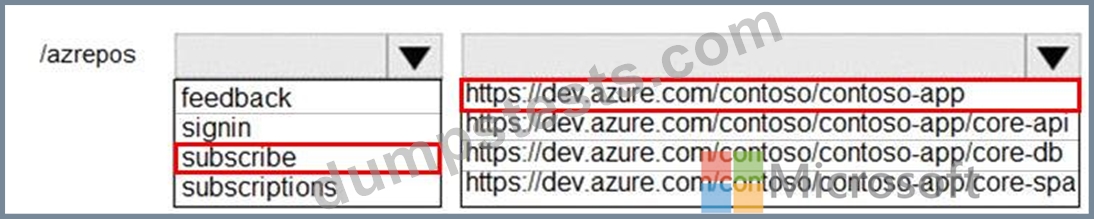
Explanation:
Box 1: subscribe
To start monitoring all Git repositories in a project, use the following slash command inside a channel:
/azrepos subscribe [project url]
Box 2: https://dev.azure.com/contoso/contoso-app
You can also monitor a specific repository using the following command:
/azrepos subscribe [repository url]
The repository URL can be to any page within your repository that has your repository name.
For example, for Git repositories, use:
/azrepos subscribe https://dev.azure.com/myorg/myproject/_git/myrepository
Reference:
https://docs.microsoft.com/en-us/azure/devops/repos/integrations/repos-slack
NEW QUESTION 132
You need to recommend a Docker container build strategy that meets the following requirements
* Minimizes image sues
* Minimizes the security surface area of the final image
What should you include m the recommendation?
- A. single-stage builds
- B. Docker Swarm
- C. multi-stage builds
- D. PowerShell Desired State Configuration (DSC)
Answer: C
Explanation:
Multi-stage builds are a new feature requiring Docker 17.05 or higher on the daemon and client. Multistage builds are useful to anyone who has struggled to optimize Dockerfiles while keeping them easy to read and maintain.
References:
https://docs.docker.com/develop/develop-images/multistage-build/
NEW QUESTION 133
You have a project in Azure DevOps that uses packages from multiple public feeds. Some of the feeds are unreliable.
You need to consolidate the packages into a single feed.
Which three actions should you perform in sequence? To answer, move the appropriate actions from the list of actions to the answer area and arrange them in the correct order.
Answer:
Explanation:
Explanation
Step 1: Create a NuGet package.
NuGet and Maven are public package managers that support multiple feeds.
Step 2: Create an Azure Artifacts feed that uses upstream sources
If you want to use packages from multiple feeds, use upstream sources to bring packages from multiple feeds together into a single feed.
Step 3: Create a Micrtosoft Visual Studio project that includes all the packages Consume NuGet packages from upstream sources: Now you can open Visual Studio and install packages from the upstream sources you just configured.
Reference:
https://docs.microsoft.com/en-us/azure/devops/artifacts/how-to/set-up-upstream-sources
NEW QUESTION 134
Your company is building a new web application.
You plan to collect feedback from pilot users on the features being delivered.
All the pilot users have a corporate computer that has Google Chrome and the Microsoft Test & Feedback extension installed. The pilot users will test the application by using Chrome.
You need to identify which access levels are required to ensure that developers can request and gather feedback from the pilot users. The solution must use the principle of least privilege.
Which access levels m Azure DevOps should you identify? To answer, select the appropriate options in the answer area NOTE: Each correct selection is worth one point.
Answer:
Explanation:
Explanation:
Box 1: Basic
Assign Basic to users with a TFS CAL, with a Visual Studio Professional subscription, and to users for whom you are paying for Azure Boards & Repos in an organization.
Box 2: Stakeholder
Assign Stakeholders to users with no license or subscriptions who need access to a limited set of features.
Note:
You assign users or groups of users to one of the following access levels:
Basic: provides access to most features
VS Enterprise: provides access to premium features
Stakeholders: provides partial access, can be assigned to unlimited users for free References: https://docs.microsoft.com/en-us/azure/devops/organizations/security/access-levels?view=vsts
NEW QUESTION 135
Where should the build and release agents for the investment planning application suite run? To answer, select the appropriate options in the answer area.
NOTE: Each correct selection is worth one point.
Answer:
Explanation:
Explanation
Box 1: A source control system
A source control system, also called a version control system, allows developers to collaborate on code and track changes. Source control is an essential tool for multi-developer projects.
Box 2: A hosted service
To build and deploy Xcode apps or Xamarin.iOS projects, you'll need at least one macOS agent. If your pipelines are in Azure Pipelines and a Microsoft-hosted agent meets your needs, you can skip setting up a self-hosted macOS agent.
Scenario: The investment planning applications suite will include one multi-tier web application and two iOS mobile applications. One mobile application will be used by employees; the other will be used by customers.
References:
https://docs.microsoft.com/en-us/azure/devops/pipelines/agents/v2-osx?view=azure-devops
NEW QUESTION 136
You need to ensure that an Azure web app named az400-9940427-main can retrieve secrets from an Azure key vault named az400-9940427-kv1 by using a system managed identity.
The solution must use the principle of least privilege.
To complete this task, sign in to the Microsoft Azure portal.
Answer:
Explanation:
1. In Azure portal navigate to the az400-9940427-main app.
2. Scroll down to the Settings group in the left navigation.
3. Select Managed identity.
4. Within the System assigned tab, switch Status to On. Click Save.
References:
https://docs.microsoft.com/en-us/azure/app-service/overview-managed-identity
NEW QUESTION 137
Your company is creating a suite of three mobile applications.
You need to control access to the application builds. The solution must be managed at the organization level What should you use? To answer, select the appropriate options m the answer area.
NOTE: Each correct selection is worth one point.
Answer:
Explanation:
Explanation
Box 1: Microsoft Visual Studio App Center distribution Groups
Distribution Groups are used to control access to releases. A Distribution Group represents a set of users that can be managed jointly and can have common access to releases. Example of Distribution Groups can be teams of users, like the QA Team or External Beta Testers or can represent stages or rings of releases, such as Staging.
Box 2: Shared
Shared distribution groups are private or public distribution groups that are shared across multiple apps in a single organization. Shared distribution groups eliminate the need to replicate distribution groups across multiple apps.
Note: With the Deploy with App Center Task in Visual Studio Team Services, you can deploy your apps from Azure DevOps (formerly known as VSTS) to App Center. By deploying to App Center, you will be able to distribute your builds to your users.
References: https://docs.microsoft.com/en-us/appcenter/distribution/groups
NEW QUESTION 138
You are defining release strategies for two applications as shown in the following table.
Which release strategy should you use for each application? To answer, drag the appropriate release strategies to the correct applications. Each release strategy may be used once, more than once, or not at all. You may need to drag the split bar between panes or scroll to view content.
NOTE: Each correct selection is worth one point.
Answer:
Explanation:
Explanation
App1: Canary deployment
With canary deployment, you deploy a new application code in a small part of the production infrastructure.
Once the application is signed off for release, only a few users are routed to it. This minimizes any impact.
With no errors reported, the new version can gradually roll out to the rest of the infrastructure.
App2: Rolling deployment:
In a rolling deployment, an application's new version gradually replaces the old one. The actual deployment happens over a period of time. During that time, new and old versions will coexist without affecting functionality or user experience. This process makes it easier to roll back any new component incompatible with the old components.
NEW QUESTION 139
Note: This question is part of a series of questions that present the same scenario. Each question in the series contains a unique solution that might meet the stated goals. Some question sets might have more than one correct solution, while others might not have a correct solution.
After you answer a question in this section, you will NOT be able to return to it. As a result, these questions will not appear in the review screen.
Your company has a project in Azure DevOps for a new web application.
You need to ensure that when code is checked in, a build runs automatically.
Solution: From the Pre-deployment conditions settings of the release pipeline, you select After stage.
Does this meet the goal?
- A. No
- B. Yes
Answer: A
Explanation:
Explanation
Use a Pull request trigger.
References: https://docs.microsoft.com/en-us/azure/devops/pipelines/build/triggers
NEW QUESTION 140
You are developing a multi-tier application. The application will use Azure App Service web apps as the front end and an Azure SQL database as the back end. The application will use Azure functions to write some data to Azure Storage.
You need to send the Azure DevOps team an email message when the front end fails to return a status code of
200.
Which feature should you use?
- A. availability tests in Azure Application Insights
- B. Application Map in Azure Application Insights
- C. Service Map in Azure Log Analytics
- D. Profiler in Azure Application Insights
Answer: A
Explanation:
Explanation
https://docs.microsoft.com/en-us/azure/azure-monitor/app/monitor-web-app-availability
NEW QUESTION 141
SIMULATION
You need to create an instance of Azure Application Insights named az400-9940427-main and configure the instance to receive telemetry data from an Azure web app named az400-9940427-main.
To complete this task, sign in to the Microsoft Azure portal.
- A. Step 1: Create an instance of Azure Application Insights
1. Open Microsoft Azure Portal
2. Log into your Azure account, Select Create a resource > Developer tools > Application Insights.
3. Enter the following settings, and then select Review + create.
Name: az400-9940427-main
Step 2: Configure App Insights SDK
4. Open your ASP.NET Core Web App project in Visual Studio > Right-click on the AppName in the Solution Explorer > Select Add > Application Insights Telemetry.
5. Click the Get Started button
6. Select your account and subscription > Select the Existing resource you created in the Azure portal > Click Register. - B. Step 1: Create an instance of Azure Application Insights
1. Open Microsoft Azure Portal
2. Log into your Azure account, Select Create a resource > Developer tools > Application Insights.
3. Enter the following settings, and then select Review + create.
Name: az400-9940427-main
Step 2: Configure App Insights SDK
4. Open your ASP.NET Core Web App project in Visual Studio > Right-click on the AppName in the Solution Explorer > Select Add > Application Insights Telemetry.
5. Click the Get Started button
6. Select your account and subscription > Select the Existing resource you created in the Azure portal > Click Register.
Answer: B
Explanation:
References:
https://docs.microsoft.com/bs-latn-ba/azure/azure-monitor/learn/dotnetcore-quick-start?view=vs-2017
NEW QUESTION 142
You have a protect in Azure DevOps.
You need to associate an automated test to a test case.
Which three actions should you perform in sequence? To answer, move the appropriate actions from the list of actions to the answer area and arrange them in the correct order.
Answer:
Explanation:
Explanation
The process to associate an automated test with a test case is:
* Create a test project containing your automated test. What types of tests are supported?
* Check your test project into an Azure DevOps or Team Foundation Server (TFS) repository.
* Create a build pipeline for your project, ensuring that it contains the automated test. What are the differences if I am still using a XAML build?
* Use Visual Studio Enterprise or Professional 2017 or a later version to associate the automated test with a test case as shown below. The test case must have been added to a test plan that uses the build you just defined.
Reference:
https://docs.microsoft.com/en-us/azure/devops/test/associate-automated-test-with-test-case
NEW QUESTION 143
You are configuring Azure Pipelines for three projects in Azure DevOps as shown in the following table.
Which version control system should you recommend for each project? To answer, drag the appropriate version control systems to the correct projects. Each version control system may be used once, more than once, or not at all. You may need to drag the split bar between panes or scroll to view content.
NOTE: Each correct selection is worth one point.
Answer:
Explanation:
Explanation:
Project1:Git in Azure Repos
Project2: Github Enterprise
GitHub Enterprise is the on-premises version of GitHub.com. GitHub Enterprise includes the same great set of features as GitHub.com but packaged for running on your organization's local network. All repository data is stored on machines that you control, and access is integrated with your organization's authentication system (LDAP, SAML, or CAS).
Project3: Bitbucket cloud
One downside, however, is that Bitubucket does not include support for SVN but this can be easily amended migrating the SVN repos to Git with tools such as SVN Mirror for Bitbucket .
Note: SVN is a centralized version control system.
Incorrect Answers:
Bitbucket:
Bitbucket comes as a distributed version control system based on Git.
Note: A source control system, also called a version control system, allows developers to collaborate on code and track changes. Source control is an essential tool for multi-developer projects.
Our systems support two types of source control: Git (distributed) and Team Foundation Version Control (TFVC). TFVC is a centralized, client-server system. In both Git and TFVC, you can check in files and organize files in folders, branches, and repositories.
References:
https://www.azuredevopslabs.com/labs/azuredevops/yaml/
https://enterprise.github.com/faq
NEW QUESTION 144
You use Azure Artifacts to host NuGet packages that you create.
You need to make one of the packages available to anonymous users outside your organization. The solution must minimize the number of publication points.
What should you do?
- A. Create a new feed for the package
- B. Change the feed URL of the package
- C. Promote the package to a release view.
- D. Publish the package to a public NuGet repository.
Answer: A
Explanation:
Explanation/Reference:
Explanation:
Azure Artifacts introduces the concept of multiple feeds that you can use to organize and control access to your packages.
Packages you host in Azure Artifacts are stored in a feed. Setting permissions on the feed allows you to share your packages with as many or as few people as your scenario requires.
Feeds have four levels of access: Owners, Contributors, Collaborators, and Readers.
References: https://docs.microsoft.com/en-us/azure/devops/artifacts/feeds/feed-permissions?
view=vsts&tabs=new-nav
NEW QUESTION 145
You have an Azure Kubernetes Service (AKS) cluster.
You need to deploy an application to the cluster by using Azure DevOps.
Which three actions should you perform in sequence? To answer, move the appropriate actions from the list of actions to the answer area and arrange them in the correct order.
Answer:
Explanation:
Explanation
You can set up a CI/CD pipeline to deploy your apps on a Kubernetes cluster with Azure DevOps by leveraging a Linux agent, Docker, and Helm.
Step 1: Create a service principle in Azure Active Directory (Azure AD) We need to assign 3 specific service principals with specific Azure Roles that need to interact with our ACR and our AKS.
Create a specific Service Principal for our Azure DevOps pipelines to be able to push and pull images and charts of our ACR.
Create a specific Service Principal for our Azure DevOps pipelines to be able to deploy our application in our AKS.
Step 2: Add a Helm package and deploy a task to the deployment pipeline This is the DevOps workflow with containers:
Step 3: Add a Docker Compose task to the deployment pipeline.
Dockerfile file is a script leveraged by Docker, composed of various commands (instructions) and arguments listed successively to automatically perform actions on a base image in order to create a new Docker image by packaging the app.
Reference:
https://cloudblogs.microsoft.com/opensource/2018/11/27/tutorial-azure-devops-setup-cicd-pipeline-kubernetes-d
NEW QUESTION 146
Note: This question is part of a series of questions that present the same scenario. Each question in the series contains a unique solution that m.ght meet the stated goals. Some question sets might have more than one correct solution, while others might not have a correct solution.
After you answer a question in this section, you win NOT be able to return to it. As a result, these questions win not appear in the review screen.
You integrate a cloud- hosted Jenkins server and a new Azure DevOps deployment You need Azure DevOps to send a notification to Jenkins when a developer commits changes to a branch in Azure Repos.
Solution: You create a service hook subscription that uses the code pushed event.
Does this meet the goal?
- A. NO
- B. Yes
Answer: B
Explanation:
You can create a service hook for Azure DevOps Services and TFS with Jenkins.
References:
https://docs.microsoft.com/en-us/azure/devops/service-hooks/services/jenkins
NEW QUESTION 147
You need to create deployment files for an Azure Kubernetes Service (AKS) cluster. The deployments must meet the provisioning storage requirements shown in the following table.
Which resource type should you use for each deployment? To answer, select the appropriate options in the answer area.
NOTE: Each correct selection is worth one point.
Answer:
Explanation:
Explanation:
Deployment 1: Kubernetes.io/azure-file
You can use Azure Files to connect using the Server Message Block (SMB) protocol.
Deployment 2: Kubernetes.io/azure-disk
Deployment 3: azurekeyvault-flexvolume
azurekeyvault-flexvolume: Key Vault FlexVolume: Seamlessly integrate your key management systems with Kubernetes.
Secrets, keys, and certificates in a key management system become a volume accessible to pods. Once the volume is mounted, its data is available directly in the container filesystem for your application.
Incorrect Answers:
blobfuse-flexvolume: This driver allows Kubernetes to access virtual filesystem backed by the Azure Blob storage.
References:
https://docs.microsoft.com/bs-cyrl-ba/azure/aks/azure-files-dynamic-pv
https://docs.microsoft.com/en-us/azure/aks/azure-disks-dynamic-pv
NEW QUESTION 148
You provision an Azure Kubernetes Service (AKS) cluster that has RBAC enabled. You have a Helm chart for a client application.
You need to configure Helm and Tiller on the cluster and install the chart.
Which three commands should you recommend be run in sequence? To answer, move the appropriate commands from the list of commands to the answer area and arrange them in the correct order.
Answer:
Explanation:
Explanation
Step 1: Kubectl create
You can add a service account to Tiller using the --service-account <NAME> flag while you're configuring Helm (step 2 below). As a prerequisite, you'll have to create a role binding which specifies a role and a service account name that have been set up in advance.
Example: Service account with cluster-admin role
$ kubectl create -f rbac-config.yaml
serviceaccount "tiller" created
clusterrolebinding "tiller" created
$ helm init --service-account tiller
Step 2: helm init
To deploy a basic Tiller into an AKS cluster, use the helm init command.
Step 3: helm install
To install charts with Helm, use the helm install command and specify the name of the chart to install.
References:
https://docs.microsoft.com/en-us/azure/aks/kubernetes-helm
https://docs.helm.sh/using_helm/#tiller-namespaces-and-rbac
NEW QUESTION 149
You have a private project in Azure DevOps.
You need to ensure that a project manager can create custom work item queries to report on the project's progress. The solution must use the principle of least privilege.
To which security group should you add the project manager?
- A. Reader
- B. Project Administrators
- C. Project Collection Administrators
- D. Contributor
Answer: D
Explanation:
Explanation
Contributors have permissions to contribute fully to the project code base and work item tracking. The main permissions they don't have or those that manage or administer resources.
Reference:
https://docs.microsoft.com/en-us/azure/devops/organizations/security/permissions
NEW QUESTION 150
You need to recommend a Docker container build strategy that meets the following requirements
* Minimizes image sues
* Minimizes the security surface area of the final image
What should you include m the recommendation?
- A. single-stage builds
- B. Docker Swarm
- C. multi-stage builds
- D. PowerShell Desired State Configuration (DSC)
Answer: C
Explanation:
Multi-stage builds are a new feature requiring Docker 17.05 or higher on the daemon and client. Multistage builds are useful to anyone who has struggled to optimize Dockerfiles while keeping them easy to read and maintain.
References: https://docs.docker.com/develop/develop-images/multistage-build/
NEW QUESTION 151
......
Download Real Microsoft AZ-400 Exam Dumps Test Engine Exam Questions: https://www.dumpstests.com/AZ-400-latest-test-dumps.html
Verified AZ-400 Dumps Q&As - AZ-400 Test Engine with Correct Answers: https://drive.google.com/open?id=1dsHcYUE2_Nh0p6MHkpB32N875TS5A0BP