

2021 AZ-400 exam torrent AZ-400 Study Guide
Easily pass AZ-400 Exam with our Dumps & PDF Test Engine
Conclusion
In summary, Microsoft AZ-400 is not one of the easy exams, as it’s of the expert-level and earns you the Microsoft Certified: DevOps Engineer Expert certification. However, keep in mind that for admission to the AZ-400 exam you must already be an expert either in Azure Administration or development as well as have a clear understanding and knowledge of Azure and cloud computing. Thus, you need to be serious about your prep process and opt for the most effective options. Start with books covered in this description, attend the official training courses, take practice tests, and pass this exam on the first try.
Skills measured
- Facilitate communication and collaboration (10-15%)
- Develop a Site Reliability Engineering (SRE) strategy (5-10%)
- Develop an instrumentation strategy (5-10%)
- The content of this exam was updated on May 25, 2021. Please download the exam skills outline below to see what changed.
- Define and implement continuous integration (20-25%)
- Define and implement a continuous delivery and release management strategy (10-15%)
- Manage source control (10-15%)
- Develop a security and compliance plan (10-15%)
NEW QUESTION 21
You need to implement the code flow strategy for Project2 in Azure DevOps.
Which three actions should you perform in sequence? To answer, move the appropriate actions from the list of actions to the answer area and arrange in the correct order.
Answer:
Explanation:
Explanation
Step 1: Create a repository
A Git repository, or repo, is a folder that you've told Git to help you track file changes in. You can have any number of repos on your computer, each stored in their own folder.
Step 2: Create a branch
Branch policies help teams protect their important branches of development. Policies enforce your team's code quality and change management standards.
Step 3: Add a build validation policy
When a build validation policy is enabled, a new build is queued when a new pull request is created or when changes are pushed to an existing pull request targeting this branch. The build policy then evaluates the results of the build to determine whether the pull request can be completed.
Scenario:
Implement a code flow strategy for Project2 that will:
Enable Team2 to submit pull requests for Project2.
Enable Team2 to work independently on changes to a copy of Project2.
Ensure that any intermediary changes performed by Team2 on a copy of Project2 will be subject to the same restrictions as the ones defined in the build policy of Project2.
References: https://docs.microsoft.com/en-us/azure/devops/repos/git/manage-your-branches
NEW QUESTION 22
You need to increase the security of your team's development process.
Which type of security tool should you recommend for each stage of the development process? To answer, drag the appropriate security toots to the correct stages. Each security tool may be used once, more than once, or not at all. You may need to drag the split bar between panes or scroll to view content NOTE: Each correct selection is worth one point.
Answer:
Explanation:
Explanation:
Box 1: Threat modeling
Threat modeling's motto should be, "The earlier the better, but not too late and never ignore." Box 2: Static code analysis Validation in the CI/CD begins before the developer commits his or her code. Static code analysis tools in the IDE provide the first line of defense to help ensure that security vulnerabilities are not introduced into the CI/CD process.
Box 3: Penetration testing
Once your code quality is verified, and the application is deployed to a lower environment like development or QA, the process should verify that there are not any security vulnerabilities in the running application. This can be accomplished by executing automated penetration test against the running application to scan it for vulnerabilities.
References: https://docs.microsoft.com/en-us/azure/devops/articles/security-validation-cicd-pipeline?view=vsts
NEW QUESTION 23
Your company has a project in Azure DevOps.
You plan to create a release pipeline that will deploy resources by using Azure Resource Manager templates.
The templates will reference secrets stored in Azure Key Vault.
You need to recommend a solution for accessing the secrets stored in the key vault during deployments. The solution must use the principle of least privilege.
What should you include in the recommendation? To answer, drag the appropriate configurations to the correct targets. Each configuration may be used once, more than once, or not at all. You may need to drag the split bar between panes or scroll to view content.
NOTE: Each correct selection is worth one point.
Answer:
Explanation:
Explanation
Box 1: A key Vault advanced access policy
Box 2: RBAC
Management plane access control uses RBAC.
The management plane consists of operations that affect the key vault itself, such as:
* Creating or deleting a key vault.
* Getting a list of vaults in a subscription.
* Retrieving Key Vault properties (such as SKU and tags).
* Setting Key Vault access policies that control user and application access to keys and secrets.
References:
https://docs.microsoft.com/en-us/azure/azure-resource-manager/resource-manager-tutorial-use-key-vault
NEW QUESTION 24
You provision an Azure Kubernetes Service (AKS) cluster that has RBAC enabled. You have a Helm chart for a client application.
You need to configure Helm and Tiller on the cluster and install the chart.
Which three commands should you recommend be run in sequence? To answer, move the appropriate commands from the list of commands to the answer area and arrange them in the correct order.
Answer:
Explanation:
Explanation
Step 1: Kubectl create
You can add a service account to Tiller using the --service-account <NAME> flag while you're configuring Helm (step 2 below). As a prerequisite, you'll have to create a role binding which specifies a role and a service account name that have been set up in advance.
Example: Service account with cluster-admin role
$ kubectl create -f rbac-config.yaml
serviceaccount "tiller" created
clusterrolebinding "tiller" created
$ helm init --service-account tiller
Step 2: helm init
To deploy a basic Tiller into an AKS cluster, use the helm init command.
Step 3: helm install
To install charts with Helm, use the helm install command and specify the name of the chart to install.
References:
https://docs.microsoft.com/en-us/azure/aks/kubernetes-helm
https://docs.helm.sh/using_helm/#tiller-namespaces-and-rbac
NEW QUESTION 25
You need to prepare a network security group (NSG) named az400-9940427-nsg1 to host an Azure DevOps pipeline agent. The solution must allow only the required outbound port for Azure DevOps and deny all other inbound and outbound access to the Internet.
To complete this task, sign in to the Microsoft Azure portal.
- A. 1. Open Microsoft Azure Portal and Log into your Azure account.
2. Select network security group (NSG) named az400-9940427-nsg1
3. Select Settings, Outbound security rules, and click Add
4. Click Advanced
5. Change the following settings:
* Destination Port range: 8080
* Protocol. TCP
* Action: Allow
Note: By default, Azure DevOps Server uses TCP Port 8080. - B. 1. Open Microsoft Azure Portal and Log into your Azure account.
2. Select network security group (NSG) named az400-9940427-nsg1
3. Select Settings, Outbound security rules, and click Add
4. Click Advanced
5. Change the following settings:
* Destination Port range: 8080
* Action: Allow
Note: By default, Azure DevOps Server uses TCP Port 8080.
Answer: A
Explanation:
References:
https://robertsmit.wordpress.com/2017/09/11/step-by-step-azure-network-security-groups-nsg-security-center-azure-nsg-network/
https://docs.microsoft.com/en-us/azure/devops/server/architecture/required-ports?view=azure-devops
NEW QUESTION 26
You plane to store signed images in an Azure Container Registry instance named az4009940427acr1.
You need to modify the SKU for az4009940427acr1 to support the planned images. The solution must minimize costs.
To complete this task, sign in to the Microsoft Azure portal.
Answer:
Explanation:
See solution below.
Explanation
1. Open Microsoft Azure Portal, and select the Azure Container Registry instance named az4009940427acr1.
2. Under Policies, select Content Trust > Enabled > Save.
References:
https://docs.microsoft.com/en-us/azure/container-registry/container-registry-content-trust
NEW QUESTION 27
Your company has 60 developers who are assigned to four teams. Each team has 15 members.
The company uses an agile development methodology.
You need to structure the work of the development teams so that each team owns their respective work while working together to reach a common goal.
Which parts of the taxonomy should you enable the team to perform autonomously?
- A. Initiatives and Epics
- B. Features and Tasks
- C. Stories and Tasks
- D. Epics and Features
Answer: B
Explanation:
A feature typically represents a shippable component of software.
Features, examples:
* Add view options to the new work hub
* Add mobile shopping cart
* Support text alerts
* Refresh the web portal with new look and feel
User Stories and Tasks are used to track work. Teams can choose how they track bugs, either as requirements or as tasks Incorrect Answers:
B, C: An epic represents a business initiative to be accomplished.
Epics, examples:
* Increase customer engagement
* Improve and simplify the user experience
* Implement new architecture to improve performance
* Engineer the application to support future growth
* Support integration with external services
* Support mobile apps
Reference:
https://docs.microsoft.com/en-us/azure/devops/boards/backlogs/define-features-epics
https://docs.microsoft.com/en-us/azure/devops/boards/work-items/about-work-items
NEW QUESTION 28
SIMULATION
You plan to implement a CI/CD strategy for an Azure Web App named az400-11566895-main.
You need to configure a staging environment for az400-11566895-main.
To complete this task, sign in to the Microsoft Azure portal.
- A. Add a slot
1. In the Azure portal, search for and select App Services and select your app az400-11566895-main.
2. In the left pane, select Deployment slots > Add Slot.
3. In the Add a slot dialog box, give the slot a name, and select whether to clone an app configuration from another deployment slot. Select Add to continue.
4. After the slot is added, select Close to close the dialog box. The new slot is now shown on the Deployment slots page.
- B. Add a slot
1. In the Azure portal, search for and select App Services and select your app az400-11566895-main.
2. In the left pane, select Deployment slots > Add Slot.
3. In the Add a slot dialog box, give the slot a name, and select whether to clone an app configuration from another deployment slot. Select Add to continue.
4. After the slot is added, select Close to close the dialog box. The new slot is now shown on the Deployment slots page.
Answer: B
Explanation:
Reference:
https://docs.microsoft.com/en-us/azure/app-service/deploy-staging-slots
NEW QUESTION 29
You need to recommend a procedure to implement the build agent for Project1.
Which three actions should you recommend be performed in sequence? To answer, move the appropriate actions from the list of actions to the answer area and arrange them in the correct order.
Answer:
Explanation:
Explanation
Scenario:
Step 1: Sign in to Azure Devops by using an account that is assigned the Administrator service connection security role.
Note: Under Agent Phase, click Deploy Service Fabric Application. Click Docker Settings and then click Configure Docker settings. In Registry Credentials Source, select Azure Resource Manager Service Connection. Then select your Azure subscription.
Step 2: Create a personal access token..
A personal access token or PAT is required so that a machine can join the pool created with the Agent Pools (read, manage) scope.
Step 3: Install and register the Azure Pipelines agent on an Azure virtual machine.
By running a Azure Pipeline agent in the cluster, we make it possible to test any service, regardless of type.
References:
https://docs.microsoft.com/en-us/azure/service-fabric/service-fabric-tutorial-deploy-container-app-with-cicd-vsts
https://mohitgoyal.co/2019/01/10/run-azure-devops-private-agents-in-kubernetes-clusters/
NEW QUESTION 30
You need to configure GitHub to use Azure Active Directory (Azure AD) for authentication. What should you do first?
- A. Register GitHub in Azure AD.
- B. Modify the Security settings of the GitHub organization.
- C. Create an Azure Active Directory B2C (Azure AD B2C) tenant.
- D. Create a conditional access policy in Azure AD.
Answer: A
NEW QUESTION 31
You create an alert rule in Azure Monitor as shown in the following exhibit.
Which action will trigger an alert?
- A. a change to a role assignment for the ASP-9bb7 resource
- B. a failed attempt to delete the ASP-9bb7 resource
- C. a successful attempt to delete the ASP-9bb7 resource
- D. a failed attempt to scale up the ASP-9bb7 resource
Answer: B
NEW QUESTION 32
Your company has a project in Azure DevOps.
You plan to create a release pipeline that will deploy resources by using Azure Resource Manager templates.
The templates will reference secrets stored in Azure Key Vault.
You need to recommend a solution for accessing the secrets stored in the key vault during deployments. The solution must use the principle of least privilege.
What should you include in the recommendation? To answer, drag the appropriate configurations to the correct targets. Each configuration may be used once, more than once, or not at all. You may need to drag the split bar between panes or scroll to view content.
NOTE: Each correct selection is worth one point.
Answer:
Explanation:
Explanation
Box 1: A key Vault advanced access policy
Box 2: RBAC
Management plane access control uses RBAC.
The management plane consists of operations that affect the key vault itself, such as:
* Creating or deleting a key vault.
* Getting a list of vaults in a subscription.
* Retrieving Key Vault properties (such as SKU and tags).
* Setting Key Vault access policies that control user and application access to keys and secrets.
References:
https://docs.microsoft.com/en-us/azure/azure-resource-manager/resource-manager-tutorial-use-key-vault
NEW QUESTION 33
You have an Azure DevOps project that contains a build pipeline. The build pipeline uses approximately 50 open source libraries.
You need to ensure that the project can be scanned for known security vulnerabilities in the open source libraries.
What should you do? To answer, select the appropriate options in the answer area.
NOTE: Each correct selection is worth one point.
Answer:
Explanation:
References:
https://www.azuredevopslabs.com/labs/vstsextend/whitesource/
NEW QUESTION 34
You need to configure a cloud service to store the secrets required by the mobile applications to call the share.
What should you include in the solution? To answer, select the appropriate options m the answer ater, NOTE: Each correct selection is worth one point.
Answer:
Explanation:
References: https://docs.microsoft.com/en-us/rest/api/storageservices/authorize-with-shared-key
NEW QUESTION 35
You use Azure Artifacts to host NuGet packages that you create.
You need to make one of the packages available to anonymous users outside your organization. The solution must minimize the number of publication points.
What should you do?
- A. Create a new feed for the package
- B. Change the feed URL of the package.
- C. Promote the package to a release view.
- D. Publish the package to a public NuGet repository.
Answer: A
NEW QUESTION 36
You have an existing build pipeline in Azure Pipelines.
You need to use incremental builds without purging the environment between pipeline executions.
What should you use?
- A. Microsoft-hosted parallel jobs
- B. a self-hosted agent
- C. a File Transform task
Answer: B
Explanation:
Explanation
When you run a pipeline on a self-hosted agent, by default, none of the subdirectories are cleaned in between two consecutive runs. As a result, you can do incremental builds and deployments, provided that tasks are implemented to make use of that. You can override this behavior using the workspace setting on the job.
Reference:
https://docs.microsoft.com/en-us/azure/devops/pipelines/process/phases
NEW QUESTION 37
You plan to create alerts that will be triggered based on the page load performance of a home page.
You have the Application Insights log query shown in the following exhibit.
Use the drop-down menus to select the answer choice that completes each statement based on the information presented in the graphic.
NOTE: Each correct selection is worth one point.
Answer:
Explanation:
Reference:
https://devblogs.microsoft.com/premier-developer/alerts-based-on-analytics-query-using-custom-log-search/
NEW QUESTION 38
You mc configuring Azure DevOps build pipelines.
You plan to use hosted build agents.
Which build agent pool should you use to compile each application type? To answer, drag the appropriate built agent pools to the correct application types. Each butt agent pool may be used once, more than once, or not at all. You may need to drag the split bar between panes or scroll to view content.
NOTE: Each correct selection is worth one point.
Answer:
Explanation:
Explanation
Box 1: Hosted macOS
Hosted macOS pool (Azure Pipelines only): Enables you to build and release on macOS without having to configure a self-hosted macOS agent. This option affects where your data is stored.
Box 2: Hosted
Hosted pool (Azure Pipelines only): The Hosted pool is the built-in pool that is a collection of Microsoft-hosted agents.
NEW QUESTION 39
You have an Azure Kubernetes Service (AKS) cluster.
You need to deploy an application to the cluster by using Azure DevOps.
Which three actions should you perform in sequence? To answer, move the appropriate actions from the list of actions to the answer area and arrange them in the correct order.
Answer:
Explanation:
Explanation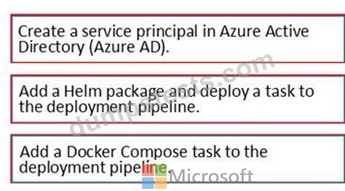
You can set up a CI/CD pipeline to deploy your apps on a Kubernetes cluster with Azure DevOps by leveraging a Linux agent, Docker, and Helm.
Step 1: Create a service principle in Azure Active Directory (Azure AD) We need to assign 3 specific service principals with specific Azure Roles that need to interact with our ACR and our AKS.
Create a specific Service Principal for our Azure DevOps pipelines to be able to push and pull images and charts of our ACR.
Create a specific Service Principal for our Azure DevOps pipelines to be able to deploy our application in our AKS.
Step 2: Add a Helm package and deploy a task to the deployment pipeline This is the DevOps workflow with containers:
Step 3: Add a Docker Compose task to the deployment pipeline.
Dockerfile file is a script leveraged by Docker, composed of various commands (instructions) and arguments listed successively to automatically perform actions on a base image in order to create a new Docker image by packaging the app.
Reference:
https://cloudblogs.microsoft.com/opensource/2018/11/27/tutorial-azure-devops-setup-cicd-pipeline-kubernetes-d
NEW QUESTION 40
Note: This question is part of a series of questions that present the same scenario. Each question in the series contains a unique solution that might meet the stated goals. Some question sets might have more than one correct solution, while others might not have a correct solution.
After you answer a question in this section, you will NOT be able to return to it. As a result, these questions will not appear in the review screen.
You plan to update the Azure DevOps strategy of your company.
You need to identify the following issues as they occur during the company's development process:
* Licensing violations
* Prohibited libraries
Solution: You implement continuous integration.
Does this meet the goal?
- A. No
- B. Yes
Answer: B
Explanation:
WhiteSource is the leader in continuous open source software security and compliance management.
WhiteSource integrates into your build process, irrespective of your programming languages, build tools, or development environments. It works automatically, continuously, and silently in the background, checking the security, licensing, and quality of your open source components against WhiteSource constantly-updated denitive database of open source repositories.
Reference:
https://azuredevopslabs.com/labs/vstsextend/whitesource/
NEW QUESTION 41
You have a private distribution group that contains provisioned and unprovisioned devices.
You need to distribute a new iOS application to the distribution group by using Microsoft Visual Studio App Center.
What should you do?
- A. Add the device owner to the collaborators group.
- B. Select Register devices and sign my app.
- C. Create an active subscription in App Center Test.
- D. Generate a new .p12 file for each device.
Answer: B
Explanation:
Explanation
The following diagram displays the entire app re-signing flow in App Center.
Reference:
https://docs.microsoft.com/hu-hu/appcenter/distribution/auto-provisioning
NEW QUESTION 42
You manage an Azure web app that supports an e-commerce website.
You need to increase the logging level when the web app exceeds normal usage patterns. The solution must minimize administrative overhead.
Which two resources should you include in the solution? Each correct answer presents part of the solution.
NOTE: Each correct selection is worth one point.
- A. the Azure Monitor autoscale settings
- B. an Azure Automation runbook
- C. an Azure Monitor alert that has a static threshold
- D. an Azure Monitor alert that has a dynamic threshold
- E. an Azure Monitor alert that uses an action group that has an email action
Answer: B,D
Explanation:
Explanation
A: You can use Azure Monitor to monitor base-level metrics and logs for most services in Azure. You can call Azure Automation runbooks by using action groups or by using classic alerts to automate tasks based on alerts.
B: Metric Alert with Dynamic Thresholds detection leverages advanced machine learning (ML) to learn metrics' historical behavior, identify patterns and anomalies that indicate possible service issues. It provides support of both a simple UI and operations at scale by allowing users to configure alert rules through the Azure Resource Manager API, in a fully automated manner.
Reference:
https://docs.microsoft.com/en-us/azure/azure-monitor/platform/alerts-dynamic-thresholds
https://docs.microsoft.com/en-us/azure/automation/automation-create-alert-triggered-runbook
NEW QUESTION 43
You have an Azure Resource Manager template that deploys a multi-tier application.
You need to prevent the user who performs the deployment from viewing the account credentials and connection strings used by the application.
What should you use?
- A. an Appsettings.json files
- B. Azure Key Vault
- C. an Azure Resource Manager parameter file
- D. a Web.config file
- E. an Azure Storage table
Answer: B
Explanation:
Explanation
When you need to pass a secure value (like a password) as a parameter during deployment, you can retrieve the value from an Azure Key Vault. You retrieve the value by referencing the key vault and secret in your parameter file. The value is never exposed because you only reference its key vault ID. The key vault can exist in a different subscription than the resource group you are deploying to.
References:
https://docs.microsoft.com/en-us/azure/azure-resource-manager/resource-manager-keyvault-parameter
NEW QUESTION 44
......
Exam AZ-400: Designing and Implementing Microsoft DevOps Solutions
Candidates for this exam should have subject matter expertise working with people, processes, and technologies to continuously deliver business value.
Responsibilities for this role include designing and implementing strategies for collaboration, code, infrastructure, source control, security, compliance, continuous integration, testing, delivery, monitoring, and feedback.
A candidate for this exam must be familiar with both Azure administration and development and must be expert in at least one of these areas.
Part of the requirements for: Microsoft Certified: DevOps Engineer Expert
AZ-400 PDF Pass Leader, AZ-400 Latest Real Test: https://www.dumpstests.com/AZ-400-latest-test-dumps.html
Valid AZ-400 Test Answers & AZ-400 Exam PDF: https://drive.google.com/open?id=1wQcVA-3kwPUM1Y980rNDRCxb1wglCg8V