

Latest CIPS L4M5 Exam questions and answers
DumpsTests L4M5 Exam Practice Test Questions (Updated 165 Questions)
CIPS L4M5 Exam Syllabus Topics:
| Topic | Details |
|---|---|
| Topic 1 |
|
| Topic 2 |
|
| Topic 3 |
|
| Topic 4 |
|
| Topic 5 |
|
| Topic 6 |
|
| Topic 7 |
|
| Topic 8 |
|
| Topic 9 |
|
| Topic 10 |
|
| Topic 11 |
|
| Topic 12 |
|
| Topic 13 |
|
| Topic 14 |
|
NEW QUESTION 56
A procurement professional is sourcing low value items. He conducts market analysis and realise that these items can be provided by many suppliers and switching cost between suppliersis relatively low. He also assume that the relationship between buyer and supplier will be transactional rather than long-term. According to Thomas-Kilmann conflict model instrument, which of the following is the most appropriate style that the procurement professional should adopt when negotiating with these suppliers?
- A. Competing
- B. Avoiding
- C. Collaborating
- D. Compromising
Answer: A
Explanation:
According to Thomas-Kilmann conflict model instrument, there are 5 conflict management styles:
Graphical user interface, text, application, email Description automatically generated
In this scenario, the buyer's bargaining power is stronger than suppliers', and the relationship is transactional.
Therefore, to get the most preferable outcome, the procurement professional can take an assertive approach, while he doesn't need to co-operate closely with these suppliers. Competing will be the most appropriate approach to negotiation in this scenario so that the buying organisation can get a better deal.
NEW QUESTION 57
XYZ Ltd needs to purchase a bundle of IT products from suppliers. The procurement manager requests details of costs regarding designing and managing those products. After receiving reports from suppliers, she realises that they have charged up to a 1,095% mark-up on IT products. In order to ensure value for money, which of the following should be a priority pricing arrangement of the procurement manager in the negotiation with these IT suppliers?
- A. Market penetration pricing
- B. Market skimming
- C. Premium pricing
- D. Cost plus arrangement
Answer: D
Explanation:
In the scenario, the main cost driver is suppliers' mark-up. The priority should be limit the margin to be added.
XYZ Ltd can agree "cost plus"contracts with their suppliers to ensure no IT product purchased exceeds an agreed maximum margin level. Procurement teams can use their benchmarking tools to police these contracts.
Cost plus contracts are agreements where the contractor's pricing is based on itemising allowable costs and then adding an agreed margin.
Market penetration pricing - pricing low to win a large share of the market Market skimming - pricing a new product high in order to make a large profit from the purchases by initial customers. This is an effective strategy only in the absence of competition.When competition appears, market skimmers usually drop their prices Premium pricing - usually pricing high because the market is prepared to pay extra for the kudos associated with the product, thanks to, say, a reputation for quality, or a highly fashionable brand name, and so on
NEW QUESTION 58
What letter R in the acronym SMART stands for?
- A. Risk-free
- B. Recommended
- C. Random
- D. Relevant
Answer: D
Explanation:
Explanation
SMART is an acronym that you can use toguide your goal setting. SMART is an acronym that stands for Specific, Measurable, Achievable, Relevant, and Time-bound A student met this question in the L4M5 exam. SMART is mentioned primarily in L4M3 Commercial Contracting.
LO: Unknown, AC: Unknown
NEW QUESTION 59
Which ofthe following is a true statement regarding macroeconomic factors and their potential impact on negotiations?
- A. Expectations on macroeconomic prospect are always correct
- B. Macroeconomic factors cannot be influenced by anyone's expectation or sentiment
- C. Macroeconomic factors always directly influence the negotiations
- D. Changes in macroeconomic factors may affect businesses and individuals differently
Answer: D
Explanation:
Explanation
'Macroeconomic factors always directly influence the negotiations': This statement is false. For any given negotiation it is not the macroeconomic factor itself that necessarily influences the negotiation but the change or rate of change that factor.
'Changes in macroeconomic factors may affect businesses and individualsdifferently': This statement is true.
Macroeconomic factors are factors that have general effects on the economy and many businesses may be completely unaffected or affected more or less than others in the same industry by a change in a factor.
'Macroeconomic factors cannot be influenced by anyone's expectation or sentiment': This statement is false.
When it comes to macroeconomic factors another key consideration is expectation regarding what might happen to these factors, or specifically the measures, metrics or percentage rates associated with these factors in the future.
'Expectations on macroeconomic prospect are always correct': This statement is false. Expectations are not always correct.
LO 2, AC 2.2
NEW QUESTION 60
A purchasing manager is having a negotiation with a supplier to extend the duration of the contract. In order topersuade the supplier to cut the cost by 10%, she promises to shorten the payment period from
45 days to 30 days for each delivery. The supplier's representative does not agree the offer and clearly states that his proposed price is already lower than the market price. The purchasing manager has used which type of power?
- A. Expertise
- B. Informational
- C. Reward
- D. Coercive
Answer: C
Explanation:
In the scenario, to exchange cost cutting, the purchasing manager promises to 'reward' supplier shorter payment period. This is an example of reward power, which results from one person's ability to compensate or reward another for compliance.
The reward does not need to be money, but could be introduction to other buyers in the group, positive references, agreement to trial new product, quicker payment or indeed any other variable that the buyer knows is attractive and valued by the supplier.
NEW QUESTION 61
Which of the following is the best description of direct cost?
- A. Direct costs include only raw materials and labour of making the final product
- B. Direct costs are only variable raw materials that constitute a product
- C. Direct costs include raw materials, labour andoverheads
- D. Direct costs include raw materials, labour and other expenses attributable to the final product
Answer: D
Explanation:
Direct costs are those costs of a product/service directly attributable/traceable to its production, for example, the costs of labour and materials directly used to produce the goods/services which the organisation sells.
NEW QUESTION 62
According French and Raven's base model, which of the following are sources of personal power that can be used in commercial negotiation? Select THREE that apply.
- A. Competitive power
- B. Expert power
- C. Legitimate power
- D. Coercive power
- E. Trademark power
- F. Purchasing spend power
Answer: B,C,D
Explanation:
A useful model of personal power that has survived the test of time and provide a simple way to analyse negotiation in French and Raven's Power BaseModel, which describes six bases of power:
Diagram Description automatically generated
NEW QUESTION 63
Which of the following can help both parties to break the vicious cycle of blame when a relationship needs repairing? Select TWO that apply.
- A. Constant shadowing and oversights
- B. Emotional-based assessment
- C. Both parties understand each other's goals
- D. Conflict management skills
- E. Focusing onpositions
Answer: C,D
Explanation:
In order to break vicious cycle of blame, procurement will need to use their negotiation and conflict management skills,adopting a collaborative and integrative approach. Your first action should be to establish the facts that led to the situation where the relationship broke down. Most day-to-day relationship between buying organisations and suppliers do not of course involve procurement staff, so you will need to consult with your business partners internally to establish their point of view of where the issue and sources of conflict are. You should also contact the supplier and get their side of the story - this is particularly to when you have previously identified the supplier as critical or otherwise important to your operations. Ideally you will be able to apply principled negotiation here, separating the people from the issue, focusing on interests and not positions,and then looking for options of mutual benefits.
NEW QUESTION 64
Which of the following are most likely to harm trust between buyer and supplier in a commercial relationship?
Select TWO that apply.
- A. Avoidance of submitting important documentations
- B. Exploring a disagreement to learn from each other's insights
- C. Reduced response time during contract performance
- D. Resolving some conditions that would otherwise have them competing for resources
- E. Subjective assessment of performance
Answer: A,E
Explanation:
Explanation
Trust-destroying behaviours:
- Rumours of partnership or relationship breaking down
- Emotion-based assessment of performance
- Avoiding accountability, passing the blame to others
- General mood - resentment, distrust,frustration, etc
LO 1, AC 1.4
NEW QUESTION 65
Which of the following are most likely to help buyer become preferred customer in supplier's perspective?
Select TWO that apply.
- A. Onerous supplier terms and conditions
- B. Shorter payment period
- C. Compliance with agreed repair lead time
- D. Reduction in delivery errors
- E. Ensuring an increased number of repeat orders
Answer: B,E
Explanation:
Explanation
Becoming a preferred customer to supplier's perspective can increase the purchaser's leverage in negotiation.
Beside the size of buying organisation or its spend, the following may be sufficient to differentiate the buyer from other buying organisations:
- Simple procurement processes
- Simple contracting processes
- Clear and concise documentation
- Absence of onerous supplier terms and conditions (onerous supplier terms and conditions mean that obligations imposed on suppliers are greater than their gains)
- On-time payment: The reduction in hassle for both supplier and the buyer, if bills are paid on time, is significant. From the customer's perspective it could also be the opener to agreeing preferential payment terms. A supplier may weigh up that payment on time at 60 days is worth taking, over the current 30-day terms that slip to 90 days and beyond.
-Transparent processes
- Ethical behavior
LO 1, AC 1.3
NEW QUESTION 66
All of the following shift the supply of watchesto the right except...?
- A. An advance in the technology used to manufacture watches
- B. A decrease in the wage of workers employed to manufacture watches
- C. Manufacturers' expectation of higher watch prices in thefuture
- D. An increase in the price of watches
Answer: D
Explanation:
Explanation
A supply curve will slope upward from left to right showing more supply at higher prices, as illustrated in the graph below:
A picture containing chart Description automatically generated
A movement along the supply curve will be brought about by a change in price, but a shift of the whole curve will be caused by a determinant other than price:
- The physical feasibility and time and energy required to produce the products
- Technology and innovation
- The objectives of the producers and their future expectations
- Prices of other goodsand services
- Government's policies
LO 2, AC 2.2
NEW QUESTION 67
According to Fiona Dent and Mike Brent, which of the following are characteristics of Push approach? Select TWO that apply.
- A. Collaborative
- B. Persuasion
- C. Seeking commitment
- D. Directive
- E. Inspirational
Answer: B,D
Explanation:
According to the book 'Influencing: Skills and techniques for business success' by Fiona Dent and Mike Brent, there are two major influencing styles. Push tends to be directive. It tells, and is clear and resolute, but needs to be employed in situations where firmness is required because of difficulties that exist or weakness is evident.
Pull is more participatory and collaborative. It seeks to incorporate everyone's perspective. It can appear wishy-washy if not skilfully employed. That approach should be followed which is most likely to secure commitment and not mere compliance.
The two divisions can be further divided into four style categories: directive; persuasive reasoning; collaborative - team oriented, people oriented to inspire them with a vision. The directive style relies on your expertise and reputation being respected by others, and where there really does seem to be one answer. It is "I" driven whereas persuasive reasoning is more "we" and issue driven. Directive styles can make the user appear as "a bull in a china shop"; persuasive reasoning can be portrayed as tough guy.
Collaborative influencing takes the "we" element further and seeks to mobilise everyone's ideas in a journey of discovery. It may have the flavour of "I'm your best friend", which may not go down too well. Visioning style is concerned to stir people's emotions in support of achieving an objective. This last one has been used by demagogues to stir people's hearts and minds for evil purposes as well as good.
A useful table offers the benefits, problems, words and body language associated with each style along with advice on when to use and when to avoid each. Cases and exercises illustrate these styles.
Empathy comes in for extended treatment with the definition of "standing in the other's shoes". This does not necessarily happen just intuitively, and therefore before a specific influencing effort there should bean intense effort to think about the other person or persons and to sense what it might feel like to be them - their hopes, fears, concerns, what turns them on, what turns them off, where are they coming from.
NEW QUESTION 68
Can a party gain huge advantages innegotiation from setting room layout?
- A. No, because room layout contributes nothing to the negotiation outcomes
- B. No, because the advantages gained from manipulating room layout are short-lived
- C. Yes, because the host can freely manipulate the other party's mind through setting room layout
- D. Yes, because the other party can capitulate to the host
Answer: B
Explanation:
Essentially, for trained negotiators under most circumstances, the physical locations of negotiations and the room layout should not make much difference to the outcomes of the meeting. It is reasonable to assume that most commercial negotiations are based at least initially on a principled- or pragmatic-type approach. It is arguable also that any advantage gained through intentionally creating an uncomfortable environment to put short-term pressure on TOP is likely to be short-lived as TOP will likely reflect on this later and seek means to get even.
NEW QUESTION 69
End users are the only stakeholders that are involved in the preparation of a negotiation. Is this statement true?
- A. Yes, because end-users have greaterexpert power
- B. No, because end-users are external stakeholders
- C. Yes, because only end-users understand their demand
- D. No, because budget holders also play an important role
Answer: D
Explanation:
Explanation
Commercial negotiation objectives should bedriven by the business needs of the organisation. Organisations are made up of different stakeholder groups, some of whom may have different, even conflicting objectives.
From a negotiation perspective, stakeholders can be defined as persons or groups thathave interest (or stake) in the outcome of the negotiation you are leading or participating in.
CIPS distinguishes between 3 sets of stakeholders:
- Internal stakeholders
- Connected stakeholders
- External stakeholders
End-users are examples of internalstakeholders. They are the people who will benefit from the purchase of a product or service. However, their interest may conflict with other groups, i.e. the budget controllers whose objective is minimising the expense. In negotiation perspective, procurement should involve different groups of stakeholder.
LO 1, AC 1.1
NEW QUESTION 70
Which of the following are recognised techniques in contract negotiation? Select THREE that apply.
- A. Framing and reframing
- B. Pacing and leading
- C. Validation
- D. Role ethics
- E. Ratification
- F. Anchoring
Answer: A,B,F
Explanation:
Explanation
The question asks about negotiation techniques which are not present in the book. In this question, there are only 3 recognised techniques:
- Framing and reframing: A frame is an assumption, or set of assumptions, that guides our attention and behavior. Reframing is the ability to identify and significantly change assumptions or perspectives. Framing has a significant impact on the effectiveness of negotiation outcomes and negotiator working relationships.
You can read more on framing and reframing here.
- Anchoring: Anchoring bias is well-known cognitive bias in negotiation and in other contexts. The anchoring bias describes the common tendency to give too much weight to the first number put forth in a discussion and then inadequately adjust from that starting point, or the "anchor." We even fixate on anchors when we know they are irrelevant to the discussion at hand. You can read more on anchoring here.
- Pacing and leading: Pacing and leading is a two-step lever of persuasion. First - You "match your pace" to the person you want to influence in as many ways as possible. You can do this by mimicking the way the person talks, stands, their appearance, etc. You can also mimic less tangible aspects like the way they act, or their emotional state.Second - Once you've set your pace with someone, lead them to whatever decision or behavior you want them to take! You can read more on pacing and leading here.
NEW QUESTION 71
'What specific tests do you carry out to ensure quality is achieved?' This is an example of which type of negotiation question?
- A. Closed
- B. Probing
- C. Leading
- D. Reflective
Answer: B
Explanation:
Explanation
The question requires more detailed answer, it is an example of probing question.
Probing questions are typically follow-up questions, and aim to elicit more detailed information on the back of the answer elicited from theopen questions. Probing question are also useful to check that the supplier fully understand their offering, as well as your needs, can also be used to communicate to the suppliers that you know this category well.
LO 3, AC 3.3
NEW QUESTION 72
Which of the following are most likely to be sources of conflict that can emerge from the process of commercial negotiations? Select TWO that apply.
- A. Differences in conflict management style
- B. Types of purchase
- C. Differences in culture
- D. Line of the best fits
- E. Standard terms and conditions
Answer: A,C
Explanation:
There are multiple sources of divergent positions that can arise in situations where money is exchange for goods and services. There are 2 different types of sources. Those that arise from the content or subject matter of the negotiation (what is being negotiated) and those that arise from the process of negotiation (how it is being negotiated).
Sources of divergent positions - the process of negotiation:
Table Description automatically generated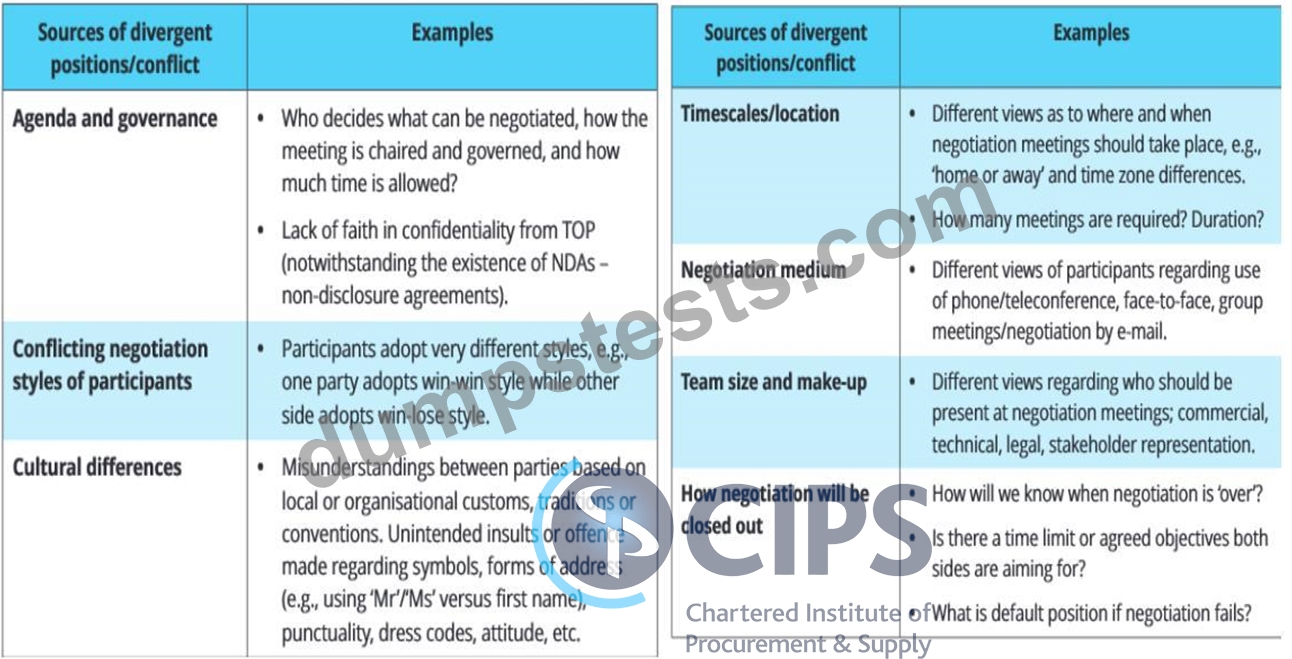
Line of best fits is the line that goes approximately through the middle of the data points with an equal number of data points above and below it. Line of best fits is a method of calculating medium value instatistics.
Standard terms and conditions are basic terms and conditions of business governing transactions that do not have a definitive contract, usually designed to be included in form documents such as orders. While there may be conflicts regarding standard terms and conditions, they are about the content of negotiation, not the process.
Type of purchase: when buying organisation makes an decision to purchase an item, a buyer is faced with three possible scenarios. The item to be bought could be a straight re-buy, a modified re-buy or a new purchase. Decision on type of purchase is purely an internal decision.
NEW QUESTION 73
When is the best time to adopt accommodating style according to Thomas-Kilmann conflict mode instrument?
- A. When both buyer and supplier want to find anintegrative solution as their concerns are too important to be compromised
- B. When buyer needs to gather more information to gain more advantages in later negotiations
- C. When buyer and supplier have equal power but are strongly committed to mutually exclusive goals
- D. When preserving harmony and avoiding disruption with supplier are especially important
Answer: D
Explanation:
Explanation
According to Thomas-Kilmann conflict model instrument, there are 5 conflict management styles:
Accommodating is an unassertive andcooperative approach to resolving the conflict. Accommodating means conceding to the other party with little debate or fight, not challenging or strongly putting forward your own point of view and generally giving and yielding to the other party's point of view. Accommodating is best used when:
1. When others can resolve the conflict more effectively
2. When the issue is much more important to the other person than to yourself - to satisfy the needs of others and to show you are reasonable
3. To build upsocial credit for later issues which are important to you
4. When continued competition would only damage your cause
5. When preserving harmony and avoiding disruption are especially important
6. To aid in the managerial development of subordinates by allowing them to experiment and learn from their own mistakes LO 1, AC 1.1
NEW QUESTION 74
Which of the following isthe definition of safety margin?
- A. The amount of revenue that remains after subtracting costs directly associated with production
- B. The incremental money generated for each product/unit sold after deducting the variable costs
- C. The difference between current or forecasted sales and sales at the break-even point
- D. The production level at which total revenues for a product equal total expenses
Answer: C
Explanation:
As a financial metric, the margin of safety (safety margin) is equal to the difference between current or forecasted sales and sales at the break-even point. The margin of safety is sometimes reported as a ratio, in which the aforementioned formula is divided by current or forecasted sales to yield a percentage value. The figure is used in both break-even analysis and forecasting to inform a firm's management of the existing cushion in actual sales or budgeted sales before the firm would incur a loss.
This is a question that a student met in her actual exam. The margin of safety is not even mentioned in the CIPS study guide.
NEW QUESTION 75
Are tactical ploys only used in distributive approach?
- A. Yes, because they will be irritants to long-term relationship
- B. No, because tactical ploys strengthen the other party's position
- C. Yes, because tactical ploys will help to gain insights into the other party's interests
- D. No, because tactical ploys will be more effective with integrative approach
Answer: A
Explanation:
There are many tactics and ploys that can be used to persuade others, particularly those not trained in negotiation. But in generalthese tactics should be used with care, as they can backfire; and in situations where a long-term relationship is desired, they can be, if detected, become an irritant to TOP.
Tactics are particularly effective if and when you are dealing with untrained negotiators, in consumer's buying situation and in once-off encounter.
NEW QUESTION 76
A buying organisation with a low spend but the reputation for paying on-time. In order to increase buyer's leverage in negotiation with suppliers, which of the following should be a priority of this buyer?
- A. Unavailable technical support
- B. Unclear tender award criteria
- C. Spend concentration
- D. Volume separation
Answer: C
Explanation:
Explanation
According to Paul Steele's 'The Seller's Perspective', customer can be classified into 4 categories as below:
To increase theleverage in negotiation, buyer may increase its attractiveness and/or increase spend value. In this scenario, the buyer is already attractive to supplier as it always pays on-time, but the spend is still low. So to have greater leverage, the buyer has toincrease its spend volume by spend concentration. Spend concentration may take many forms as following:
- Vendor base reduction
- Volume pooling
- Volume redistribution
- Volume consolidation across categories
- Standardisation and harmonisation of specifications
- Forming purchasing consortia
Chart, treemap chart Description automatically generated
LO 1, AC 1.3
NEW QUESTION 77
Which of the following are examples of push techniques in commercial negotiations? Select TWO that apply.
- A. Threat of punishment, costs and damage
- B. Listening to, involving andsupporting others
- C. Using language and imagery to 'paint a picture others can see'
- D. Argument based on information, logic and reason
- E. Working together to define the problem, the goals and the best solution
Answer: A,D
Explanation:
There are two major persuasion methods: 'push' and 'pull'.
Persuasion can be defined as encouraging someone to do something that you want them to do for you.
Persuasion is reasoning with someone so that they will believe or do something they might not otherwise do.
Persuasion can be considered as 'pushing' on TOP so that they can accept the change in attitude or behaviour as a result of your actions.
Influence is the ability to affect the manner of thinking of another. Influence can be considered as pulling on TOP so that you achieve the same result, but TOP feels they have changed their attitude or behaviour as a result of their reflection and thinking, and not your direct actions.
There are 5 options in this question:
'Threat of punishment, costs and damage': The influencertries to 'push' the other party to act as he/she wants by using force. This method is effective but short-lived. The influencer also risks to developing reputation for being heavy handed and dictatorial.
'Argument based on information, logic and reason':The influencer uses logic and reasons to persuade the other party. This is also known as 'Persuasive Reasoning' (Push)
'Using language and imagery to 'paint a picture others can see'': The influencer seeks to influence another by understanding the other'semotions, and stimulating that party's imagination to visualise the desired future goal of the influencer. This is also known as 'visionary (pull)'
'Working together to define the problem, the goals and the best solution': In this technique, the person seeking to influence another involves the other party in the decision making process. This is known as 'collaborative (pull)'
'Listening to, involving and supporting others': In this technique, the person seeking to influence another tries to discover the other party's emotion and aims at mutual understanding. This is also a collaborative approach.
NEW QUESTION 78
To buying organisation, savings can be achieved from different saving levers or tactics. Which of the following are means that deliver savings through optimising specifications?
- A. Value engineering
- B. Part substitution
- C. Budgetlinkages
- D. Volume pooling
- E. Compare total cost of ownership
Answer: A,B
Explanation:
If driving greater value and efficiency from your supply base is your end, you should remember that there are many ways to do this without seeking to negotiate lowerprices. Below are 7 types of saving levers:
Table Description automatically generated
NEW QUESTION 79
When is the best time for buyer to propose the negotiation agenda to potential supplier?
- A. Atconclusion stage
- B. At opening stage
- C. At preparation stage
- D. At testing stage
Answer: C
Explanation:
A business negotiation agenda is a formal agreed upon list of goals to be achieved or items to be discussed in a particular order during a meeting or negotiation. Agendascan be formal and obvious, or informal and subtle in negotiations.
The agenda is one of the main structural elements of negotiation, in addition to such questions as site, identification of participants, and elements of timing. Together, they answer the who, what, when, and where questions. As with other aspects of negotiation, the agenda can be used either manipulatively to enhance leverage or to improve the prospects for agreement and the possibilities for mutual gain. In most cases, it will be used bothways, reflecting the nature of negotiation as a "mixed-motive" situation.
Although it can be instrumental to [research] volunteer as a sole source to write the agenda, in most cases it becomes a joint activity to construct a consensual basis for subsequent negotiation. In these situations, agenda-building becomes one of the pre-negotiation activities that set the tone for the relationship (Saunders,
1985). In other situations, the parties may engage in actual negotiation without a formal or written agenda.When this occurs, the risks and uncertainties may be high but the party who appreciates the importance of the informal agenda has a tremendous advantage.
Whether one plans it or not, during the course of negotiation the parties will discuss a finite set of issues in some sequence and from a particular perceptual framework. Consciousness of the universality and centrality of the agenda is prerequisite to guiding negotiation to a successful conclusion.
NEW QUESTION 80
......
Pass Your CIPS Exam with L4M5 Exam Dumps: https://www.dumpstests.com/L4M5-latest-test-dumps.html
Pass L4M5 Exam Info and Free Practice Test : https://drive.google.com/open?id=1ueDNn9ybMdo8yaJS6dCV_fxR7BYlM4nl