

[2022] L4M5 by CIPS Level 4 Diploma in Procurement and Supply Actual Free Exam Practice Test
Free CIPS Level 4 Diploma in Procurement and Supply L4M5 Exam Question
NEW QUESTION 69
Which of the following is the most appropriate pricing arrangement in contracts where major inputs are commodities?
- A. Standard schedule of rates
- B. Price adjustment mechanism
- C. Fixed pricing arrangement
- D. Cost reimbursable pricingarrangement
Answer: B
Explanation:
In contracts which have major commodity input, the price is determined by market forces with no individual supplier or buyer able to influence it significantly.Prices are much more variable even within long term contracts and seeking a fixed price would create financial risks for both the buyers and the suppliers. It is often intelligent to agree a contract price adjustment mechanism to allow for market price changes so both sides share risk.
NEW QUESTION 70
Katie is preparing a negotiation with a strategic supplier. Through deep market analysis, she realises that her company and the supplier have equal bargaining power. Via regular communication, Katie knows that both parties are arguing on amount of liquidated damages and neither party shall concede all of their requirements but some are negotiable. Katie and her counterpart from supplying company still desire a long-term relationship and hope that the meeting between them will be a solution for current situation. Which of the following isthe most appropriate approach that Katie should adopt to achieve the above outcome?
- A. Accommodating approach
- B. Avoiding approach
- C. Competing approach
- D. Compromising approach
Answer: D
Explanation:
Explanation
Competing is assertive anduncooperative, a power-oriented mode. When competing, an individual pursues his or her own concerns at the other person's expense, using whatever power seems appropriate to win his or her position. Competing might mean standing up for your rights, defending a position you believe is correct, or simply trying to win. Competing will not allow long-term relationship to flourish.
Compromising is intermediate in both assertiveness and cooperativeness. When compromising, the objective is to find an expedient, mutually acceptable solution that partially satisfies both parties. Compromising falls on a middle ground between competing and accommodating, giving up more than competing but less than accommodating. Likewise, it addresses an issue more directly than avoiding but doesn't explore it in as much depth as collaborating. Compromising might mean splitting the difference, exchanging concessions, or seeking a quick middle-ground position. It is a valid approach when long-term relationships are at stake and it is important to find some common ground on which to base an agreement. Both sides get something but not everything. Therefore, this is the most appropriate for this scenario.
Avoiding is unassertive and uncooperative. When avoiding, an individual does not immediately pursue his or her own concerns or those of the other person. He or she does not address the conflict. Avoiding might take the form of diplomatically sidestepping an issue, postponing an issue until a better time, or simply withdrawing from a threatening situation. In the scenario, both parties want to take the opportunity, then avoiding is not an appropriate solution.
Accommodating is unassertive and cooperative-the opposite of competing. When accommodating, an individual neglects his or her own concerns to satisfy the concerns of the other person; there is an element of self-sacrifice in this mode. Accommodating might take the form of selfless generosity or charity, obeying another person's order when you would prefer not to, or yielding to another'spoint of view. In the scenario, neither party shall concede all of their requirements, it is unnecessary to adopt this approach.
LO 1, AC 1.1
NEW QUESTION 71
Procurement team is required to improve leverage with their suppliers through spend consolidation. To check whether there is any opportunity to consolidate spend, which of the following should be priority of procurement team?
- A. Value engineering
- B. Price analysis
- C. Spend analysis
- D. Total cost analysis
Answer: C
Explanation:
Explanation
In order to identify opportunities where you can increase your leverage with supplier, you need to understand your spend. Undertaking spend analysis of your accounts payable (AP) data is an essential first step here.
NEW QUESTION 72
In which of the following persuasion methods, the influencer uses logics and objective reasons to persuade the others to buy intoinfluencer's ideas?
- A. Persuasive reasoning (push)
- B. Visionary (pull)
- C. Directive (push)
- D. Collaborative (pull)
Answer: A
Explanation:
There are two major persuasion methods: 'push' and 'pull'.
Persuasion can be defined as encouraging someone to do something that you want them to do for you.
Persuasion is reasoning with someone so that they will believe or do something they might not otherwise do.
Persuasion can be considered as 'pushing' on TOP so that they can accept the change in attitude or behaviour as a result of your actions.
Influence is the ability to affect the manner of thinking of another. Influence can be considered as pulling on TOP so that you achieve the same result, but TOP feels they have changed their attitude or behaviour as a resultof their reflection and thinking, and not your direct actions.
There are multiple variables to consider when choosing between 'push' and 'pull'. Professor Fiona Dent of Ashridge Business School proposes situations when each style might be most appropriate, breaking down push into 'directive' and 'reasoning' and 'pull' into 'collaborative' and 'visionary':
Table Description automatically generated
Text Description automatically generated
Using logical and objective reasons is one of the typical characteristics of persuasion reasoning method.
NEW QUESTION 73
Which of the following may help the procurement professional increase expert power in commercial negotiation? Select TWO that apply.
- A. Personality
- B. Official positions
- C. Insights
- D. Ability to compensation
- E. Expertise knowledge
Answer: C,E
Explanation:
Expert power is based on a person's high levels of skill and knowledge, formal training, qualifications and experience in aparticular procurement category would give someone expert status and mean that in negotiation their voice is listened to as a more objective, informed knowledge leader. Expert power is based on facts, knowledge, research, insight and study.
Legitimate power comes from rules, formal authority, organisation rank, staff rate or official position held.
Reward power comes from one person's ability to compensate or reward another for compliance.
Referent power stems from their personality, way of engaging with others and habit of acting in a way that is in line with a strong set of values and principles.
NEW QUESTION 74
Which of the following are examples of push techniques in commercial negotiations? Select TWO that apply.
- A. Working together to define the problem, the goals and the best solution
- B. Threat of punishment, costs and damage
- C. Argument based on information, logic and reason
- D. Using language and imagery to 'paint a picture others can see'
- E. Listening to, involving andsupporting others
Answer: B,C
Explanation:
There are two major persuasion methods: 'push' and 'pull'.
Persuasion can be defined as encouraging someone to do something that you want them to do for you.
Persuasion is reasoning with someone so that they will believe or do something they might not otherwise do.
Persuasion can be considered as 'pushing' on TOP so that they can accept the change in attitude or behaviour as a result of your actions.
Influence is the ability to affect the manner of thinking of another. Influence can be considered as pulling on TOP so that you achieve the same result, but TOP feels they have changed their attitude or behaviour as a result of their reflection and thinking, and not your direct actions.
There are 5 options in this question:
'Threat of punishment, costs and damage': The influencertries to 'push' the other party to act as he/she wants by using force. This method is effective but short-lived. The influencer also risks to developing reputation for being heavy handed and dictatorial.
'Argument based on information, logic and reason':The influencer uses logic and reasons to persuade the other party. This is also known as 'Persuasive Reasoning' (Push)
'Using language and imagery to 'paint a picture others can see'': The influencer seeks to influence another by understanding the other'semotions, and stimulating that party's imagination to visualise the desired future goal of the influencer. This is also known as 'visionary (pull)'
'Working together to define the problem, the goals and the best solution': In this technique, the person seeking to influence another involves the other party in the decision making process. This is known as 'collaborative (pull)'
'Listening to, involving and supporting others': In this technique, the person seeking to influence another tries to discover the other party's emotion and aims at mutual understanding. This is also a collaborative approach.
NEW QUESTION 75
Buying organisation may increase its leverage with suppliers by concentrating spend. Which of the following are most likely to be forms of supplier spend consolidation? Select THREE that apply.
- A. Volume separation
- B. Volume redistribution
- C. Volume consolidation across categories
- D. Paying supplier on time
- E. Forming purchasing consortia
- F. Simplify procurement process
Answer: B,C,E
Explanation:
Buying organisation may increaseits leverage with suppliers by concentrating spend. Supplier spend consolidation can take many forms as outlined below:
Vendor base reduction: straightforward reduction of number of suppliers in any category Volume pooling: pooling cross organisational requirement until your order volume is high enough to attract new bidders/additional discounts Volume redistribution: making recommendations following spend analysis to move from one supplier to another Volume consolidation across categories: certainpurchase requirements may be common across a number of categories Standardisation and harmonisation of specifications: analysis of specifications and standards for a high spend purchased input, may show that there is a little difference between them and that the specification can be standardised or at least harmonised across the group or across national, regional or global operations.
Forming purchasing consortia: buyers may decide to come together and combine their purchase volumes to attract better deals.
NEW QUESTION 76
Which of the following is most likely a consequence of falling interest rate?
- A. Decrease investment
- B. Increase aggregate demand
- C. Decreaseconsumption
- D. Increase savings
Answer: B
Explanation:
If interest rate are too low and credit is too, cheap rates can fund a spending boom with consumers and businesses buying (investment) more than they can afford to pay back.
NEW QUESTION 77
'What specific tests do you carry out to ensure quality is achieved?' This is an example of which type of negotiation question?
- A. Reflective
- B. Leading
- C. Closed
- D. Probing
Answer: D
Explanation:
Explanation
The question requires more detailed answer, it is an example of probing question.
Probing questions are typically follow-up questions, and aim to elicit more detailed information on the back of the answer elicited from theopen questions. Probing question are also useful to check that the supplier fully understand their offering, as well as your needs, can also be used to communicate to the suppliers that you know this category well.
LO 3, AC 3.3
NEW QUESTION 78
Which of thefollowing are most likely to be sources of conflict that can emerge from the content of commercial negotiations? Select TWO that apply.
- A. Cultural differences
- B. Contract governing law
- C. Payment terms
- D. Framework arrangement
- E. Requisition
Answer: B,C
Explanation:
Explanation
There are multiple sources of divergent positions that can arise in situations where money is exchange for goods and services. There are 2 different types of sources. Those that arise from the content or subject matter of the negotiation (what is being negotiated) and those that arise from the process of negotiation (how it is being negotiated).
Sources of divergent position - the content of negotiation:
Table Description automatically generated
Cultural differences are the source of conflict in the process of negotiation.
Requisition is an internal document raised by user or store to communicate to procurement the need to buy the product or service specified. This is merely a internal document.
Framework arrangement is a rather loose set-up, without any legal standing. It usually occurs when an organisation has decided for itself to limit the number of suppliers it is willing to work with and, through a purely internal process, sets up an approved list of such suppliers.
LO 1, AC 1.1
NEW QUESTION 79
Which of the following should be done when undertaking a reflection activity on negotiation? Select TWO that apply.
- A. Be honest and objective about your skills
- B. Identify areas in your skill set where you need to improve
- C. Gloss over areas where you need to improve your skills or performance
- D. Be overly modest about your contribution to the outcomes of negotiation
- E. Use generalised or ambiguous language when describing your strengths and development areas
Answer: A,B
Explanation:
Giving positive group and individual feedback is easy, as is self-congratulation and, in many cases, it is hoped, this will be an accurate reflection on actual performance. When it comes to developmental or difficult feedback, it is only natural to want to move on and not reflect on the negative or developmental points, or why a negotiation did not achieve its objectives. But this is a mistake. The best learning opportunities come from reflection on what could be done better, and this can beachieved without blame, threat or condemnation.
Everyone and every team will make mistakes and/or have areas where they could have improved. Clearly, if every reflection session concludes that an individual or team keeps making the same mistake, then thereis a case to change roles or consider alternative approaches.
About Dos and Don'ts of reflection, you can refer here:
https://offices.depaul.edu/human-resources/employee-relations/Documents/Self%20Assesement.pdf
NEW QUESTION 80
A new manager has been appointed with responsibility for an organisation's category which has major impact on organisational cost base and there are little competitions in the supply market. They have an objective to improve supplier cost structures over time. Which of the following should they carry out first?
- A. STEEPLE analysis
- B. Competitive rivalry analysis
- C. Purchase price cost analysis
- D. Volume concentration
Answer: C
Explanation:
The objective of the buyer here is to improve supplier cost structures over time, which requires them to have insight into supplier's current cost information. Purchase price cost analysis (PPCA) can help here. PPCA is a method for gathering, analysing and using price and cost information in asystematic way. The process allows the identification of future savings and opportunities to improve current costs.
STEEPLE analysis is used to analyse the macro environment that may have impact on an organisation.
Competitive rivalry is a part ofPorter's Five Forces which is a tool for strategy making.
Volume concentration is a way to increase the purchasing quantities in order for a buying organisation to improve its leverage in negotiation.
NEW QUESTION 81
Premium pricing strategies used by suppliers are characterised by which of the following? Select TWO that apply.
- A. Price is based on cost structures
- B. Premium price is determined by variable costs only
- C. Typically found in the early part of the product life cycle
- D. This strategy is often used when supplier attempts to enter new market
- E. Products are charged at a price based on supplier's reputation
Answer: C,E
Explanation:
There are several pricing strategies used by suppliers:
Cost-plus pricing - Total variable + Fixed cost + profit
Premium pricing - based on branding. Supplier determines to charge a very high price, notconnected with cost structures, usually based on its reputation and/or the perception that the product/service is of a superior quality. This strategy typically found in the early part of the product life cycle/when demand exceeds supply.
Penetration pricing - Supplier attempts to enter a new market or extend its share in an established one. It is characterised by price reductions to increase volume, followed by steady price increases; may even be loss leading at start (no profit made) Marginal cost pricing - covers only variable cost Market pricing - suppliers prices in line with what the market is willing to pay
NEW QUESTION 82
Which of the following are most likely to beindirect costs of a garment manufacturer? Select THREE that apply.
- A. Packaging material
- B. Utilities
- C. Maintenance materials
- D. Textile
- E. Zips pads
- F. Depreciation of machinery
Answer: B,C,F
Explanation:
Indirect costs are those cost that are not directly attributable to production. Examples of indirect costs including the following:
Indirect labour: This covers every person in the factory who does not directly perform a production operation such as managers, supervisors, engineers, store personnel,clerks, maintenance staff, porters, canteen staff, security and cleaners etc.
Expenses: Included in this element is every fixed and variable expenses incurred in operating the factory, such as rent, rates, utilities, insurance, depreciation, maintenance, air conditioning and the various types of energy generation required by a clothing factory.
Indirect materials: Also known as consumables, this element contains all the materials not directly connected to the makeup of a garment. Some of the typical items involved are office materials, spare parts, marker paper, maintenance materials, chalk & pins.
Direct costs are those costs of a product/service directly attributable/traceable to its production. Examples of direct costs including the following:
Direct Materials: Direct materials are all the materials and trimmings which go into the construction and finish of the garment. Typically, these materials would include cloth, lining, fusible, zips pads, tapes, labels, tickets, hangers and packaging materials.
Direct Labour: This cover the cost of all the labor directly involved in producing the garment and could include cutting, fusing, regular sewing, special machine operations, pressing, finishing, inspection and packing. Labor of all types and grade has a directoverhead which include holiday pay, sick pay, fringe benefits etc and the statutory payments made by the employer for each employee. This is usually expressed as a percentage of salary and when this percentage is added to the employee's wage, it becomes the basis for calculating direct labor costs.
NEW QUESTION 83
Which of the following statements about oligopoly isincorrect?
- A. Oligopolistic firms recognize their interdependence
- B. A few firms play an important role in the sale of a product
- C. Prices in oligopoly are predicted to fluctuate widely and frequently
- D. One firm's behaviour is a function of what its rivals do
Answer: C
Explanation:
Explanation
An oligopoly exists when there are small number of producers that exert a significant influence in the market.
Oligopoly's main characteristics are discussed as follows:
- Interdependence
The most important feature of oligopolyis the interdependence in decision-making of the few firms which comprise the industry. This is because when the number of competitors is few, any change in price, output, product etc. by a firm will have a direct effect on the fortune of its rivals, which will then retaliate in changing their own prices, output or products as the case may be.
- Importance of advertising and selling costs
A direct effect of interdependence of oligopolists is that the various firms have to employ variousaggressive and defensive marketing weapons to gain a greater share in the market or to prevent a fall in their market share. For this various firms have to incur a good deal of costs on advertising and on other measures of sales promotion. Therefore, thereis a great importance of advertising and selling costs under conditions of market situation characterised by oligopoly
- Group behaviour
Another important feature of oligopoly is that for the proper solution to the problem of determination of price and output under, it analysis of group behaviour is impor-tant.
- Indeterminateness of demand curve facing an oligopolist
In this question, 'Prices in oligopoly are predicted to fluctuate widely and frequently' is an incorrect statement as producers in oligopoly often try to set up price. Prices fluctuate more frequently in perfect competition.
LO 2, AC 2.2
NEW QUESTION 84
Which of the following are most likely to be sources of conflict that can emerge from the process of commercial negotiations? Select TWO that apply.
- A. Differences in conflict management style
- B. Types of purchase
- C. Standard terms and conditions
- D. Differences in culture
- E. Line of the best fits
Answer: A,D
Explanation:
There are multiple sources of divergent positions that can arise in situations where money is exchange for goods and services. There are 2 different types of sources. Those that arise from the content or subject matter of the negotiation (what is being negotiated) and those that arise from the process of negotiation (how it is being negotiated).
Sources of divergent positions - the process of negotiation:
Table Description automatically generated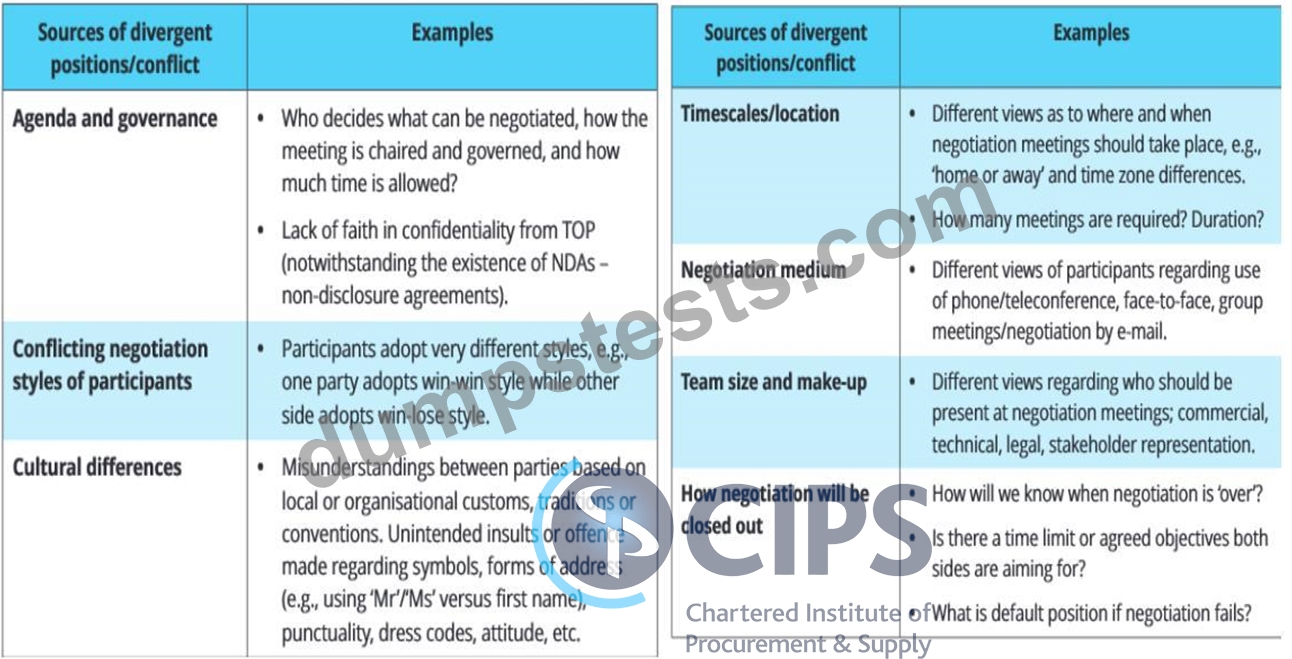
Line of best fits is the line that goes approximately through the middle of the data points with an equal number of data points above and below it. Line of best fits is a method of calculating medium value instatistics.
Standard terms and conditions are basic terms and conditions of business governing transactions that do not have a definitive contract, usually designed to be included in form documents such as orders. While there may be conflicts regarding standard terms and conditions, they are about the content of negotiation, not the process.
Type of purchase: when buying organisation makes an decision to purchase an item, a buyer is faced with three possible scenarios. The item to be bought could be a straight re-buy, a modified re-buy or a new purchase. Decision on type of purchase is purely an internal decision.
NEW QUESTION 85
What letter R in the acronym SMART stands for?
- A. Random
- B. Recommended
- C. Relevant
- D. Risk-free
Answer: C
Explanation:
Explanation
SMART is an acronym that you can use toguide your goal setting. SMART is an acronym that stands for Specific, Measurable, Achievable, Relevant, and Time-bound A student met this question in the L4M5 exam. SMART is mentioned primarily in L4M3 Commercial Contracting.
LO: Unknown, AC: Unknown
NEW QUESTION 86
A buying organisation with a low spend but the reputation for paying on-time. In order to increase buyer's leverage in negotiation with suppliers, which of the following should be a priority of this buyer?
- A. Volume separation
- B. Unavailable technical support
- C. Spend concentration
- D. Unclear tender award criteria
Answer: C
Explanation:
Explanation
According to Paul Steele's 'The Seller's Perspective', customer can be classified into 4 categories as below:
To increase theleverage in negotiation, buyer may increase its attractiveness and/or increase spend value. In this scenario, the buyer is already attractive to supplier as it always pays on-time, but the spend is still low. So to have greater leverage, the buyer has toincrease its spend volume by spend concentration. Spend concentration may take many forms as following:
- Vendor base reduction
- Volume pooling
- Volume redistribution
- Volume consolidation across categories
- Standardisation and harmonisation of specifications
- Forming purchasing consortia
Chart, treemap chart Description automatically generated
LO 1, AC 1.3
NEW QUESTION 87
Which of thefollowing is an objective of proposing phase?
- A. Start making tentative offers
- B. Create atmosphere conducive to agreement
- C. Trade concessions
- D. Check hypothesis and assumptions
Answer: A
Explanation:
In the study guide, CIPS lists 5 stages of an negotiation:
The opening phase: confirm understanding and get the issues on the table. At this stage, both parties should check agenda, authority and create atmosphere conducive to agreement The testing phase is an information gathering stage where the hypothesis and assumptions you have made in the planning stage can be tested and confirmed or disconfirmed The proposing phase: Both sides may start making tentative proposals regarding their offering.
The bargaining phase: Both parties trade concessions; the preliminary stages are over and proposals move from being tentative and general to being more definite and specific.
The agreement and closing phase: both parties should seek agreement or if TOP does not have the final authority, some sort of acknowledgement of what key terms are should be sought.
NEW QUESTION 88
Which of the following are most likely to help buyer become preferred customer in supplier's perspective?
Select TWO that apply.
- A. Onerous supplier terms and conditions
- B. Shorter payment period
- C. Reduction in delivery errors
- D. Compliance with agreed repair lead time
- E. Ensuring an increased number of repeat orders
Answer: B,E
Explanation:
Explanation
Becoming a preferred customer to supplier's perspective can increase the purchaser's leverage in negotiation.
Beside the size of buying organisation or its spend, the following may be sufficient to differentiate the buyer from other buying organisations:
- Simple procurement processes
- Simple contracting processes
- Clear and concise documentation
- Absence of onerous supplier terms and conditions (onerous supplier terms and conditions mean that obligations imposed on suppliers are greater than their gains)
- On-time payment: The reduction in hassle for both supplier and the buyer, if bills are paid on time, is significant. From the customer's perspective it could also be the opener to agreeing preferential payment terms. A supplier may weigh up that payment on time at 60 days is worth taking, over the current 30-day terms that slip to 90 days and beyond.
-Transparent processes
- Ethical behavior
LO 1, AC 1.3
NEW QUESTION 89
Which of the following are tools that help procurement visualise cost breakdowns of products and services purchased from supplier?
1. Spend candlesticks
2. Spend tree
3. Aggregate expenditure model
4. Spendwaterfall
- A. 2 and 4 only
- B. 1 and 3 only
- C. 1 and 2 only
- D. 3 and 4 only
Answer: A
Explanation:
Understanding where and with whom your supplier spends their money, or understanding the 'cost breakdowns' or 'price build-up' of the goods andservices you purchase from the supplier, will help you know where and when they can offer price concessions.
Cost information can be expressed with more impact through graphs that can be created using Excel and PowerPoint or other softwares. There are two commonly used models known as 'spend waterfall' and 'spend tree'. Spend waterfall shows the build-up of costs, while the spend tree shows all the spends that an organisation makes.
There is no graph known as 'spend candlesticks'. Candlestick chart is astyle of financial chart used to describe price movements of a security, derivative, or currency.
The aggregate expenditure model is a method of calculating GDP. The aggregate expenditure model focuses on the relationships between production (GDP) and planned spending: GDP = planned spending = consumption + investment + government purchases + net exports.
NEW QUESTION 90
Which of the following are most likely to turn buying organisation into an unattractive customer in supplier's perspective? Select TWO that apply.
- A. Adopting clear and concise CSR policies
- B. Using SRM technology
- C. Demands for kickback
- D. Unclear tender award criteria
- E. Reduced paperwork in procurement processes
Answer: C,D
Explanation:
Becoming a preferred customerto supplier's perspective can increase the purchaser's leverage in negotiation.
Beside the size of buying organisation or its spend, the following may be sufficient to differentiate the buyer from other buying organisations:
Simple procurement processes: Using SRM technology may help to simplify the process Simple contracting processes Clear and concise documentation: Reduced paperwork helps both supplier and buyer save their time and resources.
Absence of onerous supplier terms and conditions
On-time payment
Transparent processes: Unclear tender award criteria can be seen as opaque. Suppliers who attended the tendering processes cannot know the reasons why their bids are rejected and hesitate to attend other tendering.
Ethical behaviour: Suppliers may prefer a buyer who adopts CSR policy because they can predict potential customer's behaviour. Demands for kickback are unethical behaviours.
NEW QUESTION 91
Which of the following are most likely to be fundamentals of Fisher & Ury's principled negotiation?
1. Depersonalise the argument
2. Focuson positions
3. Generate creative options
4. Using subjective criteria
- A. 1 and 3 only
- B. 2 and 4 only
- C. 2 and 3 only
- D. 1 and 4 only
Answer: A
Explanation:
Explanation
Principled negotiation is based on four fundamentals: people, interest, options andcriteria:
Diagram Description automatically generated
1st Principle: separate the people from the problem: Negotiator should depersonalise the situation and accepting that the subject matter of the negotiation. This can be difficult for untrained negotiators, but this is a key skill to develop
2ndprinciple: focus on interests, not positions: It is important in principled negotiations not to focus on their parties' positions (what are expressed during negotiations), but on the interests (underlying needs) behind them
3rd principle: invent options for mutual gains: this principle aims to help the parties find a solution that both would benefit from. The more options - or tradeables - that can be brought to the table the better.
4th principle: insist on using objective criteria: is about making sure that the negotiation stays focused on outcomes based on objective criteria and that it is productive.
LO 1, AC 1.2
NEW QUESTION 92
SBL provides contract bathroom furniture and fittings for a wide variety of domestic and commercial clients.
To some suppliers, SBL spendclaims a large portion of their revenue. But SBL is famous for imposing draconian obligations on these suppliers. Which of the following is most likely to be overarching objective of these suppliers to SBL?
- A. Hold on and keep SBL happy but make sure that the business is profitable
- B. Charge a higher price to compensate for all the pain SBL has put
- C. Win and keep business with SBL at any costs, even without profits
- D. Drop the business with SBL immediately
Answer: B
Explanation:
According to Paul Steele's 'The Seller's Perspective', customer can be classified into 4 categories as below:
Chart, treemap chart Description automatically generated
In this scenario, although SBL's spend claims large portion in suppliers' revenues, their draconian treatment will reduce SBL's attractiveness in supplier's perspective.SBL falls into Exploit quadrant. With exploitable customers, suppliers tend to 'milk' the customer and charge a high price to compensate for all the pain customer put on them.
NEW QUESTION 93
......
CIPS L4M5 Actual Questions and Braindumps: https://www.dumpstests.com/L4M5-latest-test-dumps.html
L4M5 dumps & CIPS Level 4 Diploma in Procurement and Supply sure practice dumps: https://drive.google.com/open?id=1e_EET7bVF3trTMBOL0q2J5gEyL9Nz6WJ