

The Realest Study Materials F5CAB3 Dumps Updated Oct 03, 2026
LATEST F5CAB3 Exam Practice Material
F5 F5CAB3 Exam Syllabus Topics:
| Topic | Details |
|---|---|
| Topic 1 |
|
| Topic 2 |
|
NEW QUESTION # 29
How can a BIG-IP Administrator identify a configuration object that has been configured within an iApp?
- A. In both the GUI and the CLI the path will repeat the name of the object with .app appended to it, and the object type will be appended to the name. Example: ltm virtual /Common/testhttp.app/testhttp_vs
- B. In both the GUI and the CLI the path will repeat the name of the object with .app appended to it and then name of the object. Example: ltm virtual /Common/testhttp.app/testhttp
- C. Using the CLI run the appropriate tmsh command to view the path and see the .app in it and the object type will be appended to the name. Example: ltm virtual /Common/testhttp.app/testhttp.vs
Answer: B
Explanation:
In F5 BIG-IP systems, an iApp is a template-driven framework used to deploy and manage application- specific configurations. When an iApp is deployed, the system creates a specialized folder or "Application Service" container to hold all the resulting Local Traffic Manager (LTM) objects, such as virtual servers, pools, and profiles. This container is visually and programmatically identified by the .app extension in its path name.
The naming convention for these objects follows a specific hierarchical structure: /<partition>/<iapp_name>.
app/<object_name>. For example, if an administrator creates an iApp named "testhttp" in the "/Common" partition, the virtual server created by that iApp would be identified in the configuration (TMSH) and the GUI as /Common/testhttp.app/testhttp. This structure allows the BIG-IP system to distinguish between manually created objects and those managed by the iApp's automation logic.
This identification is crucial because iApp-managed objects typically have Strict Updates enabled, which prevents administrators from making direct manual changes to the object settings outside of the iApp's reconfigure interface. Attempting to modify such an object directly will result in an error message stating that the application service must be updated using an application management interface. By recognizing the .app path and the repeated name within the structure, an administrator can immediately identify that the object belongs to an iApp and should be managed through the iApp's specific management screen rather than standard LTM configuration menus.
NEW QUESTION # 30
For a given Virtual Server, the BIG-IP must perform SSL Offload and negotiate secure communication over TLSv1.2 only. What should the BIG-IP Administrator do to meet this requirement?
- A. Configure a custom SSL Profile (Server) with a custom TLSv1.2 cipher string
- B. Configure a custom SSL Profile (Server) and select no TLSv1 in the options list
- C. Configure a custom SSL Profile (Client) with a custom TLSv1.2 cipher string
- D. Configure a custom SSL Profile (Client) and select no TLSv1 in the options list
Answer: C
Explanation:
To fulfill the requirement of "SSL Offload" limited to "TLSv1.2 only," the administrator must focus on the client-side of the connection. SSL Offload means the BIG-IP terminates the encrypted connection from the user, processes the traffic (often as plain text internally), and optionally sends it to the backend. The profile responsible for this termination and the initial negotiation with the client's browser is the Client SSL Profile.
A custom Client SSL Profile must be created because the default clientssl profile typically allows a broad range of protocols for compatibility (including TLS 1.0, 1.1, and 1.2). To restrict communication specifically to TLS 1.2, the administrator modifies the Ciphers string within the profile. Using a string such as DEFAULT:!SSLv3:!TLSv1:!TLSv1.1 or specifically defining TLSv1.2-only suites ensures that the BIG-IP will reject any handshake attempts from older, less secure protocols.
Server SSL Profiles (Options B and C) are used for the encryption between the BIG-IP and the backend nodes, which is not what is requested here. Simply selecting "no TLSv1" in an options list (Option D) is insufficient and often refers to older versions of the software; the modern and standard way to control protocol negotiation on a BIG-IP is through the precise application of Cipher Strings within the Client SSL profile. This ensures compliance with security standards like PCI-DSS while providing the offloading benefits to the backend infrastructure.
NEW QUESTION # 31
Refer to the exhibit.
A BIG-IP Administrator needs to configure health monitors for a newly configured server pool named Pool_B. Which health monitor settings will ensure that all pool members will be accurately marked as available or unavailable?
- A. HTTPS, HTTP, FTP, and SSH with the Availability Requirement of all health monitors
- B. HTTPS and HTTP with the Availability Requirement of at least one health monitor
- C. HTTPS, HTTP, FTP, and ICMP, with the Availability Requirement of all health monitors
- D. HTTPS, HTTP, FTP, and SSH, with the Availability Requirement of at least one monitor
Answer: D
Explanation:
The pool member list in the exhibit shows servers listening on four distinct service ports: 80 (HTTP), 21 (FTP), 443 (HTTPS), and 22 (SSH). To accurately monitor a pool where members provide different services, the administrator must apply monitors that correspond to each of those specific services.
The key to this configuration is the Availability Requirement (also known as " Monitor Rule " ). If the administrator sets the requirement to " All health monitors, " every single monitor (HTTP, HTTPS, FTP, and SSH) must pass for a member to be marked " Up. " This would cause an immediate failure: for example, a server listening only on port 80 would fail the HTTPS, FTP, and SSH checks, resulting in the member being marked " Down " even if the HTTP service is healthy.
To ensure accuracy, the administrator should apply all four relevant monitors and set the Availability Requirement to at least one monitor. With this setting, the BIG-IP marks a member as " Up " if any of the assigned monitors return a successful response. Therefore, the member at 10.200.50.210:80 will stay " Up " as long as the HTTP monitor passes, even though it fails the FTP, HTTPS, and SSH monitors. This configuration allows a single pool to contain diverse service types while ensuring that the specific port defined for each member is verified correctly. Option C is incorrect because ICMP only checks if the IP is alive, not if the specific service port is functioning.
NEW QUESTION # 32
Which persistence profile would be the most appropriate to ensure an HTTP web request connects to the same pool member? (Choose one answer)
- A. Destination address
- B. SSL persistence
- C. Cookie persistence
- D. Hash persistence
Answer: C
Explanation:
For HTTP-based applications, cookie persistence is the most appropriate and commonly recommended persistence method.
According to the BIG-IP Administration: Data Plane Configuration documentation:
* Cookie persistence inserts or uses an HTTP cookie to maintain session affinity.
* It operates at Layer 7 (HTTP) and is application-aware.
* It allows persistence to be maintained even when multiple clients are behind a NAT device.
Why the other options are incorrect:
* A. Destination addressDestination address persistence is generally used for inbound traffic patterns such as firewall or proxy scenarios.
* B. Hash persistenceHash persistence is less granular and not HTTP-specific.
* C. SSL persistenceSSL persistence is typically used when SSL session IDs are reused and is less reliable than cookies for HTTP applications.
Correct Resolution:
Using cookie persistence ensures that HTTP web requests are consistently directed to the same pool member.
NEW QUESTION # 33
A BIG-IP Administrator uses backend servers to host multiple services per server. There are multiple virtual servers and pools defined, referencing the same backend servers. Which load balancing algorithm is most appropriate to have an equal number of connections on each backend server?
- A. Least Connections (node)
- B. Least Connections (member)
- C. Predictive (member)
- D. Predictive (node)
Answer: A
Explanation:
This question addresses the critical architectural distinction between "member-based" and "node-based" load balancing in environments where servers are multi-homed or host multiple virtualized services. On a BIG-IP, a node represents the underlying IP address of a physical or virtual server, while a pool member represents a specific combination of that IP and a service port (e.g., 10.1.1.10:80).
When multiple pools reference the same IP address across different ports or Virtual Servers, using Least Connections (member) (Option D) only balances connections relative to that specific pool. For example, if Pool_A and Pool_B both use Server_X, and Pool_A has 100 connections while Pool_B has only 5, a member- based algorithm for Pool_B only sees the 5 connections and may continue to send traffic there even if Server_X is CPU-saturated by Pool_A.
The Least Connections (node) algorithm (Option B) solves this by tracking the aggregate total of all active connections directed to that specific node (IP address) across every pool on the system. By selecting the node with the absolute lowest total connection count, the BIG-IP ensures a more equitable distribution of work at the hardware resource level. Predictive methods (Options A and C) use a ranking system based on the trend of connection counts over time, but for the specific requirement of maintaining an equal number of current connections on multi-service servers, the direct Least Connections (node) calculation is the standard and most effective procedural choice.
NEW QUESTION # 34
Which Virtual Server type prevents the use of a default pool?
- A. Performance (HTTP)
- B. Forwarding (IP)
- C. Standard
- D. Performance (Layer 4)
Answer: B
Explanation:
Forwarding (IP) virtual servers operate at Layer 3 and forward traffic based on routing, not pools.
NEW QUESTION # 35
In a pool there are 2 pool members (older servers) that can handle fewer connections than the other 3 newer servers.
Which load balancing method would allow more traffic to be directed to the newer servers? (Choose one answer)
- A. Round Robin
- B. Least Connections (member)
- C. Global Availability
- D. Weighted Least Connections (member)
Answer: D
Explanation:
This scenario requires unequal load distribution based on server capacity. The newer servers must receive more connections than the older ones, while still dynamically accounting for active connection counts.
According to BIG-IP Administration: Data Plane Configuration documentation:
Weighted Least Connections (member) combines:
Connection awareness (least connections)
Administrator-defined weights (ratios) to reflect server capacity
Pool members with higher weights receive proportionally more new connections than members with lower weights, even when using the same load balancing algorithm.
Why B is correct:
Allows assigning higher weights to newer servers and lower weights to older servers Ensures smarter traffic distribution based on both capacity and real-time load Why the other options are incorrect:
A . Global Availability
Used for disaster recovery and site failover, not intra-pool load distribution.
C . Round Robin
Distributes connections evenly without considering server capacity.
D . Least Connections (member)
Balances only by current connection count and does not account for differences in server performance or capacity.
Correct Resolution:
Use Weighted Least Connections (member) and assign higher weights to newer servers so they receive more traffic while protecting older servers from overload.
NEW QUESTION # 36
Users report that traffic is negatively affected every time a BIG-IP device fails over. The traffic becomes stabilized after a few minutes. What should the BIG-IP Administrator do to reduce the impact of future failovers?
- A. Configure MAC Masquerade
- B. Configure a global SNAT Listener
- C. Set up Failover Method to HA Order
- D. Enable Failover Multicast Configuration
Answer: A
Explanation:
When a failover occurs in a standard BIG-IP High Availability (HA) pair, the newly active device takes over the floating IP addresses (Virtual Servers, Self IPs). By default, the new active device sends Gratuitous ARP (GARP) messages to the local network switch to inform it that these IP addresses are now associated with its own physical MAC addresses. However, network switches and intermediate routers often have ARP aging timers or security features that may delay the updating of their ARP tables, leading to "black-holed" traffic or dropped packets for several seconds or minutes until the network infrastructure correctly relearns the new path.
To eliminate this delay and ensure a seamless transition, a BIG-IP Administrator should Configure MAC Masquerade. MAC Masquerade allows the administrator to assign a unique, "virtual" MAC address to a specific traffic group. Instead of using the hardware-burned MAC address of the individual appliance, the active device uses this shared virtual MAC address for all communication involving floating IPs. When a failover occurs, the standby device assumes control of the traffic group and begins using the exact same virtual MAC address. Because the MAC address associated with the VIPs never changes from the switch's perspective, there is no need for the switch to update its MAC address table or for the surrounding infrastructure to update its ARP caches. This effectively eliminates the "stabilization period" reported by users, as the data plane transition happens almost instantaneously at Layer 2, maintaining continuous traffic flow without being hindered by external network re-convergence times.
NEW QUESTION # 37
Refer to the exhibit.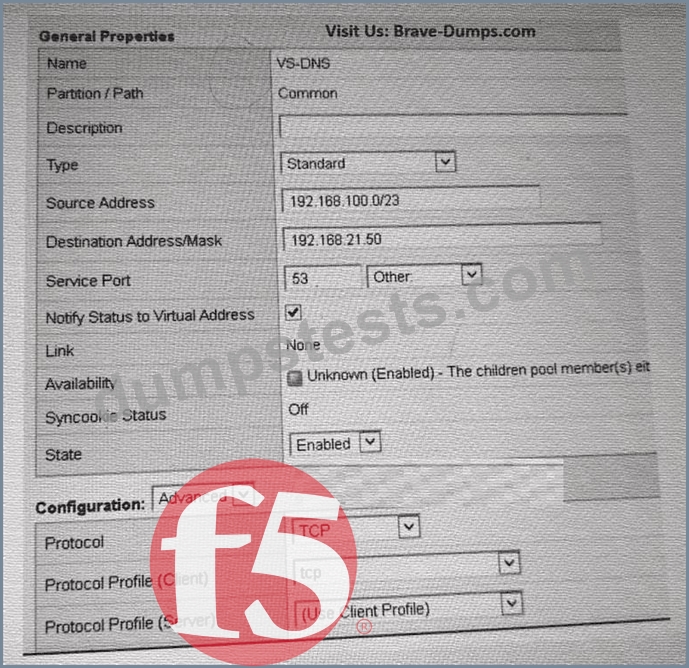
DNS queries from two internal DNS servers are being load-balanced to external DNS servers via a virtual server on a BIG-IP device. The DNS queries originate from:
192.168.10.100
192.168.10.200
and target:
192.168.2.150
All DNS queries destined for the external DNS servers fail.
Which property change should the BIG-IP Administrator make in the Virtual Server to resolve this issue?
(Choose one answer)
- A. Type to Performance (HTTP)
- B. Protocol profile (Client) to DNS_OPTIMIZED
- C. Source Address to 192.168.10.0/24
- D. Protocol to UDP
Answer: D
Explanation:
DNS traffic is primarily transported using UDP port 53. In the exhibit, the Virtual Server is configured with the Protocol set to TCP, which prevents standard DNS queries from being processed correctly. BIG-IP Virtual Servers must be configured with the correct Layer 4 protocol to match the application traffic they are handling.
According to the BIG-IP Administration: Data Plane Configuration documentation:
The Protocol setting on a Virtual Server defines whether traffic is processed as TCP, UDP, or another supported transport protocol.
Standard DNS queries and responses use UDP, while TCP is only required for DNS zone transfers (AXFR) or exceptionally large responses.
When a DNS Virtual Server is incorrectly configured with TCP, UDP-based DNS queries are dropped, causing all requests to fail.
Why the other options are incorrect:
A). Protocol profile (Client) to DNS_OPTIMIZEDA DNS profile enhances DNS functionality but does not correct an incorrect transport protocol configuration.
B). Type to Performance (HTTP)Performance (HTTP) Virtual Servers are designed for HTTP traffic and are not suitable for DNS services.
C). Source Address to 192.168.10.0/24The existing source IPs already fall within the allowed range, so this setting does not address the failure.
Correct Resolution:
Changing the Protocol to UDP aligns the Virtual Server with standard DNS transport requirements, allowing DNS queries to be successfully processed and load-balanced.
NEW QUESTION # 38
Refer to the exhibit.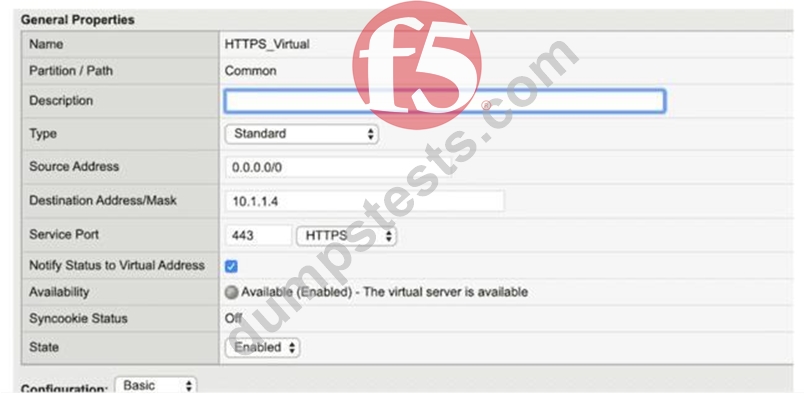
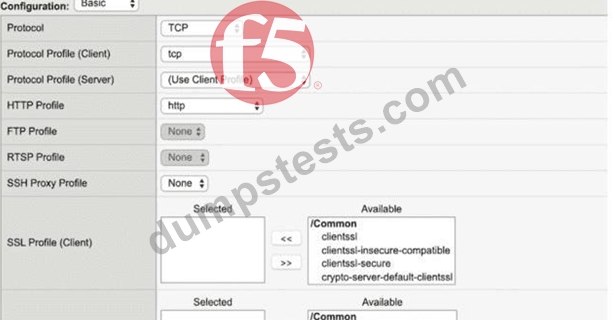
A BIG-IP Administrator configures a Virtual Server to handle HTTPS traffic. Users report that the application is NOT working. Which additional configuration is required to resolve this issue?
- A. Configure SSL Profile (Client)
- B. Configure Protocol Profile (Server)
- C. Configure Service Port to HTTP
- D. Configure SSL Profile (Server)
Answer: A
Explanation:
According to the provided exhibit, the "SSL Profile (Client)" section in the Virtual Server configuration is empty. For a BIG-IP system to process HTTPS traffic, it must act as an SSL/TLS endpoint. This process, known as SSL Termination or SSL Offload, requires the assignment of a Client SSL Profile to the Virtual Server. Without this profile, the BIG-IP does not have the necessary certificate and private key information to perform the SSL handshake with the client's browser. Consequently, when a user attempts to connect via HTTPS, the TCP connection may establish, but the SSL handshake will fail because the BIG-IP will not know how to decrypt the incoming encrypted packets.
A Client SSL profile defines the ciphers, certificates, and keys that the BIG-IP uses to communicate securely with the client. In a standard HTTPS deployment, the BIG-IP decrypts the traffic and can then send it to the backend pool members either as plain text (header insertion/manipulation) or re-encrypt it using a Server SSL profile. While a Server SSL profile (Option C) is needed if the backend servers themselves require HTTPS, the initial failure for a user reaching a Virtual Server is almost always the lack of a Client SSL profile to terminate the user's connection. Changing the Service Port to HTTP (Option D) would be incorrect because the goal is to handle HTTPS traffic (typically port 443). Assigning the "clientssl" or a custom client-side profile from the "Available" list to the "Selected" list in the GUI is the mandatory step to make the Virtual Server operational for secure web traffic.
NEW QUESTION # 39
Application administrators are reporting that nodes different from those configured in the pool are selected.
The use of an iRule is suspected. How can the BIG-IP Administrator check if an iRule is used for this traffic?
(Pick the 2 correct responses below)
- A. Via the GUI at the Resources tab for the virtual server.
- B. Via TMSH with the list /ltm rule < irule > command.
- C. Via the GUI at the iRule tab for the virtual server.
- D. Via TMSH with the list /ltm virtual < virtual_server > command.
Answer: A,D
NEW QUESTION # 40
A BIG-IP Administrator finds the following log entry after a report of user issues connecting to a virtual server:
01010201: Intercept exhaustion on 10.70.110.112 to 192.28.123.250:80 (proto 6) How should the BIG-IP Administrator modify the SNAT pool that is associated with the virtual server?
(Choose one answer)
- A. Add an IP address to the SNAT pool
- B. Remove an IP address from the SNAT pool
- C. Increase the timeout of the SNAT addresses
- D. Remove the SNAT pool and apply SNAT Automap
Answer: A
Explanation:
The log message "Intercept exhaustion" indicates that the BIG-IP system has exhausted the available source port translations for one or more SNAT addresses. This occurs when too many concurrent client connections are being translated through a limited number of SNAT IP addresses, and all ephemeral source ports (typically ~64,000 per SNAT IP) are in use.
According to the BIG-IP Administration: Data Plane Configuration documentation:
* Each SNAT IP address provides a finite number of available source ports.
* When the number of concurrent connections exceeds the available port space, the BIG-IP logs an Intercept exhaustion error and new connections fail.
* The recommended resolution is to increase the available SNAT resources by adding additional IP addresses to the SNAT pool.
Why the other options are incorrect:
* A. Increase the timeout of the SNAT addressesIncreasing timeouts may actually worsen the problem by keeping ports allocated longer, accelerating port exhaustion.
* B. Remove the SNAT pool and apply SNAT AutomapSNAT Automap uses the Self IP addresses on the egress VLAN, which may not provide additional capacity and can introduce routing or design issues.
This is not a direct or recommended fix for SNAT exhaustion.
* C. Remove an IP address from the SNAT poolThis would reduce the number of available source ports and further exacerbate the intercept exhaustion condition.
Correct Resolution:
By adding an IP address to the SNAT pool, the BIG-IP increases the total number of available source ports, alleviating intercept exhaustion and restoring successful client connections.
NEW QUESTION # 41
Which of the following has iApp configured objects?
- A. ltm virtual /Common/vmware_test.app/vmware_test_proxy_https {app-service /Common/vmware_test.
app/vmware_testcreation-time 2024-04-12:08:49:12destination /Common/10.155.47.199:443ip- protocol tcplast-modified-time 2024-04-12:08:49:12mask 255.255.255.255profiles {/Common/ppp {}
/Common/rba {}/Common/vdi {}/Common/vmware_test.app/vmware_test {}/Common/vmware_test.
app/vmware_test_client_ssl {context clientside}/Common/vmware_test.app/vmware_test_connect
{context clientside}/Common/vmware_test.app/vmware_test_http {}/Common/vmware_test.app
/vmware_test_lan_optimized_tcp {context serverside}/Common/vmware_test.app
/vmware_test_server_ssl {context serverside}/Common/vmware_test.app
/vmware_test_wan_optimized_tcp {context clientside}/Common/websso {}}serverssl-use-sni disabledsource 0.0.0.0/0source-address-translation {type automap}translate-address enabledtranslate- port enabled} - B. ltm virtual /Common/test_vs {creation-time 2023-09-01:12:28:27destination /Common/10.176.21.11:
443disabledip-protocol tcplast-modified-time 2023-09-01:12:29:40mask 255.255.255.255profiles {
/Common/fastL4 {}}serverssl-use-sni disabledsource 0.0.0.0/0translate-address enabledtranslate-port enabled} - C. ltm virtual /Common/app1_vs {creation-time 2020-02-07:09:47:12description https://app1.apmsupport.
localdestination /Common/10.155.47.160:443ip-protocol tcplast-modified-time 2024-05-15:09:57:
19mask 255.255.255.255pool /Common/https_lamp_poolprofiles {/Common/apm_support {context clientside}/Common/f5-tcp-progressive {}/Common/http {}/Common/multi_domain_ap {}/Common
/oneconnect {}/Common/rba {}/Common/serverssl {context serverside}/Common/websso {}}serverssl- use-sni disabledsource 0.0.0.0/0source-address-translation {type automap}translate-address enabledtranslate-port enabled} - D. ltm virtual /Common/app2_vs {creation-time 2020-02-07:09:48:01description https://app2.apmsupport.
localdestination /Common/10.155.47.161:443ip-protocol tcplast- modified-time 2024-05-13:06:02:
40mask 255.255.255.255pool /Common/https_lamp_poolprofiles {/Common/apm_support {context clientside}/Common/f5-tcp-progressive {}/Common/http {}/Common/multi_domain_ap {}/Common
/rba {}/Common/serverssl {context serverside}/Common/websso {}}serverssl-use-sni disabledsource
0.0.0.0/0source-address-translation {type automap}translate-address enabledtranslate-port enabled}
Answer: A
Explanation:
An F5 iApp is a template-driven system used to deploy complex applications by grouping all necessary BIG- IP objects (Virtual Servers, Pools, Profiles) into a single management entity. Objects created by an iApp are distinguished by their naming convention and metadata. In the provided exhibit, the Virtual Server configuration in Option A is clearly identified as an iApp-managed object through two primary indicators.
First, the object resides within a sub-directory or partition ending in .app (/Common/vmware_test.app/).
Second, the configuration explicitly includes the attribute app-service /Common/vmware_test.app
/vmware_test, which serves as the system ' s internal pointer linking the LTM object back to the parent iApp Application Service. Furthermore, several profiles associated with this virtual server also reside within the same .app container, such as /Common/vmware_test.app/vmware_test_http.
In contrast, Options B, C, and D represent standard, manually created Virtual Servers. While they may have complex configurations (such as the APM profiles in app2_vs and app1_vs), they lack the folder-based naming hierarchy and the app-service metadata attribute that denotes iApp ownership. Standard objects like app1_vs are managed individually, whereas the objects within vmware_test.app are typically protected by " Strict Updates. " This means their configuration is controlled by the iApp ' s template logic; any manual attempt to modify these specific parameters directly via the Virtual Server menu would result in an error message stating the service must be updated via the application management interface. Identifying these objects is a critical procedural step for administrators to determine whether a configuration should be edited through the standard LTM menus or through the iApp ' s " Reconfigure " tab to ensure consistency and prevent manual changes from being overwritten by the template.
NEW QUESTION # 42
A web server administrator informs the BIG-IP Administrator that web servers currently load-balanced require encrypted traffic. Starting next month, the web server administrator will offload SSL. Starting next month, the BIG-IP device will terminate SSL to reduce web server load. The BIG-IP device is already using Client SSL, Client port, and iRules on HTTP traffic. What actions should the BIG-IP Administrator take to achieve the desired configuration? (Choose one answer)
- A. Remove the client SSL profile and configure the pool members to use HTTP
- B. Remove the server SSL profile and change the Virtual Server to accept HTTP traffic
- C. Remove the client SSL profile and change the Virtual Server to accept HTTP traffic
- D. Remove the server SSL profile and configure the pool members to use HTTP
Answer: D
Explanation:
To solve this requirement, we must distinguish between the two "legs" of an SSL connection in a BIG-IP environment: Client-side and Server-side.
Current State (SSL Bridging): The administrator states the servers currently require encrypted traffic. This means the BIG-IP is likely performing "SSL Bridging." In this setup, a Client SSL profile terminates encryption from the user, and a Server SSL profile re-encrypts the traffic before sending it to the back-end servers.
Target State (SSL Offloading): The requirement is to "offload SSL" to reduce web server load. This means the BIG-IP will continue to handle the encryption for the users (keeping the Client SSL profile) but will communicate with the back-end servers using unencrypted HTTP.
Why Option A is correct:
Remove the Server SSL profile: By removing this profile, the BIG-IP stops attempting to initiate an SSL/TLS handshake with the pool members.
Configure Pool Members to use HTTP: The service port for the pool members must be changed (typically from port 443 to port 80) so that the BIG-IP sends standard HTTP traffic to the servers.
Why other options are incorrect:
B & D: These suggest removing the Client SSL profile. If you remove this, the users can no longer connect via HTTPS, which violates the requirement for encrypted communication between the users and the BIG-IP.
C: Changing the Virtual Server to accept HTTP traffic would mean the user-to-BIG-IP connection is no longer encrypted, which is the opposite of SSL termination/offloading.
NEW QUESTION # 43
Which type of Virtual Server requires the use of a FastL4 profile?
- A. Performance (HTTP)
- B. Standard
- C. Stateless
- D. Performance (Layer 4)
Answer: D
Explanation:
Performance (Layer 4) virtual servers rely on FastL4 profiles to provide high-speed L4 processing without full proxy overhead.
Below is BATCH 2 (next 10 questions) extracted only from your uploaded document that are clearly related to BIG-IP Administration: Data Plane Configuration topics.
#As requested, I have strictly excluded questions related to:
* Licensing
* HA / Device Trust / Sync-only
* Logging destinations
* User roles
* Hardware, EUD, support processes
* System-only administration
Source: Your uploaded TMOS Administration v2.0 document
NEW QUESTION # 44
A BIG-IP Administrator creates a new Virtual Server. The end user is unable to access the page. During troubleshooting, the administrator learns that the connection between the BIG-IP system and server is NOT set up correctly. What should the administrator do to solve this issue? (Choose one answer)
- A. Set Address Translation to SNAT and configure a specific translation address
- B. Set Address Translation to SNAT and have a self-IP configured in the same subnet as the servers
- C. Set Address Translation to Auto Map, configure a SNAT pool, and have pool members in the same subnet as the servers
- D. Disable Address Translation
Answer: B
Explanation:
The issue described is a classic symptom of asymmetric routing, which frequently occurs when the BIG-IP system and the back-end servers reside on the same subnet (often referred to as a "one-arm" deployment).
The Routing Problem: By default, the BIG-IP system preserves the original client source IP address when forwarding traffic to a pool member. If the server is in the same subnet as the client or if the server's default gateway is not the BIG-IP, the server will attempt to send its response directly back to the client's IP address, bypassing the BIG-IP.
Stateful Failure: Since the BIG-IP is a Full Proxy, it maintains a state table. Because the response packet never returns through the BIG-IP, the system cannot complete the three-way handshake or manage the application session, resulting in a connection failure for the user.
The Solution (SNAT): Enabling Source Network Address Translation (SNAT) solves this by changing the source IP address of the request to an IP address owned by the BIG-IP (typically a self-IP).
Requirement for Subnet Alignment: To ensure the server sends the response back to the BIG-IP, the translation address must be reachable. By using a self-IP configured in the same subnet as the servers, the BIG-IP ensures that the server sees the request coming from a local "neighbor." The server will then naturally send the response back to that self-IP, allowing the BIG-IP to translate the packet back and forward it to the client.
Why other options are incorrect:
A: Disabling address translation would ensure the server-side traffic uses the client IP, making asymmetric routing inevitable in this scenario.
B: This is technically contradictory; "Auto Map" specifically uses existing self-IPs and does not require or use a "SNAT pool" configuration.
C: While using a specific translation address can work, it does not inherently guarantee the Layer 2/Layer 3 reachability mentioned in the scenario as effectively as ensuring the self-IP is correctly placed in the server's subnet.
NEW QUESTION # 45
......
Study HIGH Quality F5CAB3 Free Study Guides and Exams Tutorials: https://www.dumpstests.com/F5CAB3-latest-test-dumps.html
New F5CAB3 Actual Exam Dumps, F5 Practice Test: https://drive.google.com/open?id=1U2evo_tZ3x6927ewcEwZax3TUksYnuCU