

Real 1Z0-082 Exam PDF Test Engine Practice Test Questions
Oracle 1Z0-082 Real 2022 Braindumps Mock Exam Dumps
Average Salary for Oracle 1z0-082: Oracle Database Administration 1 Exam
Oracle Database administrator roles are in great demand nowadays. The average salaries of Oracle 1Z0-068 Exam Certified professional in:
- India - 69,96,000 16,42,330 INR
- England - 71,000 POUND
- United State - 94,000 USD
- Europe - 80,000 Euro
NEW QUESTION 15
Which two statements are true about segment types in an Oracle Database?
- A. Cluster segments may contain data from multiple tables.
- B. Index segments always have two or more extents.
- C. Temporary segments are only stored in a temporary tablespace.
- D. Undo segments are only stored in an undo tablespace.
- E. Table segments always have two or more extents.
Answer: C
NEW QUESTION 16
Which three statements are true about table data storage in an Oracle Database? (Choose three.)
- A. Multiple row pieces from the same row may be stored in the same block
- B. Data block headers contain their own Data Block Address (DBA)
- C. Index block free space is always contiguous in the middle of the block
- D. A table row piece can be chained across several database blocks
- E. Data block free space is always contiguous in the middle of the block
- F. Multiple row pieces from the same row may be stored in different database blocks
Answer: D,E,F
NEW QUESTION 17
You currently have an active transaction in your session and have been granted select access to vstransaction.
In which three situations will re-executing this query still return a row but with a different XID, indicating a new transaction has started?
- A. after successfully executing a commit or rollback followed by a DML statement
- B. after successfully executing a commit or rollback followed by a select statement
- C. after successfully executing a create table as select statement followed by a select for update statement
- D. after successfully executing a create table statement followed by a create index statement
- E. after successfully executing a DML statement following a failed DML statement
- F. after successfully executing a truncate statement followed by a DML statement
Answer: A,C,F
NEW QUESTION 18
Which three Oracle database space management features will work with both Dictionary and Locally managed tablespaces? (Choose three.)
- A. Automatic data file extension (AUTOEXTEND)
- B. Online table segment shrink
- C. Oracle Managed Files (OMF)
- D. Online index segment shrink
- E. Capacity planning growth reports based on historical data in the Automatic Workload Repository (AWR)
Answer: A,C,E
NEW QUESTION 19
Which two statements are true about interval data types?
- A. INTERVAL day to second columns support fractions of seconds.
- B. INTERVAL year TO month columns support yearly intervals.
- C. INTERVAL year to month columns only support monthly intervals within a range of years.
- D. INTERVAL year to month columns only support monthly Intervals within a single year.
- E. The year field in an interval year to month column must be a positive value.
- F. The value in an interval day to SECOND column can be copied into an interval year to month column.
Answer: A,B
NEW QUESTION 20
Examine this description of the TRANSACTIONS table:
Which two SQL statements execute successfully? (Choose two.)
SELECT customer_id AS "CUSTOMER-ID", transaction_date AS DATE, amount + 100
- A. 'DUES AMOUNT' FROM transactions;
- B. "DUES" FROM transactions;
SELECT customer_id AS "CUSTOMER-ID", transaction_date AS "DATE", amount + 100 - C. 100 "DUES AMOUNT" FROM transactions;
SELECT customer_id CUSTID, transaction_date TRANS_DATE, amount + 100 DUES FROM - D. DUES FROM transactions;
SELECT customer_id AS CUSTOMER-ID, transaction_date AS TRANS_DATE, amount + - E. transactions;
SELECT customer_id AS 'CUSTOMER-ID', transaction_date AS DATE, amount + 100
Answer: D,E
NEW QUESTION 21
Which two are true about conventional path SQL load? (Choose two.)
- A. It locks objects being processed.
- B. It cannot load data into clustered tables.
- C. It always generates redo.
- D. It enforces referential integrity constraints.
- E. It does not generate UNDO.
Answer: D,E
NEW QUESTION 22
In your data center, Oracle Managed Files (OMF) is used for all databases.
All tablespaces are smallfile tablespaces.
SALES_Q1 is a permanent user-defined tablespace in the SALES database.
Examine this command which is about to be issued by a DBA logged in to the SALES database:
ALTER TABLESPACE sales_q1 ADD DATAFILE;
Which are two actions, either one of which you could take to ensure that the command executes successfully? (Choose two.)
- A. Ensure that DB_RECOVERY_FILE_DEST and DB_CREATE_FILE_DEST each specify locations with at least 50 Mb of available space.
- B. Ensure that DB_RECOVERY_FILE_DEST and DB_CREATE_FILE_DEST each specify with at least 50 Mb of available space.
- C. Add the AUTOEXTEND ON clause with NEXT set to 100M.
- D. Specify a path in the DATAFILE clause of the command specifying a location with at least 100M of available space.
- E. Ensure that DB_CREATE_FILE_DEST specifies a location with at least 100 Mb of available space.
Answer: D,E
NEW QUESTION 23
Which three statements are true about inner and outer joins? (Choose three.)
- A. An inner join returns matched rows
- B. A full outer join returns matched and unmatched rows
- C. A left or right outer join returns only unmatched rows
- D. Outer joins can be used when there are multiple join conditions on two tables
- E. Outer joins can only be used between two tables per query
- F. A full outer join must use Oracle syntax
Answer: A,B,C
Explanation:
Reference:
https://www.studytonight.com/dbms/joining-in-sql.php
NEW QUESTION 24
The orders table has a column ORDER_DATE of data type date.
The default display format for a date Is DD-MON-RR.
Which two where conditions demonstrate the correct usage of conversion functions?
- A. WHERE order date > TO DATE('JUL 10 2018', *MON DD YYYY')
- B. WHERE order_date > TO_CHAR(ADD_MONTHS(SYSDATE, 6), 'MON DD YYYY')
- C. WHERE TO_CHAR(order_date, 'MON DD YYYY') = 'JAN 20 2019'
- D. WHERE order_date IN (TO_DATE ('Oct 21 2018', 'Mon DD YYYY'), TC_CHAR('Nov 21 2018', 'Mon DD YYYY'))
- E. WHERE order_date > TO_DATE<ADD_MONTHS(SYSDATE, c) , 'MON DD YYYY')
Answer: A,C
NEW QUESTION 25
Which two tasks can you perform using DBCA for databases? (Choose two.)
- A. Enable flashback database for an existing database
- B. Configure a nonstandard block size for a new database
- C. Register a new database with an available Enterprise Manager Management server
- D. Configure incremental backups for a new database
- E. Change the standard block size of an existing database
Answer: B,C
Explanation:
Reference:
https://docs.oracle.com/cd/B16254_01/doc/server.102/b14196/install003.htm
NEW QUESTION 26
Table ORDER_ITEMS contains columns ORDER_ID, UNIT_PRICE and QUANTITY, of data type NUMBER.
Examine these SQL statements:
Statement 1:
SELECT MAX(unit_price * quantity) "Maximum Order"
FROM order_items;
Statement 2:
SELECT MAX(unit_price * quantity) "Maximum Order"
FROM order_items
GROUP BY order_id;
Which two statements are true?
- A. Statement 1 returns only one row of output.
- B. Both the statements give the same output.
- C. Statement 2 returns only one row of output.
- D. Statement 2 may return multiple rows of output.
- E. Both statements will return NULL if either UNIT_PRICE or QUANTITY contains NULL.
Answer: A,D
Explanation:
https://docs.oracle.com/javadb/10.8.3.0/ref/rrefsqlj27781.html
The Expression can contain multiple column references or expressions, but it cannot contain another aggregate or subquery. It must evaluate to a built-in data type. You can therefore call methods that evaluate to built-in data types. (For example, a method that returns a java.lang.Integer or int evaluates to an INTEGER.) If an expression evaluates to NULL, the aggregate skips that value.
NEW QUESTION 27
You execute this command:
During the export operation, you detach from the job by using CTRL+C and then execute this command:
Export> STOP_JOB=immediate
Are you sure you wish to stop the job ([yes]/no): yes
Which two statements are true about the job? (Choose two.)
- A. You can reattach to it and monitor it
- B. It is paused and can be resumed
- C. It terminates
- D. You can no longer monitor it
- E. It continues to run in the background
Answer: C,D
Explanation:
Explanation/Reference: https://blog.oracle48.nl/killing-and-resuming-datapump-expdp-and-impdp-jobs/
NEW QUESTION 28
The SALES_Q1 and USERS tablespaces exist in one of your databases and TEMP is a temporary tablespace.
Segment creation is not deferred.
You execute this command: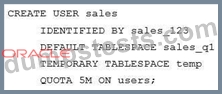
Which three statements must be true so that the SALES user can create tables in SALES_Q1? (Choose three.)
- A. The sales user must have a quota on the SALES_Q1 tablespace to hold the initial extends of all tables they plan to create in their schema
- B. The sales user must have a quota on the TEMP tablespace
- C. The sales user must have a quota on the SALES_Q1 tablespace to hold all the rows to be inserted into any table in their schema
- D. The sales user must have been granted the CREATE TABLE privilege
- E. The sales user must have their quota on the users tablespace removed
- F. The sales user must have been granted the CREATE SESSION privilege
Answer: A,D,E
NEW QUESTION 29
Which three statements are true about external tables in Oracle 18c and later releases? (Choose three.)
- A. The ORACLE_DATAPUMP access driver can be used to unload data from a database into an external table
- B. The ORACLE_DATAPUMP access driver can be used to load data into a database from an external table
- C. They support UPDATEs but not INSERTs and DELETEs
- D. External table files can be used for other external tables in a different database
- E. The ORACLE_LOADER access driver can be used to unload data from a database into an external table
- F. They cannot be partitioned
Answer: A,D,E
Explanation:
https://docs.oracle.com/en/database/oracle/oracle-database/18/admin/managing-tables.html#GUID-F6948F0E-0557-4C42-9145-1897DE974CC3
NEW QUESTION 30
Which three statements are true about time zones, date data types, and timestamp data types in an Oracle database? (Choose three.)
- A. A TIMESTAMP WITH LOCAL TIMEZONE data type column is stored in the database using the time zone of the session that inserted the row
- B. A TIMESTAMP data type column contains information about year, month, and day
- C. The CURRENT_TIMESTAMP function returns data without time zone information
- D. The DBTIMEZONE function can return an offset from Universal Coordinated Time (UTC)
- E. The SESSIONTIMEZONE function can return an offset from Universal Coordinated Time (UTC)
Answer: C,D,E
NEW QUESTION 31
Which two statements are true about the configuration and use of UNDO_RETENTION with GURANTEED ? (Choose two.) RETENTION
- A. UNDO_RETENTION specifies for how long Oracle attempts to keep unexpired UNDO.
- B. UNDO_RETENTION specifies how long all types of UNDO are retained.
- C. UNDO_RETENTION specifies for how long Oracle attempts to keep expired and unexpired UNDO.
- D. Unexpired UNDO is always retained.
- E. Active UNDO is always retained.
Answer: B,D
NEW QUESTION 32
Evaluate these commands which execute successfully:
Which two statements are true about the ORD_ITEMS table and the ORD_SEQ sequence? (Choose two.)
- A. Any user inserting rows into table ORD_ITEMS must have been granted access to sequence ORD_SEQ
- B. Column ORD_NO gets the next number from sequence ORD_SEQ whenever a row is inserted into ORD_ITEMS and no explicit value is given for ORD_NO
- C. Sequence ORD_SEQ cycles back to 1 after every 5000 numbers and can cycle 20 times
- D. Sequence ORD_SEQ is guaranteed not to generate duplicate numbers
- E. If sequence ORD_SEQ is dropped then the default value for column ORD_NO will be NULL for rows inserted into ORD_ITEMS
Answer: A,D
NEW QUESTION 33
Which two statements are true about the Automatic Diagnostic Repository (ADR)? (Choose two.)
- A. The ADR base defaults to $ORACLE_HOME/rdbms/admin if
neither DIAGNOSTIC_DEST nor ORACLE_BASE is set - B. It is held inside an Oracle database schema
- C. It supports diagnostics for Automatic Storage Management (ASM)
- D. It supports diagnostics for Oracle Clusterware
- E. The ADR base defaults to $ORACLE_HOME/dbs if the DIAGNOSTIC_DEST parameter and the ORACLE_BASE environment variable are not set
Answer: A,B
Explanation:
Explanation/Reference: https://docs.oracle.com/cd/E11882_01/install.112/e27508/admin.htm
NEW QUESTION 34
In the ORCL database, UNDOTBS1 is the active undo tablespace with these properties:
1. A size of 100 MB
2. AUTOEXTEND is off
3. UNDO_RETENTION is set to 15 minutes
4. It has RETENTION GUARANTEE
UNDOTBS1 fills with uncommitted undo 10 minutes after the database opens.
What will happen when the next update is attempted by any transaction?
- A. It succeeds and the least recently read undo block of UNDOTBS1 is overwritten by the generated undo.
- B. It succeeds and the generated undo is stored in SYSAUX.
- C. It succeeds and the generated undo is stored in SYSTEM.
- D. It fails and returns the error message "ORA-30036: unable to extend segment by 8 in undo tablespace
'UNDOTBS1' ". - E. It succeeds and the least recently written undo block of UNDOTBS1 is overwritten by the generated undo.
Answer: E
Explanation:
Explanation
NEW QUESTION 35
Which two statements are true about User Authentication in an Oracle Database?
- A. Password authentication must be used for system-privileged administrative users.
- B. Password File authentication is supported for any type of database user.
- C. Operating System authentication may be used for system-privileged administrative users.
- D. Password File authentication must be used for system-privileged administrative users.
- E. REKOTE_LOGIN_PASSMOREFiLE must be set to exclusive to permit password changes for system-privileged administrative users.
Answer: A,C
NEW QUESTION 36
You want to use table compression suitable for OLTP that will:
Compress rows for all DML statements on that table
Minimize the overheads associated with compression
Which compression option is best suited for this?
- A. COLUMN STORE COMPRESS FOR ARCHIVE LOW
- B. ROW STORE COMPRESS BASIC
- C. COLUMN STORE COMPRESS FOR QUERY LOW
- D. COLUMN STORE COMPRESS FOR ARCHIVE HIGH
- E. ROW STORE COMPRESS ADVANCED
Answer: E
Explanation:
Reference:
https://www.oracle.com/technetwork/database/options/compression/advanced-compression-wp-12c-1896128.pdf
NEW QUESTION 37
Which two statements are true about Enterprise Manager (EM) Express?
- A. You can use a single instance of EM Express to manage multiple database running on the same server.
- B. By default, EM express is available for a database after database creation using DBCA.
- C. You cannot start up a database instance using EM Express.
- D. EM Express uses a separate repository database to store target database metadata.
- E. You can shut down a database instance using EM Express.
Answer: B,E
NEW QUESTION 38
The SCOTT/TIGER user exists in two databases, BOSTON_DB and DALLAS_DB, in two different locations.
Each database has a tnsnames.ora file defining DALLAS_DB as a service name.
Examine this command:
CREATE DATABASE LINK dblink1 CONNECT TO scott IDENTIFIED BY tiger USING
`dallas_db';
How do you execute the command so that only SCOTT in BOSTON_DB can access the SCOTT schema in DALLAS_DB?
- A. as SCOTT in both the databases
- B. as SYS in both the databases
- C. as SCOTT in DALLAS_DB
- D. as SCOTT in BOSTON_DB and SYS in DALLAS_DB
- E. as SCOTT in BOSTON_DB
Answer: B
NEW QUESTION 39
Which statement is true about the INTERSECT operator used in compound queries?
- A. INTERSECT is of lower precedence than UNION or UNION ALL
- B. It processes NULLs in the selected columns
- C. Multiple INTERSECT operators are not possible in the same SQL statement
- D. It ignores NULLs
Answer: B
NEW QUESTION 40
......
Prepare For The 1Z0-082 Question Papers In Advance: https://www.dumpstests.com/1Z0-082-latest-test-dumps.html
Released Oracle 1Z0-082 Updated Questions PDF: https://drive.google.com/open?id=13LrYwHusno8XvoxBZ-dOnK98ABx5XqpD