

Prepare For Realistic NSE7_PBC-7.2 Dumps PDF - 100% Passing Guarantee
Check the Available NSE7_PBC-7.2 Exam Dumps with 40 Q's
Fortinet NSE7_PBC-7.2 certification exam is an industry-standard certification that is highly valued by employers worldwide. Fortinet NSE 7 - Public Cloud Security 7.2 certification validates the candidate's expertise in securing public cloud environments and demonstrates their commitment to ongoing professional development. Fortinet NSE 7 - Public Cloud Security 7.2 certification is ideal for cybersecurity professionals who want to advance their careers in the field of public cloud security and work on cloud-based projects.
Fortinet NSE 7 - Public Cloud Security 7.2 exam covers a wide range of topics, including cloud security architecture, cloud security operations, and cloud security services. NSE7_PBC-7.2 exam is designed to test the candidate's ability to deploy, manage, and secure public cloud infrastructures using Fortinet's cloud security solutions. It is a comprehensive exam that requires a deep understanding of the latest cloud security concepts, trends, and best practices.
NEW QUESTION # 15
Refer to the exhibit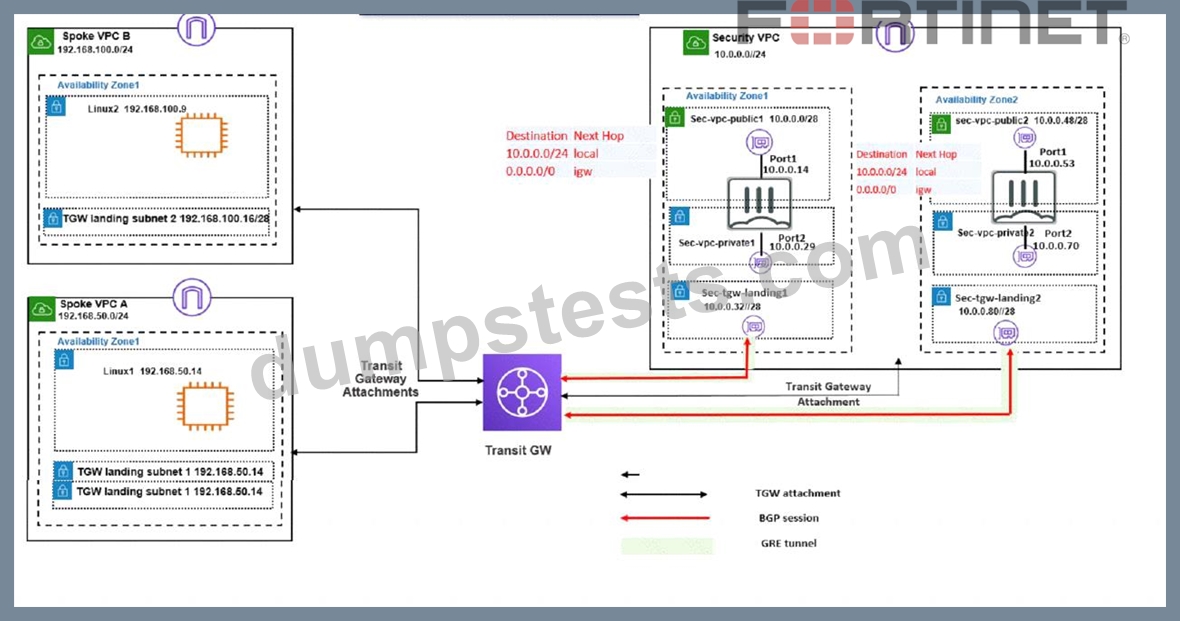
A customer has deployed an environment in Amazon Web Services (AWS) and is now trying to send outbound traffic from the Linux1 and Linux2 instances to the internet through the security VPC (virtual private cloud). The FortiGate policies are configured to allow all outbound traffic; however, the traffic is not reaching the FortiGate internal interface. Assume there are no issues with the Transit Gateway (TGW) configuration Which two settings must the customer add to correct the issue? (Choose two.)
- A. Both landing subnets in the security VPC must have a 0.0.0.0/0 traffic route to the FortiGate port2.
- B. Both landing subnets in the spoke VPCs must have a 0.0.0.0/0 traffic route to the Internet Gateway (IOW).
- C. The four landing subnets in all the VPCs must have a 0.0 0 0/0 traffic route to the TGW
- D. Both landing subnets in the spoke VPCs must have a 0.0 00/0 traffic route to the TGW
Answer: A,D
Explanation:
Explanation
The correct answer is B and C. Both landing subnets in the spoke VPCs must have a 0.0.0.0/0 traffic route to the TGW. Both landing subnets in the security VPC must have a 0.0.0.0/0 traffic route to the FortiGate port2.
According to the AWS documentation for Transit Gateway, a transit gateway is a network transit hub that connects VPCs and on-premises networks. To send outbound traffic from the Linux instances to the internet through the security VPC, you need to do the following steps:
In the main subnet routing table in the spoke VPCs, add a new route with destination 0.0.0.0/0, next hop TGW. This route directs all traffic from the Linux instances to the TGW, which can then forward it to the appropriate destination based on the TGW route table.
In the main subnet routing table in the security VPC, add a new route with destination 0.0.0.0/0, next hop FortiGate port2. This route directs all traffic from the TGW to the FortiGate internal interface, where it can be inspected and allowed by the FortiGate policies.
The other options are incorrect because:
Adding a 0.0.0.0/0 traffic route to the Internet Gateway (IGW) in the spoke VPCs is not correct, as this would bypass the TGW and the security VPC and send all traffic directly to the internet.
Adding a 0.0.0.0/0 traffic route to the TGW in all the VPCs is not necessary, as only the spoke VPCs need to send traffic to the TGW. The security VPC needs to send traffic to the FortiGate port2.
Transit Gateways - Amazon Virtual Private Cloud:Fortinet Documentation Library - Deploying FortiGate VMs on AWS
NEW QUESTION # 16
Which statement about Transit Gateway (TGW) in Amazon Web Services (AWS) is true?
- A. TGW can have multiple TGW route tables.
- B. The TGW default route table cannot be disabled.
- C. A TGW attachment can be associated with multiple TGW route tables.
- D. Both the TGW attachment and propagation must be in the same TGW route table
Answer: A
Explanation:
Explanation
According to the AWS documentation for Transit Gateway, a transit gateway is a network transit hub that connects VPCs and on-premises networks. A transit gateway route table is a set of rules that determines how traffic is routed among the attachments to the transit gateway1.
A transit gateway can have multiple route tables, and you can associate different attachments with different route tables. This allows you to control how traffic is routed between your VPCs and VPNs based on your network design and security requirements1.
The other options are incorrect because:
Both the TGW attachment and propagation must be in the same TGW route table is not true. You can associate an attachment with one route table and enable propagation from another attachment to a different route table. This allows you to separate the routing domains for your attachments1.
A TGW attachment can be associated with multiple TGW route tables is not true. You can only associate an attachment with one route table at a time. However, you can change the association at any time1.
The TGW default route table cannot be disabled is not true. You can disable the default route table by deleting all associations and propagations from it. However, you cannot delete the default route table itself1.
1: Transit Gateways - Amazon Virtual Private Cloud
NEW QUESTION # 17
You are adding more spoke VPCs to an existing hub and spoke topology Your goal is to finish this task in the minimum amount of time without making errors.
Which Amazon AWS services must you subscribe to accomplish your goal?
- A. GuardDuty, CloudWatch
- B. Inspector, S3
- C. CloudWatch, S3
- D. WAF, DynamoDB
Answer: C
Explanation:
Explanation
The correct answer is D. CloudWatch and S3.
According to the GitHub repository for the Fortinet aws-lambda-tgw script1, this function requires the following AWS services:
CloudWatch: A monitoring and observability service that collects and processes events from various AWS resources, including Transit Gateway attachments and route tables.
S3: A scalable object storage service that can store the configuration files and logs generated by the Lambda function.
By using the Fortinet aws-lambda-tgw script, you can automate the creation and configuration of Transit Gateway Connect attachments for your FortiGate devices.This can help you save time and avoid errors when adding more spoke VPCs to an existing hub and spoke topology1.
The other AWS services mentioned in the options are not required for this task. GuardDuty is a threat detection service that monitors for malicious and unauthorized behavior to help protect AWS accounts and workloads. WAF is a web application firewall that helps protect web applications from common web exploits.
Inspector is a security assessment service that helps improve the security and compliance of applications deployed on AWS. DynamoDB is a fast and flexible NoSQL database service that can store various types of data.
1:GitHub - fortinet/aws-lambda-tgw
NEW QUESTION # 18
A customer would like to use FortiGate fabric integration With FortiCNP When configuring a FortiGate VM to add to FortiCNP, which three mandatory configuration steps must you follow on FortiGate? (Choose three.)
- A. Create an IPsec tunnel.
- B. Enable two-factor authentication.
- C. Create and IPS sensor and a firewall policy
- D. Enable send logs-
- E. Create an SSL]SSH inspection profile.
Answer: C,D,E
Explanation:
Explanation
To configure a FortiGate VM to add to FortiCNP, you need to perform three steps on FortiGate:
Enable send logs in FortiGate to allow FortiCNP to receive the IPS logs from FortiGate.
Create an SSL/SSH inspection profile on FortiGate to inspect the encrypted traffic and apply IPS protection.
Create an IPS sensor and a firewall policy on FortiGate to enable IPS detection and prevention for the traffic.
References:
FortiCNP 22.4.a Administration Guide, page 22-24
FortiGate IPS Administration Guide, page 9-10
NEW QUESTION # 19
You are troubleshooting an Azure SDN connectivity issue with your FortiGate VM Which two queries does that SDN connector use to interact with the Azure management API? (Choose two.)
- A. Some queries are made to manage public IP addresses.
- B. The first query is targeted to a special IP address to get a token.
- C. There is only one query initiating from FortiGate port1 -
- D. The first query is targeted to IP address 8.8
Answer: A,B
Explanation:
Explanation
The Azure SDN connector uses two types of queries to interact with the Azure management API. The first query is targeted to a special IP address to get a token. This token is used to authenticate the subsequent queries. The second type of query is used to retrieve information about the Azure resources, such as virtual machines, network interfaces, network security groups, and public IP addresses. Some queries are made to manage public IP addresses, such as assigning or releasing them from the FortiGate VM. References: Configuring an SDN connector in Azure, Azure SDN connector using service principal, Troubleshooting Azure SDN connector
NEW QUESTION # 20
Refer to the exhibit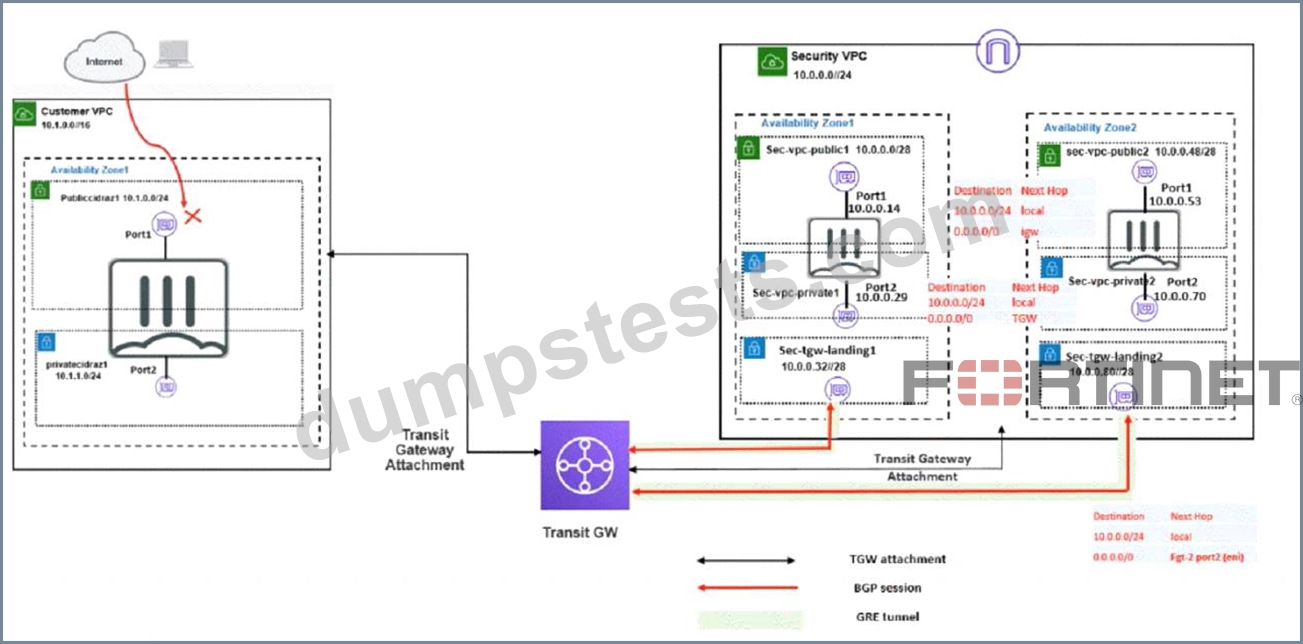
In your Amazon Web Services (AWS), you must allow inbound HTTPS access to the Customer VPC FortiGate VM from the internet However, your HTTPS connection to the FortiGate VM in the Customer VPC is not successful.
Also, you must ensure that the Customer VPC FortiGate VM sends all the outbound Internet traffic through the Security VPC How do you correct this Issue with minimal configuration changes?
(Choose three.)
- A. Deploy an internet gateway, associate an EIP in the public subnet, and attach the internet gateway to the Customer VPC,
- B. Add a route With your local internet public IP address as the destination and target internet gateway
- C. Add a route With your local internet public IP address as thedestination and target transit gateway
- D. Deploy an internet gateway, associate an EIP in the private subnet, edit route tables, and add a new route destination 0.0.0.0/0 to the target internet gateway
- E. Add route destination 0 0.0 0/0 to target the transit gateway
Answer: A,D,E
Explanation:
Explanation
B: Add route destination 0.0.0.0/0 to target the transit gateway. This will ensure that the Customer VPC FortiGate VM sends all the outbound internet traffic through the Security VPC, where it can be inspected by the Security VPC FortiGate VMs1. The transit gateway is a network device that connects multiple VPCs and on-premises networks in a hub-and-spoke model2. D. Deploy an internet gateway, associate an EIP in the private subnet, edit route tables, and add a new route destination 0.0.0.0/0 to the target internet gateway. This will allow inbound HTTPS access to the Customer VPC FortiGate VM from the internet, by creating a public route for the private subnet where the FortiGate VM is located3. An internet gateway is a service that enables communication between your VPC and the internet4. An EIP is a public IPv4 address that you can allocate to your AWS account and associate with your resources. E. Deploy an internet gateway, associate an EIP in the public subnet, and attach the internet gateway to the Customer VPC. This will also allow inbound HTTPS access to the Customer VPC FortiGate VM from the internet, by creating a public route for the public subnet where the FortiGate VM is located3. This is an alternative solution to option D, depending on which subnet you want to use for the FortiGate VM.
The other options are incorrect because:
Adding a route with your local internet public IP address as the destination and target transit gateway will not allow inbound HTTPS access to the Customer VPC FortiGate VM from the internet, because it will only apply to traffic coming from your specific IP address, not from any other source on the internet1. Moreover, it will not ensure that the outbound internet traffic goes through the Security VPC, because it will only apply to traffic going to your specific IP address, not to any other destination on the internet1.
Adding a route with your local internet public IP address as the destination and target internet gateway will not allow inbound HTTPS access to the Customer VPC FortiGate VM from the internet, because it will bypass the Security VPC and send the traffic directly to the Customer VPC1. Moreover, it will not ensure that the outbound internet traffic goes through the Security VPC, because it will only apply to traffic going to your specific IP address, not to any other destination on the internet1.
NEW QUESTION # 21
Refer to the exhibit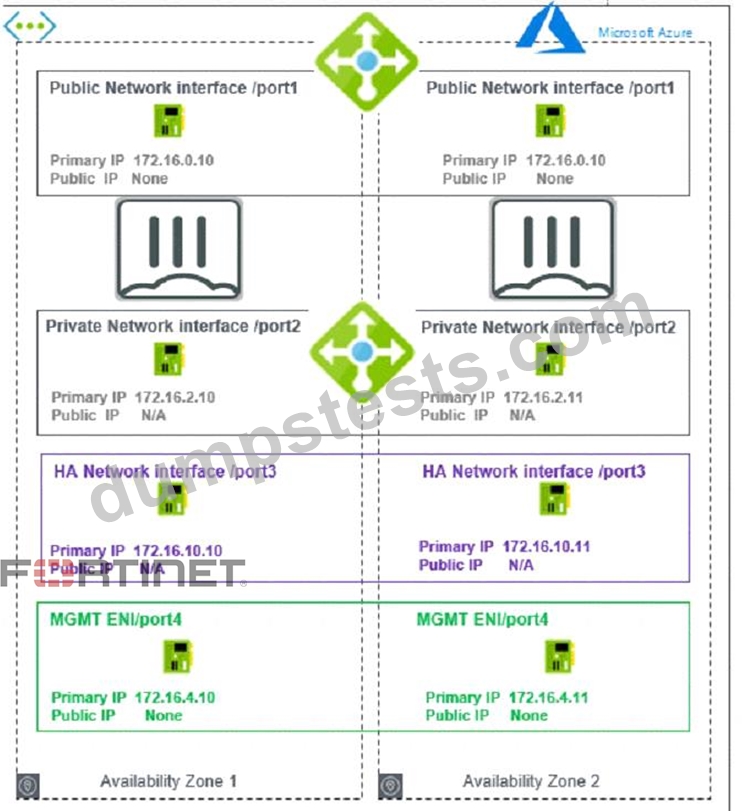
You are deploying two FortiGate VMS in HA active-passive mode with load balancers in Microsoft Azure Which two statements are true in this load balancing scenario? (Choose two.)
- A. A dedicated management interface can be used for load balancing.
- B. An internal load balancer listener is the next-hop for outgoing traffic.
- C. The FortiGate public IP is the next-hop for all the traffic.
- D. You must add a route to the Microsoft VIP used for the health check.
Answer: A,B
Explanation:
A is incorrect because the FortiGate public IP is not the next-hop for all the traffic. The FortiGate public IP is only used for incoming traffic from the internet. The Azure load balancer distributes the incoming traffic to the active FortiGate VM based on a health probe123. The FortiGate public IP is not used for outgoing traffic or internal traffic.
B is correct because an internal load balancer listener is the next-hop for outgoing traffic. The internal load balancer listener is configured with a floating IP address that is assigned to the active FortiGate VM. The internal load balancer listener also has a health probe to monitor the status of the FortiGate VMs123. The internal load balancer listener forwards the outgoing traffic to the internet through the public load balancer.
C is incorrect because you do not need to add a route to the Microsoft VIP used for the health check. The Microsoft VIP is an internal IP address that is used by the Azure load balancer to send health probes to the FortiGate VMs123. The Microsoft VIP is not reachable from outside the Azure network and does not require any routing configuration on the FortiGate VMs.
D is correct because a dedicated management interface can be used for load balancing. In this deployment, port4 is used as a dedicated management interface that connects to the management network3. The dedicated management interface can be used to access the FortiGate VMs for configuration and monitoring purposes. The dedicated management interface can also be used to synchronize the configuration and session information between the primary and secondary devices in an HA cluster2.
NEW QUESTION # 22
What are two main features in Amazon Web Services (AWS) network access control lists (ACLs)? (Choose two.)
- A. Network ACLs are tied to an instance
- B. NetworkACLs are stateless, and inbound and outbound rules are used for traffic filtering
- C. You cannot use Network ACL and Security Group at the same time.
- D. The default network ACL is configured to allow all traffic
Answer: B,D
Explanation:
Explanation
B: The default network ACL is configured to allow all traffic. This means that when you create a VPC, AWS automatically creates a default network ACL for that VPC, and associates it with all the subnets in the VPC1. By default, the default network ACL allows all inbound and outbound IPv4 traffic and, if applicable, IPv6 traffic1. You can modify the default network ACL, but you cannot delete it1. C. Network ACLs are stateless, and inbound and outbound rules are used for traffic filtering. This means that network ACLs do not keep track of the traffic that they allow or deny, and they evaluate each packet separately1. Therefore, you need to create both inbound and outbound rules for each type of traffic that you want to allow or deny1. For example, if you want to allow SSH traffic from a specific IP address to your subnet, you need to create an inbound rule to allow TCP port 22 from that IP address, and an outbound rule to allow TCP port 1024-65535 (the ephemeral ports) to that IP address2.
The other options are incorrect because:
You can use network ACL and security group at the same time. Network ACL and security group are two different types of security layers for your VPC that can work together to control traffic3. Network ACLacts as a firewall for your subnets, while security group acts as a firewall for your instances3. You can use both of them to create a more granular and effective security policy for your VPC.
Network ACLs are not tied to an instance. Network ACLs are associated with subnets, not instances1. This means that network ACLs apply to all the instances in the subnets that they are associated with1. You cannot associate a network ACL with a specific instance. However, you can associate a security group with a specific instance or multiple instances3.
NEW QUESTION # 23
You have created a TGW route table to route traffic from your spoke VPC to the security VPC where two FortiGate devices are inspecting traffic. Your spoke VPC CIDR block is already propagated to the Transit Gateway (TGW) route table.
Which type of attachment should you use to advertise routes through BGP from the spoke VPC to the security VPC?
- A. Route attachment
- B. VPC attachment
- C. Connect attachment
- D. GRE attachment
Answer: B
Explanation:
Explanation
A VPC attachment is the type of attachment that allows you to connect a VPC to a TGW and advertise routes through BGP. A VPC attachment creates a VPN connection between the VPC and the TGW, and enables dynamic routing with BGP. A connect attachment is used to connect a VPN or Direct Connect gateway to a TGW. A route attachment is not a valid type of attachment for TGW. A GRE attachment is used to connect a FortiGate device to a TGW using GRE tunnels. References:
Creating the TGW and related resources
Configuring TGW route tables
FortiGate Public Cloud 7.2.0 - Fortinet Documentation
Updating the route table and adding an IAM policy
NEW QUESTION # 24
What are three important steps required to get Terraform ready using Microsoft Azure Cloud Shell? (Choose three.)
- A. Subscribe to Terraform in Azure.
- B. Set up a storage account in Azure.
- C. use the -O command to download Terraform.
- D. Use the wget (te=aform vession) command to upload Terraform.
- E. Move the Terraform file to the bin directory.
Answer: B,D,E
Explanation:
Explanation
To get Terraform ready using Microsoft Azure Cloud Shell, you need to perform the following steps:
Set up a storage account in Azure. This is required to store the Terraform state file in a blob container, which enables collaboration and persistence of the infrastructure configuration1.
Use the wget (terraform_version) command to upload Terraform. This command downloads the latest version of Terraform from the official website and saves it as a zip file in the current directory2.
Move the Terraform file to the bin directory. This step extracts the Terraform executable from the zip file and moves it to the bin directory, which is part of the PATH environment variable. This allows you to run Terraform commands from any directory in Cloud Shell2.
The other options are incorrect because:
You do not need to use the -O command to download Terraform. This command is used to specify a different output file name for the downloaded file, but it is not necessary for this task3.
You do not need to subscribe to Terraform in Azure. Terraform is an open-source tool that can be used with any cloud provider, and there is no subscription or registration required to use it with Azure4. References:
Updating the route table and adding an IAM policy
Configure Terraform in Azure Cloud Shell with Bash
wget(1) - Linux man page
Terraform by HashiCorp
NEW QUESTION # 25
Refer to the exhibit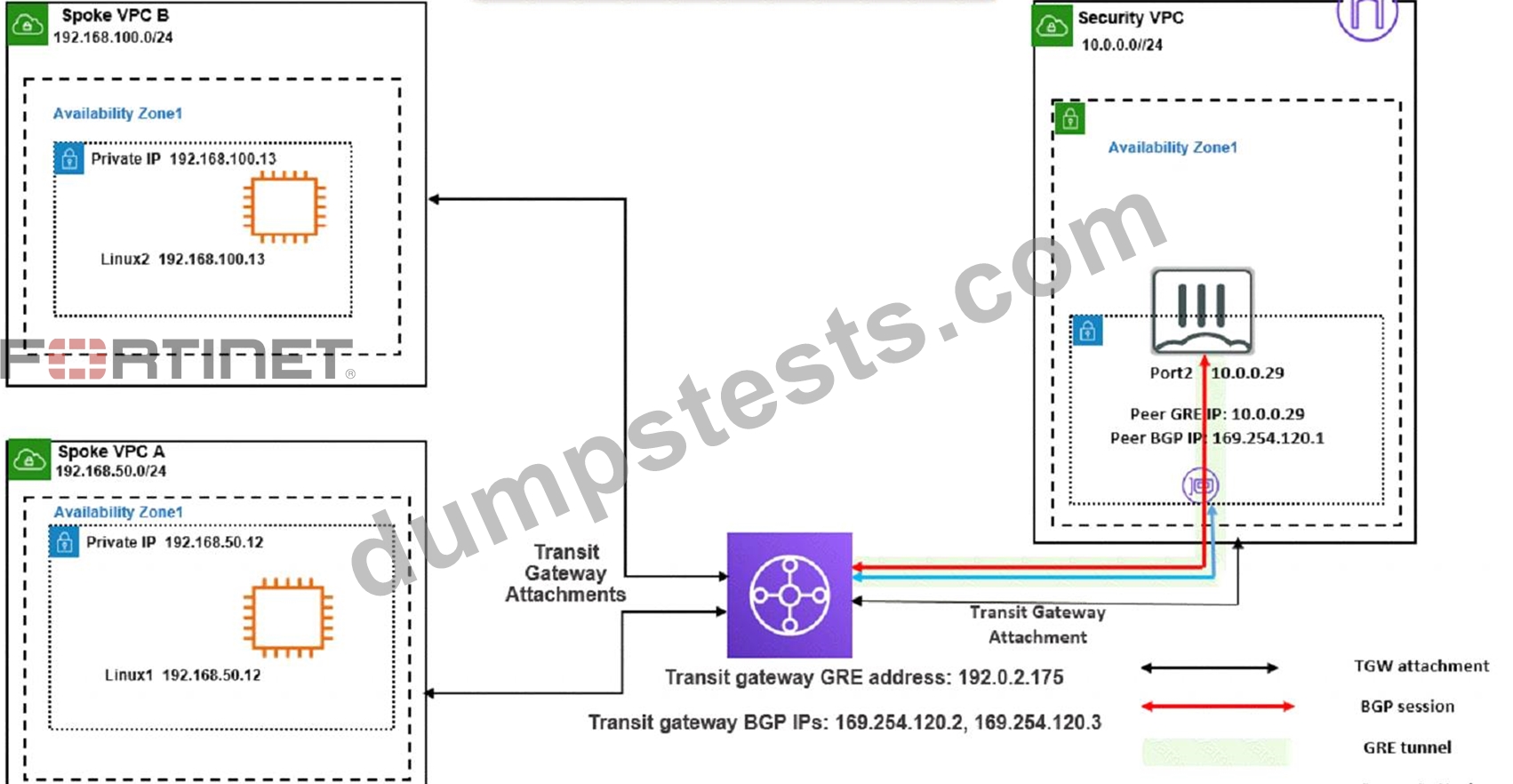
You attempted to access the Linux1 EC2 instance directly from the internet using its public IP address in AWS.
However, your connection is not successful.
Given the network topology, what can be the issue?
- A. There is no elastic IP address attached to FortiGate in the Security VPC.
- B. There is no internet gateway attached to the Spoke VPC A.
- C. There is no connection between VPC A and VPC B.
- D. The Transit Gateway BGP IP address is incorrect.
Answer: B
Explanation:
Explanation
This is because the Linux1 EC2 instance is not accessible directly from the internet using its public IP address in AWS.
An internet gateway is a horizontally scaled, redundant, and highly available VPC component that allows communication between instances in your VPC and the internet. Without an internet gateway, the Linux1 EC2 instance cannotreceive or send traffic to or from the internet, even if it has a public IP address assigned to it.
To fix this issue, you need to attach an internet gateway to the Spoke VPC A and configure a route table that directs internet-bound traffic to the internet gateway. You also need to ensure that the Linux1 EC2 instance has a security group that allows inbound and outbound traffic on the desired ports.
[Internet Gateways - Amazon Virtual Private Cloud] : [Attach an Internet Gateway to Your VPC - Amazon Virtual Private Cloud] : [Security Groups for Your VPC - Amazon Virtual Private Cloud]
NEW QUESTION # 26
Refer to the exhibit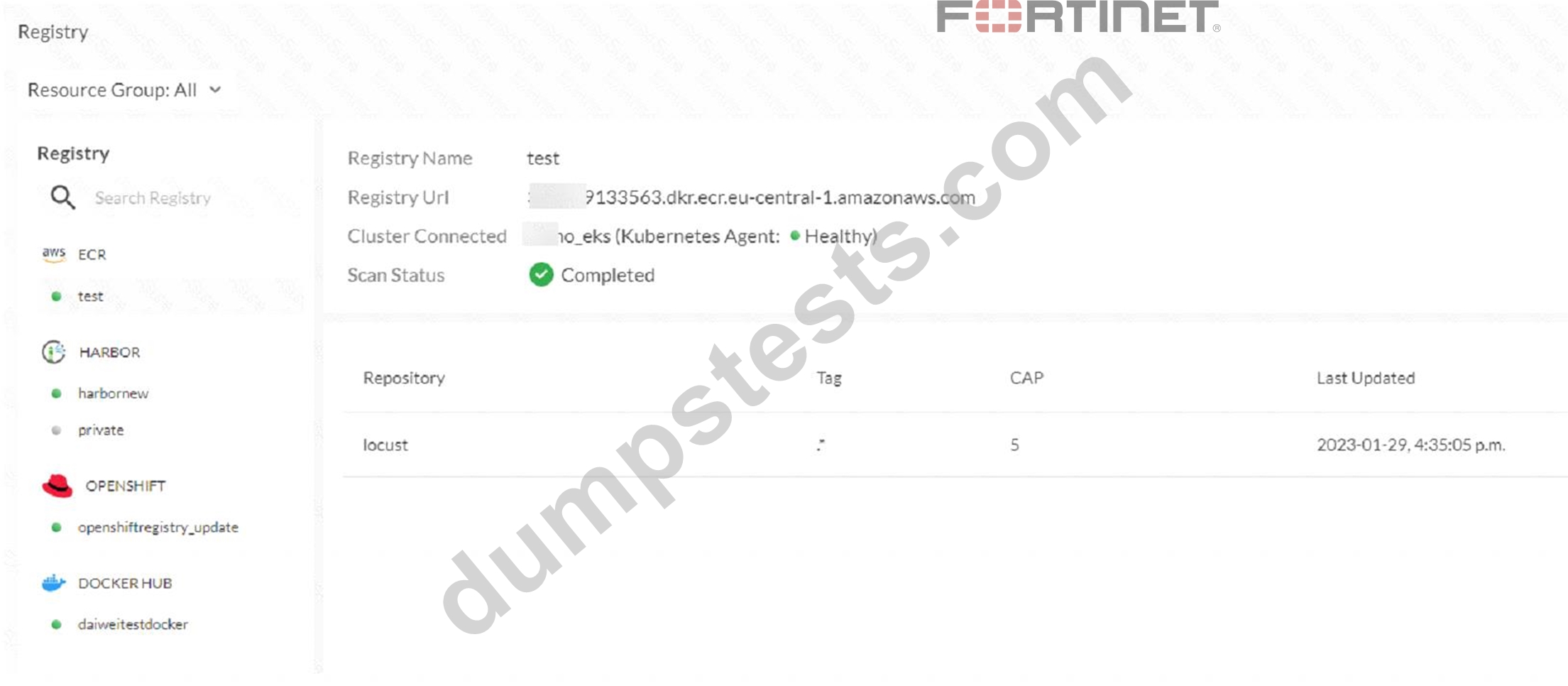
The exhibit shows the results of a FortiCNP registry scan
Which two statements are correct? (Choose two )
- A. When adding a repository, you can leave the Tag section blank to scan all images-
- B. The registry scan is part of the FortiCNP cloud protection.
- C. When adding a repository, you can add a minimum number of images to be imported through the CAP section.
- D. The registry scan is part of the FortiCNP container protection.
Answer: A,D
Explanation:
Explanation
The exhibit shows the results of a FortiCNP registry scan, which is part of the FortiCNP container protection. FortiCNP's Container Protection provides deep visibility into the security posture of container registries and images1. The registry scan utilizes Common Vulnerabilities and Exposures (CVE) index regularly updated by NVD to detect underlying vulnerabilities, security flaws, and provides security best practices2. The registry scan is performed at the registry level, and it can scan all images in a repository if the Tag section is left blank when adding a repository2. The CAP section stands for Container Assurance Policy, which defines the minimum number of images to be scanned per repository3. Therefore, the correct statements are A and C. References: Container Image Scan | FortiCNP 22.3.a, FortiCNP, Cloud Native Application Protection Platform | FortiCNP
NEW QUESTION # 27
Which statement about Transit Gateway (TGW) in Amazon Web Services (AWS) is true?
- A. TGW can have multiple TGW route tables.
- B. The TGW default route table cannot be disabled.
- C. A TGW attachment can be associated with multiple TGW route tables.
- D. Both the TGW attachment and propagation must be in the same TGW route table
Answer: A
Explanation:
Explanation
According to the AWS documentation for Transit Gateway, a transit gateway is a network transit hub that connects VPCs and on-premises networks. A transit gateway route table is a set of rules that determines how traffic is routed among the attachments to the transit gateway1.
A transit gateway can have multiple route tables, and you can associate different attachments with different route tables. This allows you to control how traffic is routed between your VPCs and VPNs based on your network design and security requirements1.
The other options are incorrect because:
Both the TGW attachment and propagation must be in the same TGW route table is not true. You can associate an attachment with one route table and enable propagation from another attachment to a different route table. This allows you to separate the routing domains for your attachments1.
A TGW attachment can be associated with multiple TGW route tables is not true. You can only associate an attachment with one route table at a time. However, you can change the association at any time1.
The TGW default route table cannot be disabled is not true. You can disable the default route table by deleting all associations and propagations from it. However, you cannot delete the default route table itself1.
1: Transit Gateways - Amazon Virtual Private Cloud
NEW QUESTION # 28
You are tasked with deploying a FortiGate HA solution in Amazon Web Services (AWS) using Terraform What are two steps you must take to complete this deployment? (Choose two.)
- A. Create an AWS Identity and Access Management (IAM) user With permissions.
- B. Use CloudSheIl to install Terraform.
- C. Enable automation on the AWS portal.
- D. Create an AWS Active Directory user with permissions.
Answer: A,B
Explanation:
Explanation
To deploy a FortiGate HA solution in AWS using Terraform, you need to create an AWS IAM user with permissions to access the AWS resources and services required by the FortiGate-VM. You also need to use CloudShell to install Terraform, which is a tool for building, changing, and versioning infrastructure as code.
References:
Deploying FortiGate-VM using Terraform | AWS Administration Guide
Setting up IAM roles | AWS Administration Guide
Launching the instance using roles and user data | AWS Administration Guide Terraform by HashiCorp
NEW QUESTION # 29
Refer to Exhibit:
The exhibit shows the Connect Peers settings on Amazon Web Services (AWS) transit gateway attachments With two FortiGate VMS in a security VPC.
Which two statements are correct? (Choose two.)
- A. The Transit Gateway GRE address is auto-generated
- B. The Peer GRE address is the FortiGate internal interface IP address
- C. The peer GRE address is the FortiGate external interface IP address.
- D. The BGP inside CIDR blocks can be any CIDR block with /29
Answer: A,C
Explanation:
Explanation
A: The peer GRE address is the FortiGate external interface IP address. This is the IP address of the FortiGate interface that is connected to the transit gateway attachment subnet1. This IP address is used to establish the GRE tunnel between the FortiGate and the transit gateway2. B. The Transit Gateway GRE address is auto-generated. This is the IP address of the transit gateway that is used to establish the GRE tunnel with the FortiGate2. This IP address is automatically assigned by AWS from the Transit Gateway CIDR range that you specify when you create the Connect attachment3.
The other options are incorrect because:
The BGP inside CIDR blocks cannot be any CIDR block with /29. They must be a /29 CIDR block from the 169.254.0.0/16 range for IPv4, or a /125 CIDR block from the fd00::/8 range for IPv64. These are the inside IP addresses that are used for BGP peering over the GRE tunnel4.
The Peer GRE address is not the FortiGate internal interface IP address. The internal interface IP address is used to route traffic from the FortiGate to the VPC subnet where the third-party appliance (such as SD-WAN) is located1. The Peer GRE address is used to route traffic from the FortiGate to the transit gateway over the GRE tunnel2.
NEW QUESTION # 30
Refer to the exhibit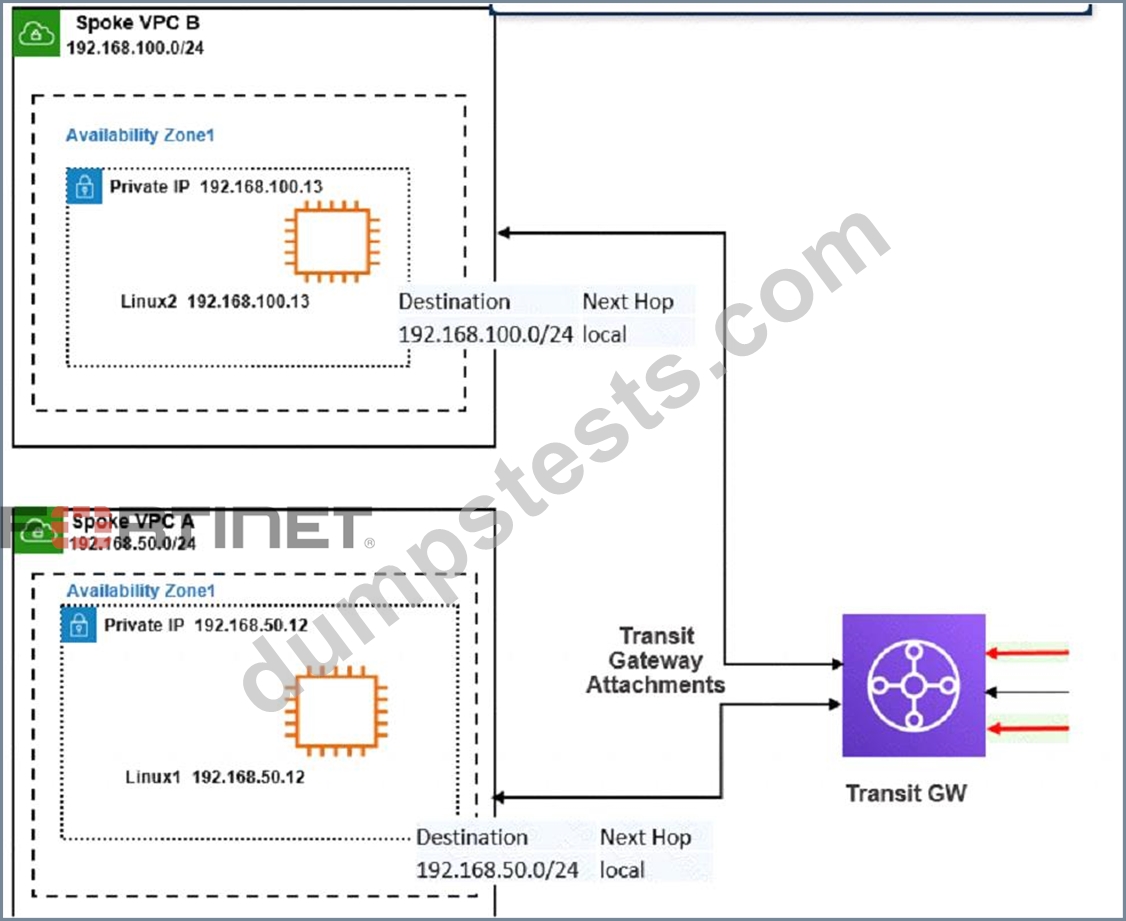
The exhibit shows a customer deployment of two Linux instances and their main routing table in Amazon Web Services (AWS). The customer also created a Transit Gateway (TGW) and two attachments Which two steps are required to route traffic from Linux instances to the TGWQ (Choose two.)
- A. In the TGW route table, associate two attachments.
- B. In the TGW route table, add route propagation to 192.168.0 0/16
- C. In the main subnet routing table in VPC A and B, add a new route with destination 0_0.0.0/0, next hop Internet gateway(IGW).
- D. In the main subnet routing table in VPC A and B, add a new route with destination 0_0.0.0/0, next hop TGW.
Answer: A,D
Explanation:
Explanation
According to the AWS documentation for Transit Gateway, a Transit Gateway is a network transit hub that connects VPCs and on-premises networks. To route traffic from Linux instances to the TGW, you need to do the following steps:
In the TGW route table, associate two attachments. An attachment is a resource that connects a VPC or VPN to a Transit Gateway. By associating the attachments to the TGW route table, you enable the TGW to route traffic between the VPCs and the VPN.
In the main subnet routing table in VPC A and B, add a new route with destination 0_0.0.0/0, next hop TGW. This route directs all traffic from the Linux instances to the TGW, which can then forward it to the appropriate destination based on the TGW route table.
The other options are incorrect because:
In the TGW route table, adding route propagation to 192.168.0 0/16 is not necessary, as this is already the default route for the TGW. Route propagation allows you to automatically propagate routes from your VPC or VPN to your TGW route table.
In the main subnet routing table in VPC A and B, adding a new route with destination 0_0.0.0/0, next hop Internet gateway (IGW) is not correct, as this would bypass the TGW and send all traffic directly to the internet. An IGW is a VPC component that enables communication between instances in your VPC and the internet.
[Transit Gateways - Amazon Virtual Private Cloud]
NEW QUESTION # 31
......
Fortinet NSE7_PBC-7.2 exam covers a wide range of topics related to public cloud security, including cloud security fundamentals, cloud infrastructure security, cloud application security, and cloud data protection. NSE7_PBC-7.2 exam is designed to validate the candidate's ability to design, implement, configure, and manage security solutions for public cloud environments. NSE7_PBC-7.2 exam also tests the candidate's understanding of the best practices for securing public cloud infrastructures and applications.
Download NSE7_PBC-7.2 Exam Dumps Questions to get 100% Success: https://www.dumpstests.com/NSE7_PBC-7.2-latest-test-dumps.html
100% Accurate Answers! NSE7_PBC-7.2 Actual Real Exam Questions: https://drive.google.com/open?id=13yINHz2Hra5dh7ogTTAD0pR5YEu3-Fr5