

Pass Microsoft DP-203 Exam Quickly With DumpsTests
Prepare DP-203 Question Answers - DP-203 Exam Dumps
NEW QUESTION # 117
You have an Azure subscription that contains a logical Microsoft SQL server named Server1. Server1 hosts an Azure Synapse Analytics SQL dedicated pool named Pool1.
You need to recommend a Transparent Data Encryption (TDE) solution for Server1. The solution must meet the following requirements:
Track the usage of encryption keys.
Maintain the access of client apps to Pool1 in the event of an Azure datacenter outage that affects the availability of the encryption keys.
What should you include in the recommendation? To answer, select the appropriate options in the answer area.
NOTE: Each correct selection is worth one point.
Answer:
Explanation:
Reference:
https://docs.microsoft.com/en-us/azure/synapse-analytics/security/workspaces-encryption
https://docs.microsoft.com/en-us/azure/key-vault/general/logging
NEW QUESTION # 118
You need to design the partitions for the product sales transactions. The solution must meet the sales transaction dataset requirements.
What should you include in the solution? To answer, select the appropriate options in the answer area.
NOTE: Each correct selection is worth one point.
Answer:
Explanation:
Explanation:
Box 1: Sales date
Scenario: Contoso requirements for data integration include:
* Partition data that contains sales transaction records. Partitions must be designed to provide efficient loads by month. Boundary values must belong to the partition on the right.
Box 2: An Azure Synapse Analytics Dedicated SQL pool
Scenario: Contoso requirements for data integration include:
* Ensure that data storage costs and performance are predictable.
The size of a dedicated SQL pool (formerly SQL DW) is determined by Data Warehousing Units (DWU).
Dedicated SQL pool (formerly SQL DW) stores data in relational tables with columnar storage. This format significantly reduces the data storage costs, and improves query performance.
Synapse analytics dedicated sql pool
Reference:
https://docs.microsoft.com/en-us/azure/synapse-analytics/sql-data-warehouse/sql-data-warehouse-overview- what-is
Topic 1, Contoso Case StudyTransactional Date
Contoso has three years of customer, transactional, operation, sourcing, and supplier data comprised of 10 billion records stored across multiple on-premises Microsoft SQL Server servers. The SQL server instances contain data from various operational systems. The data is loaded into the instances by using SQL server integration Services (SSIS) packages.
You estimate that combining all product sales transactions into a company-wide sales transactions dataset will result in a single table that contains 5 billion rows, with one row per transaction.
Most queries targeting the sales transactions data will be used to identify which products were sold in retail stores and which products were sold online during different time period. Sales transaction data that is older than three years will be removed monthly.
You plan to create a retail store table that will contain the address of each retail store. The table will be approximately 2 MB. Queries for retail store sales will include the retail store addresses.
You plan to create a promotional table that will contain a promotion ID. The promotion ID will be associated to a specific product. The product will be identified by a product ID. The table will be approximately 5 GB.
Streaming Twitter Data
The ecommerce department at Contoso develops and Azure logic app that captures trending Twitter feeds referencing the company's products and pushes the products to Azure Event Hubs.
Planned Changes
Contoso plans to implement the following changes:
* Load the sales transaction dataset to Azure Synapse Analytics.
* Integrate on-premises data stores with Azure Synapse Analytics by using SSIS packages.
* Use Azure Synapse Analytics to analyze Twitter feeds to assess customer sentiments about products.
Sales Transaction Dataset Requirements
Contoso identifies the following requirements for the sales transaction dataset:
* Partition data that contains sales transaction records. Partitions must be designed to provide efficient loads by month. Boundary values must belong: to the partition on the right.
* Ensure that queries joining and filtering sales transaction records based on product ID complete as quickly as possible.
* Implement a surrogate key to account for changes to the retail store addresses.
* Ensure that data storage costs and performance are predictable.
* Minimize how long it takes to remove old records.
Customer Sentiment Analytics Requirement
Contoso identifies the following requirements for customer sentiment analytics:
* Allow Contoso users to use PolyBase in an A/ure Synapse Analytics dedicated SQL pool to query the content of the data records that host the Twitter feeds. Data must be protected by using row-level security (RLS). The users must be authenticated by using their own A/ureAD credentials.
* Maximize the throughput of ingesting Twitter feeds from Event Hubs to Azure Storage without purchasing additional throughput or capacity units.
* Store Twitter feeds in Azure Storage by using Event Hubs Capture. The feeds will be converted into Parquet files.
* Ensure that the data store supports Azure AD-based access control down to the object level.
* Minimize administrative effort to maintain the Twitter feed data records.
* Purge Twitter feed data records;itftaitJ are older than two years.
Data Integration Requirements
Contoso identifies the following requirements for data integration:
Use an Azure service that leverages the existing SSIS packages to ingest on-premises data into datasets stored in a dedicated SQL pool of Azure Synaps Analytics and transform the data.
Identify a process to ensure that changes to the ingestion and transformation activities can be version controlled and developed independently by multiple data engineers.
NEW QUESTION # 119
You have an Azure Databricks resource.
You need to log actions that relate to changes in compute for the Databricks resource.
Which Databricks services should you log?
- A. workspace
- B. SSHE jobs
- C. clusters
- D. DBFS
Answer: A
Explanation:
Cloud Provider Infrastructure Logs.Databricks logging allows security and admin teams to demonstrate conformance to data governance standards within or from a Databricks workspace. Customers, especially in the regulated industries, also need records on activities like:- User access control to cloud data storage- Cloud Identity and Access Management roles- User access to cloud network and compute Azure Databricks offers three distinct workloads on several VM Instances tailored for your data analytics workflow-the Jobs Compute and Jobs Light Compute workloads make it easy for data engineers to build and execute jobs, and the All-Purpose Compute workload makes it easy for data scientists to explore, visualize, manipulate, and share data and insights interactively.
NEW QUESTION # 120
You need to implement an Azure Synapse Analytics database object for storing the sales transactions data.
The solution must meet the sales transaction dataset requirements.
What solution must meet the sales transaction dataset requirements.
What should you do? To answer, select the appropriate options in the answer area.
NOTE: Each correct selection is worth one point.
Answer:
Explanation:
NEW QUESTION # 121
Note: This question is part of a series of questions that present the same scenario. Each question in the series contains a unique solution that might meet the stated goals. Some question sets might have more than one correct solution, while others might not have a correct solution.
After you answer a question in this section, you will NOT be able to return to it. As a result, these questions will not appear in the review screen.
You are designing an Azure Stream Analytics solution that will analyze Twitter data.
You need to count the tweets in each 10-second window. The solution must ensure that each tweet is counted only once.
Solution: You use a tumbling window, and you set the window size to 10 seconds.
Does this meet the goal?
- A. No
- B. Yes
Answer: B
Explanation:
Explanation
Tumbling windows are a series of fixed-sized, non-overlapping and contiguous time intervals. The following diagram illustrates a stream with a series of events and how they are mapped into 10-second tumbling windows.
Reference:
https://docs.microsoft.com/en-us/stream-analytics-query/tumbling-window-azure-stream-analytics
NEW QUESTION # 122
You need to implement an Azure Databricks cluster that automatically connects to Azure Data lake Storage Gen2 by using Azure Active Directory (Azure AD) integration. How should you configure the new clutter?
To answer, select the appropriate options in the answers area. NOTE: Each correct selection is worth one point.
Answer:
Explanation:
Explanation:
https://docs.azuredatabricks.net/spark/latest/data-sources/azure/adls-passthrough.html
NEW QUESTION # 123
You build an Azure Data Factory pipeline to move data from an Azure Data Lake Storage Gen2 container to a database in an Azure Synapse Analytics dedicated SQL pool.
Data in the container is stored in the following folder structure.
/in/{YYYY}/{MM}/{DD}/{HH}/{mm}
The earliest folder is /in/2021/01/01/00/00. The latest folder is /in/2021/01/15/01/45.
You need to configure a pipeline trigger to meet the following requirements:
Existing data must be loaded.
Data must be loaded every 30 minutes.
Late-arriving data of up to two minutes must he included in the load for the time at which the data should have arrived.
How should you configure the pipeline trigger? To answer, select the appropriate options in the answer area.
NOTE: Each correct selection is worth one point.
Answer:
Explanation:
Explanation
Box 1: Tumbling window
To be able to use the Delay parameter we select Tumbling window.
Box 2:
Recurrence: 30 minutes, not 32 minutes
Delay: 2 minutes.
The amount of time to delay the start of data processing for the window. The pipeline run is started after the expected execution time plus the amount of delay. The delay defines how long the trigger waits past the due time before triggering a new run. The delay doesn't alter the window startTime.
Reference:
https://docs.microsoft.com/en-us/azure/data-factory/how-to-create-tumbling-window-trigger
NEW QUESTION # 124
You plan to develop a dataset named Purchases by using Azure databricks Purchases will contain the following columns:
* ProductID
* ItemPrice
* lineTotal
* Quantity
* StorelD
* Minute
* Month
* Hour
* Year
* Day
You need to store the data to support hourly incremental load pipelines that will vary for each StoreID. the solution must minimize storage costs. How should you complete the rode? To answer, select the appropriate options In the answer area.
NOTE: Each correct selection is worth one point.
Answer:
Explanation:
Explanation
Box 1: partitionBy
We should overwrite at the partition level.
Example:
df.write.partitionBy("y","m","d")
mode(SaveMode.Append)
parquet("/data/hive/warehouse/db_name.db/" + tableName)
Box 2: ("StoreID", "Year", "Month", "Day", "Hour", "StoreID")
Box 3: parquet("/Purchases")
Reference:
https://intellipaat.com/community/11744/how-to-partition-and-write-dataframe-in-spark-without-deleting-partitio
NEW QUESTION # 125
You are building a database in an Azure Synapse Analytics serverless SQL pool.
You have data stored in Parquet files in an Azure Data Lake Storage Gen2 container.
Records are structured as shown in the following sample.
{
"id": 123,
"address_housenumber": "19c",
"address_line": "Memory Lane",
"applicant1_name": "Jane",
"applicant2_name": "Dev"
}
The records contain two applicants at most.
You need to build a table that includes only the address fields.
How should you complete the Transact-SQL statement? To answer, select the appropriate options in the answer area.
NOTE: Each correct selection is worth one point.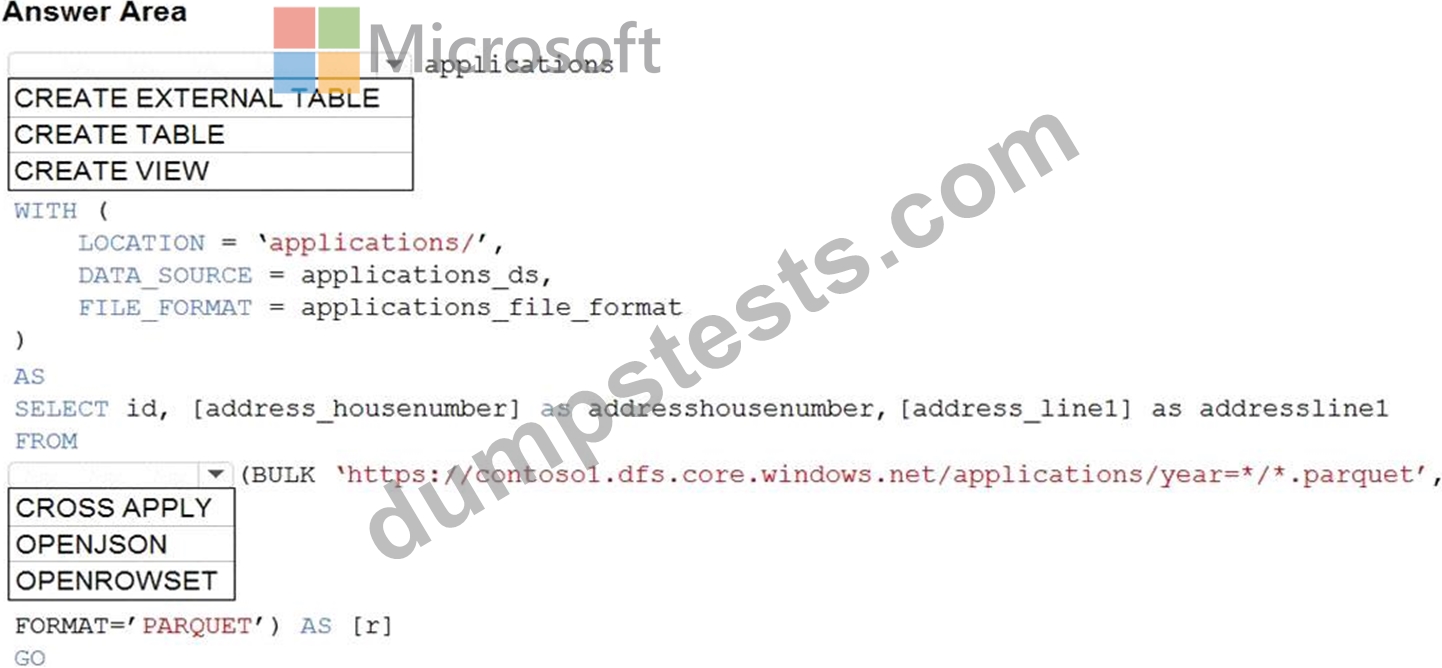
Answer:
Explanation:
Explanation
Box 1: CREATE EXTERNAL TABLE
An external table points to data located in Hadoop, Azure Storage blob, or Azure Data Lake Storage. External tables are used to read data from files or write data to files in Azure Storage. With Synapse SQL, you can use external tables to read external data using dedicated SQL pool or serverless SQL pool.
Syntax:
CREATE EXTERNAL TABLE { database_name.schema_name.table_name | schema_name.table_name | table_name } ( <column_definition> [ ,...n ] ) WITH ( LOCATION = 'folder_or_filepath', DATA_SOURCE = external_data_source_name, FILE_FORMAT = external_file_format_name Box 2. OPENROWSET When using serverless SQL pool, CETAS is used to create an external table and export query results to Azure Storage Blob or Azure Data Lake Storage Gen2.
Example:
AS
SELECT decennialTime, stateName, SUM(population) AS population
FROM
OPENROWSET(BULK
'https://azureopendatastorage.blob.core.windows.net/censusdatacontainer/release/us_population_county/year=*/* FORMAT='PARQUET') AS [r] GROUP BY decennialTime, stateName GO Reference:
https://docs.microsoft.com/en-us/azure/synapse-analytics/sql/develop-tables-external-tables
NEW QUESTION # 126
You have an Azure subscription that contains the following resources:
* An Azure Active Directory (Azure AD) tenant that contains a security group named Group1
* An Azure Synapse Analytics SQL pool named Pool1
You need to control the access of Group1 to specific columns and rows in a table in Pool1.
Which Transact-SQL commands should you use? To answer, select the appropriate options in the answer area.
Answer:
Explanation: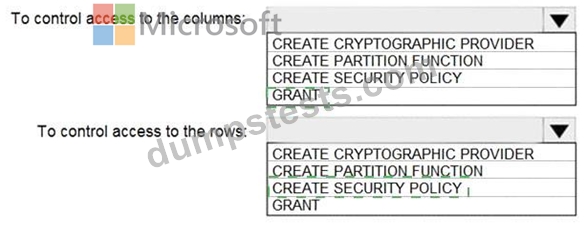
Explanation
Text Description automatically generated
Box 1: GRANT
You can implement column-level security with the GRANT T-SQL statement.
Box 2: CREATE SECURITY POLICY
Implement Row Level Security by using the CREATE SECURITY POLICY Transact-SQL statement Reference:
https://docs.microsoft.com/en-us/azure/synapse-analytics/sql-data-warehouse/column-level-security
NEW QUESTION # 127
You are developing a solution using a Lambda architecture on Microsoft Azure.
The data at test layer must meet the following requirements:
Data storage:
* Serve as a repository (or high volumes of large files in various formats.
* Implement optimized storage for big data analytics workloads.
* Ensure that data can be organized using a hierarchical structure.
Batch processing:
* Use a managed solution for in-memory computation processing.
* Natively support Scala, Python, and R programming languages.
* Provide the ability to resize and terminate the cluster automatically.
Analytical data store:
* Support parallel processing.
* Use columnar storage.
* Support SQL-based languages.
You need to identify the correct technologies to build the Lambda architecture.
Which technologies should you use? To answer, select the appropriate options in the answer area NOTE: Each correct selection is worth one point.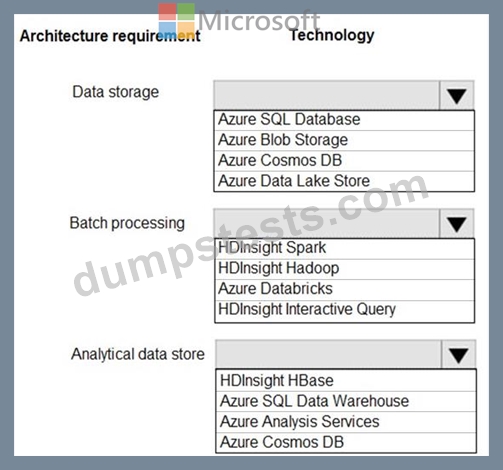
Answer:
Explanation:
Reference:
https://docs.microsoft.com/en-us/azure/storage/blobs/data-lake-storage-namespace
https://docs.microsoft.com/en-us/azure/architecture/data-guide/technology-choices/batch-processing
https://docs.microsoft.com/en-us/azure/sql-data-warehouse/sql-data-warehouse-overview-what-is
NEW QUESTION # 128
You have an Azure Synapse Analytics dedicated SQL pool named SA1 that contains a table named Table1.
You need to identify tables that have a high percentage of deleted rows. What should you run?
- A.

- B.

- C.

- D.

Answer: B
NEW QUESTION # 129
You have an Azure subscription that contains an Azure Data Lake Storage Gen2 account named storage1. Storage1 contains a container named container1. Container1 contains a directory named directory1. Directory1 contains a file named file1.
You have an Azure Active Directory (Azure AD) user named User1 that is assigned the Storage Blob Data Reader role for storage1.
You need to ensure that User1 can append data to file1. The solution must use the principle of least privilege.
Which permissions should you grant? To answer, drag the appropriate permissions to the correct resources. Each permission may be used once, more than once, or not at all. You may need to drag the split bar between panes or scroll to view content.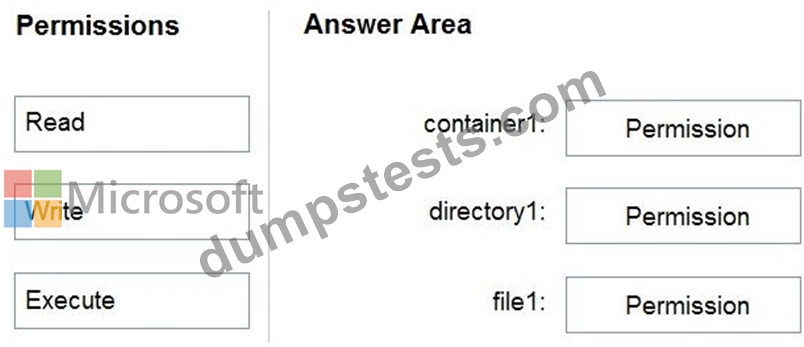
Answer:
Explanation:
Reference:
https://docs.microsoft.com/en-us/azure/storage/blobs/data-lake-storage-access-control
NEW QUESTION # 130
You build an Azure Data Factory pipeline to move data from an Azure Data Lake Storage Gen2 container to a database in an Azure Synapse Analytics dedicated SQL pool.
Data in the container is stored in the following folder structure.
/in/{YYYY}/{MM}/{DD}/{HH}/{mm}
The earliest folder is /in/2021/01/01/00/00. The latest folder is /in/2021/01/15/01/45.
You need to configure a pipeline trigger to meet the following requirements:
Existing data must be loaded.
Data must be loaded every 30 minutes.
Late-arriving data of up to two minutes must he included in the load for the time at which the data should have arrived.
How should you configure the pipeline trigger? To answer, select the appropriate options in the answer area.
NOTE: Each correct selection is worth one point.
Answer:
Explanation:
Reference:
https://docs.microsoft.com/en-us/azure/data-factory/how-to-create-tumbling-window-trigger
NEW QUESTION # 131
You are designing an Azure Synapse Analytics dedicated SQL pool.
Groups will have access to sensitive data in the pool as shown in the following table.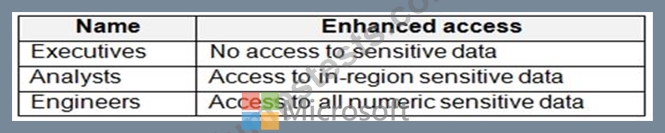
You have policies for the sensitive data. The policies vary be region as shown in the following table.
You have a table of patients for each region. The tables contain the following potentially sensitive columns.
You are designing dynamic data masking to maintain compliance.
For each of the following statements, select Yes if the statement is true. Otherwise, select No.
NOTE: Each correct selection is worth one point.
Answer:
Explanation:
Explanation
Text Description automatically generated
Reference:
https://docs.microsoft.com/en-us/azure/azure-sql/database/dynamic-data-masking-overview
NEW QUESTION # 132
......
Real Microsoft DP-203 Exam Questions [Updated 2026]: https://www.dumpstests.com/DP-203-latest-test-dumps.html
Free DP-203 Exam Dumps to Pass Exam Easily: https://drive.google.com/open?id=1I558kETWC8WYbqTyRP3kkmmfW-AJFvk1