

[Nov 17, 2026] Genuine AZ-204 Exam Dumps New 2026 Microsoft Pratice Exam
New 2026 Realistic AZ-204 Dumps Test Engine Exam Questions in here
To prepare for the AZ-204 exam, candidates should have hands-on experience with Azure services and be familiar with Azure development tools, such as Azure CLI, Azure PowerShell, and Azure SDKs. They should also have a solid understanding of cloud computing principles, including scalability, security, and reliability.
NEW QUESTION # 14
You need to support the requirements for the Shipping Logic App.
What should you use?
- A. Azure Active Directory Application Proxy
- B. Site-to-Site (S2S) VPN connection
- C. On-premises Data Gateway
- D. Point-to-Site (P2S) VPN connection
Answer: C
Explanation:
Explanation
Before you can connect to on-premises data sources from Azure Logic Apps, download and install the on-premises data gateway on a local computer. The gateway works as a bridge that provides quick data transfer and encryption between data sources on premises (not in the cloud) and your logic apps.
The gateway supports BizTalk Server 2016.
Note: Microsoft have now fully incorporated the Azure BizTalk Services capabilities into Logic Apps and Azure App Service Hybrid Connections.
Logic Apps Enterprise Integration pack bring some of the enterprise B2B capabilities like AS2 and X12, EDI standards support Scenario: The Shipping Logic app must meet the following requirements:
* Support the ocean transport and inland transport workflows by using a Logic App.
* Support industry-standard protocol X12 message format for various messages including vessel content details and arrival notices.
* Secure resources to the corporate VNet and use dedicated storage resources with a fixed costing model.
* Maintain on-premises connectivity to support legacy applications and final BizTalk migrations.
Reference:
https://docs.microsoft.com/en-us/azure/logic-apps/logic-apps-gateway-install
NEW QUESTION # 15
You are using Azure Front Door Service.
You are expecting inbound files to be compressed by using Brotli compression. You discover that inbound XML files are not compressed. The files are 9 megabytes (MB) in size.
You need to determine the root cause for the issue.
To answer, select the appropriate options in the answer area.
NOTE: Each correct selection is worth one point.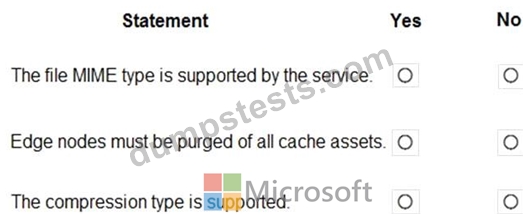
Answer:
Explanation: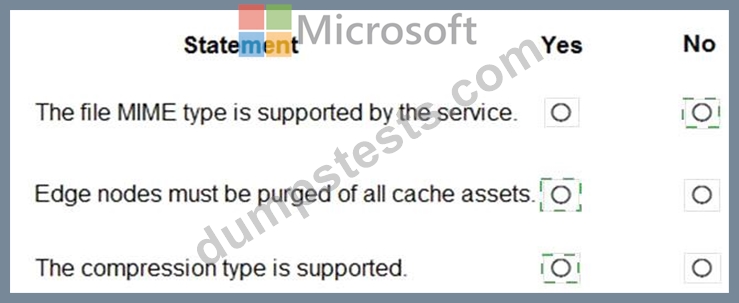
Explanation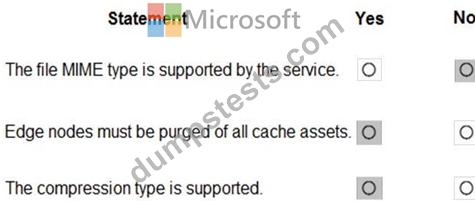
Box 1: No
Front Door can dynamically compress content on the edge, resulting in a smaller and faster response to your clients. All files are eligible for compression. However, a file must be of a MIME type that is eligible for compression list.
Box 2: No
Sometimes you may wish to purge cached content from all edge nodes and force them all to retrieve new updated assets. This might be due to updates to your web application, or to quickly update assets that contain incorrect information.
Box 3: Yes
These profiles support the following compression encodings: Gzip (GNU zip), Brotli Reference:
https://docs.microsoft.com/en-us/azure/frontdoor/front-door-caching
NEW QUESTION # 16
You need to correct the VM issues.
Which tools should you use? To answer, select the appropriate options in the answer area.
NOTE: Each correct selection is worth one point.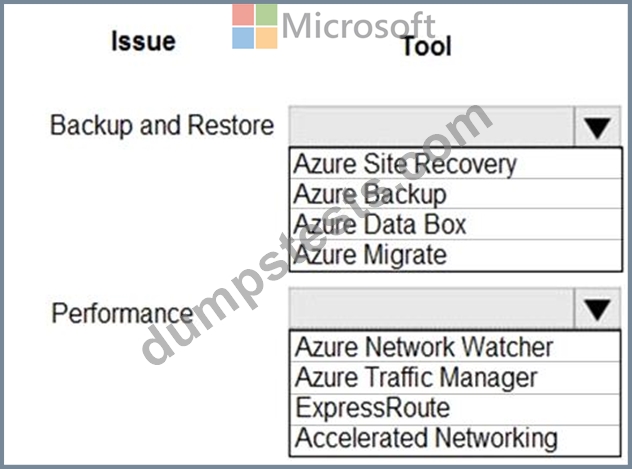
Answer:
Explanation: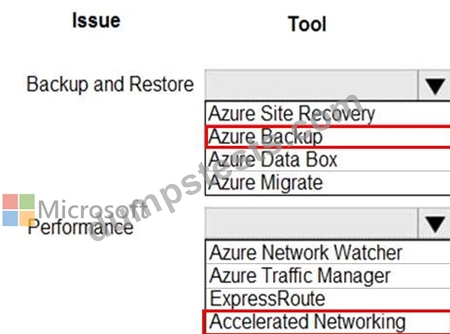
NEW QUESTION # 17
A company runs an international travel and bookings management service. The company plans to begin offering restaurant bookings. You must develop a solution that uses Azure Search and meets the following requirements:
* Users must be able to search for restaurants by name, description, location, and cuisine.
* Users must be able to narrow the results further by location, cuisine, rating, and family-friendliness.
* All words in descriptions must be included in searches.
You need to add annotations to the restaurant class.
How should you complete the code segment? To answer, select the appropriate options in the answer area.
NOTE: Each correct selection is worth one point.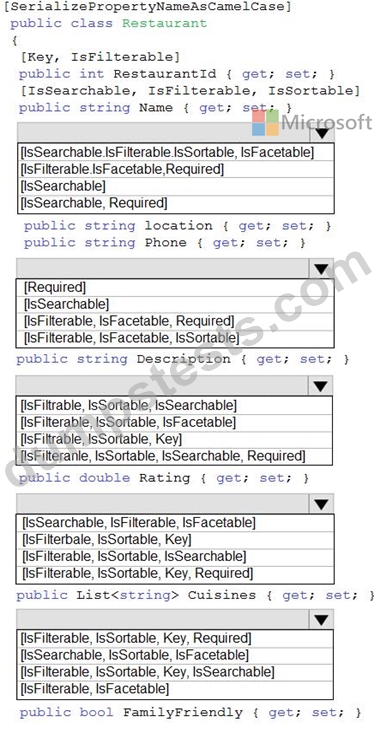
Answer:
Explanation: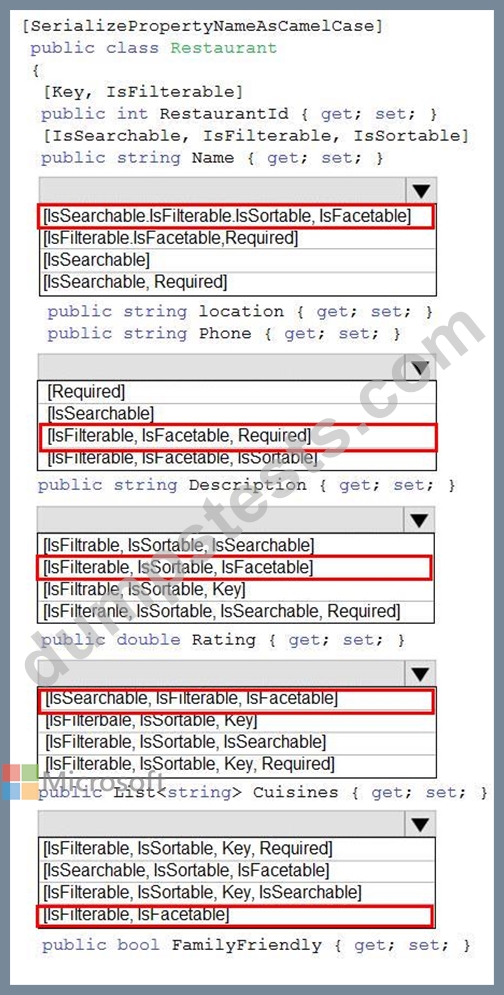
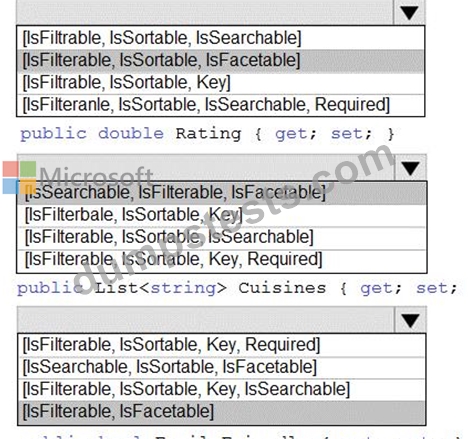
Reference:
https://www.henkboelman.com/azure-search-the-basics/
NEW QUESTION # 18
You develop a web app that uses tier D1 app service plan by using the Web Apps feature of Microsoft Azure App Service.
Spikes in traffic have caused increases in page load times.
You need to ensure that the web app automatically scales when CPU load is about 85 percent and minimize costs.
Which four actions should you perform in sequence? To answer, move the appropriate actions from the list of actions to the answer area and arrange them in the correct order.
NOTE: More than one order of answer choices is correct. You will receive credit for any of the correct orders you select.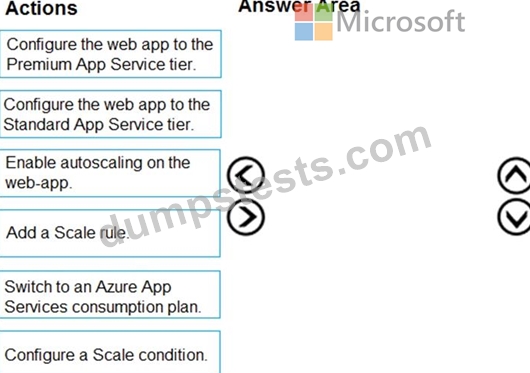
Answer:
Explanation: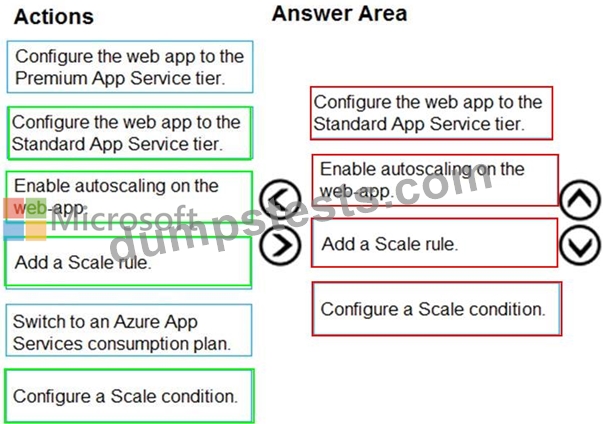
Reference:
https://docs.microsoft.com/en-us/azure/monitoring-and-diagnostics/monitoring-autoscale-get-started
NEW QUESTION # 19
You need to support the message processing for the ocean transport workflow.
Which four actions should you perform in sequence? To answer, move the appropriate actions from the list of actions to the answer area and arrange them in the correct order.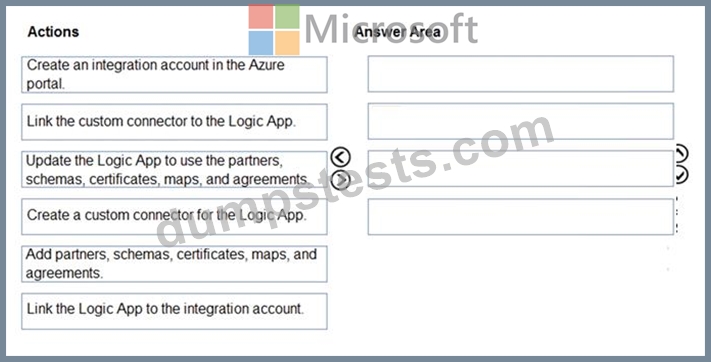
Answer:
Explanation: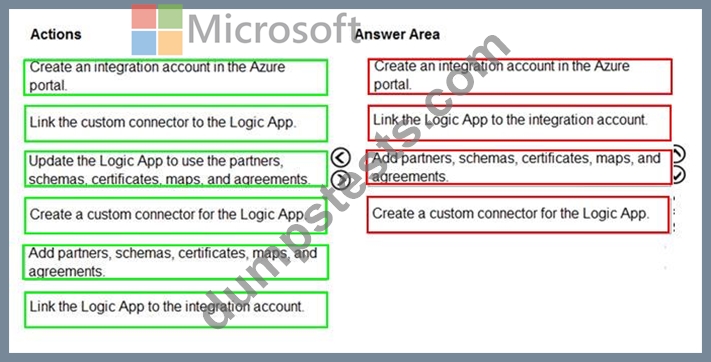
Explanation:
Step 1: Create an integration account in the Azure portal
You can define custom metadata for artifacts in integration accounts and get that metadata during runtime for your logic app to use. For example, you can provide metadata for artifacts, such as partners, agreements, schemas, and maps - all store metadata using key-value pairs.
Step 2: Link the Logic App to the integration account
A logic app that's linked to the integration account and artifact metadata you want to use.
Step 3: Add partners, schemas, certificates, maps, and agreements
Step 4: Create a custom connector for the Logic App.
References:
https://docs.microsoft.com/bs-latn-ba/azure/logic-apps/logic-apps-enterprise-integration-metadata
NEW QUESTION # 20
You have an application that provides weather forecasting data to external partners. You use Azure API Management to publish APIs.
You must change the behavior of the API to meet the following requirements:
* Support alternative input parameters.
* Remove formatting text from responses.
* Provide additional context to back-end services.
Which types of policies should you implement? To answer, drag the policy types to the correct scenarios.
Each policy type may be used once, more than once, or not at all. You may need to drag the split bar between panes or scroll to view content NOTE: Each correct selection is worth one point.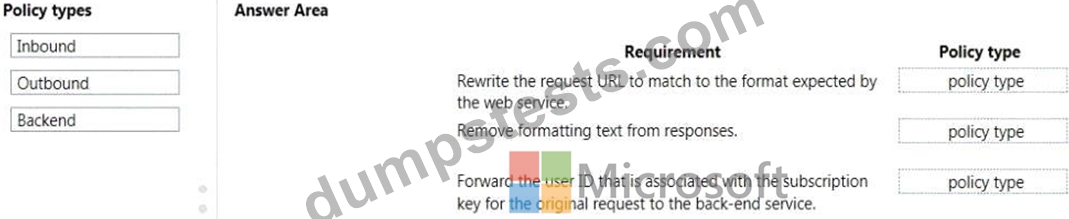
Answer:
Explanation: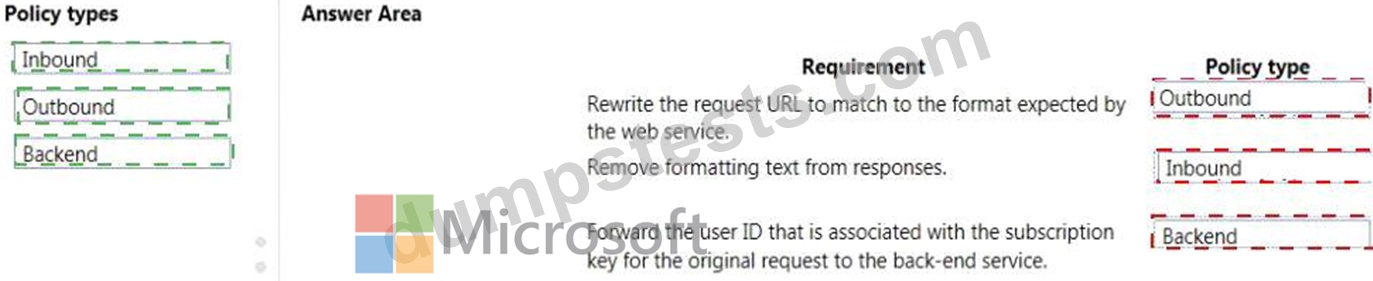
Explanation: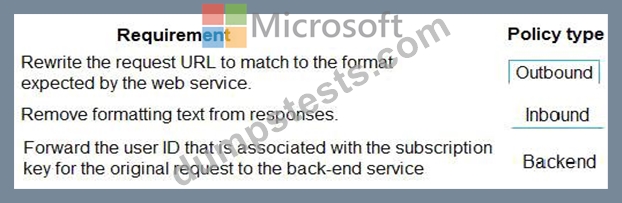
NEW QUESTION # 21
You are developing an Azure Function app.
The app must meet the following requirements:
Enable developers to write the functions by using the Rust language.
Declaratively connect to an Azure Blob Storage account.
You need to implement the app.
Which Azure Function app features should you use? To answer, drag the appropriate features to the correct requirements. Each feature may be used once, more than once, or not at all. You may need to drag the split bar between panes or scroll to view content.
NOTE: Each correct selection is worth one point.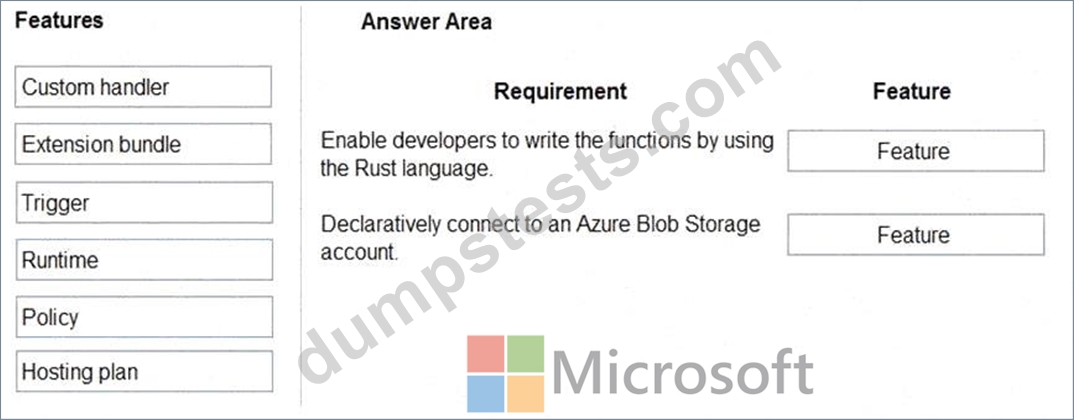
Answer:
Explanation: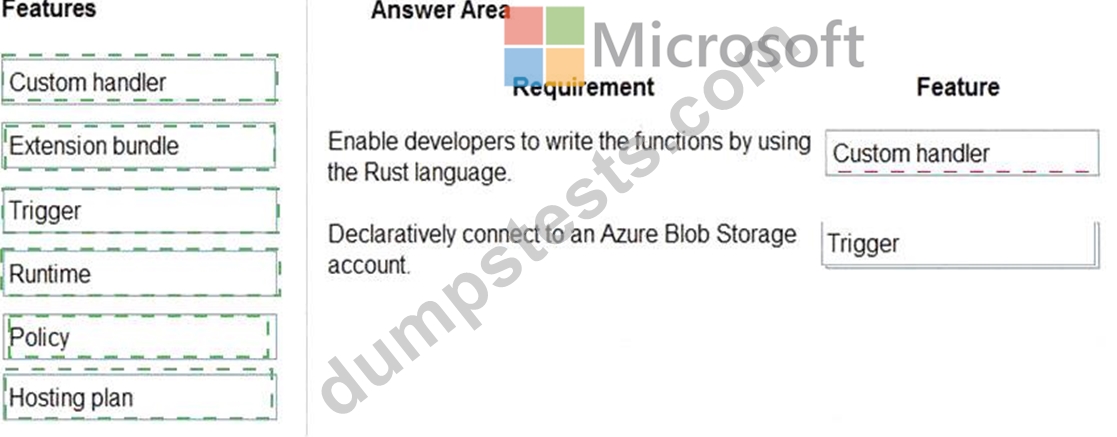
Explanation: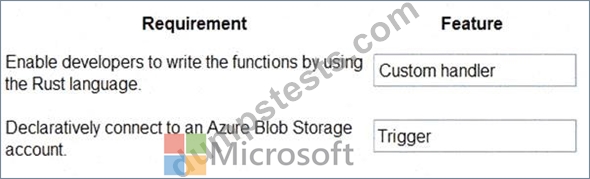
Box 1: Custom handler
Custom handlers can be used to create functions in any language or runtime by running an HTTP server process, for example Go or Rust.
Box 2: Trigger
Functions are invoked by a trigger and can have exactly one. In addition to invoking the function, certain triggers also serve as bindings. You may also define multiple bindings in addition to the trigger. Bindings provide a declarative way to connect data to your code.
Reference:
https://docs.microsoft.com/en-us/azure/azure-functions/create-first-function-vs-code-other
https://docs.microsoft.com/en-us/dotnet/architecture/serverless/azure-functions
NEW QUESTION # 22
Vou are developing a microservice to run on Azure Container Apps for a company. External HTTP ingress traffic has been enabled. The company requires that updates to the microservice must not cause downtime.
You need to deploy an update to the microservice. What should you do?
- A. Use a single environment for all containers.
- B. Use multiple environments for each container.
- C. Enable multiple revision mode.
- D. Use a private container registry and single image for all containers.
- E. Enable single revision mode.
Answer: C
NEW QUESTION # 23
You are developing an application to collect the following telemetry data for delivery drivers: first name, last name, package count, item id, and current location coordinates. The app will store the data in Azure Cosmos DB.
You need to configure Azure Cosmos DB to query the data.
Which values should you use? To answer, select the appropriate options in the answer area.
NOTE: Each correct selection is worth one point.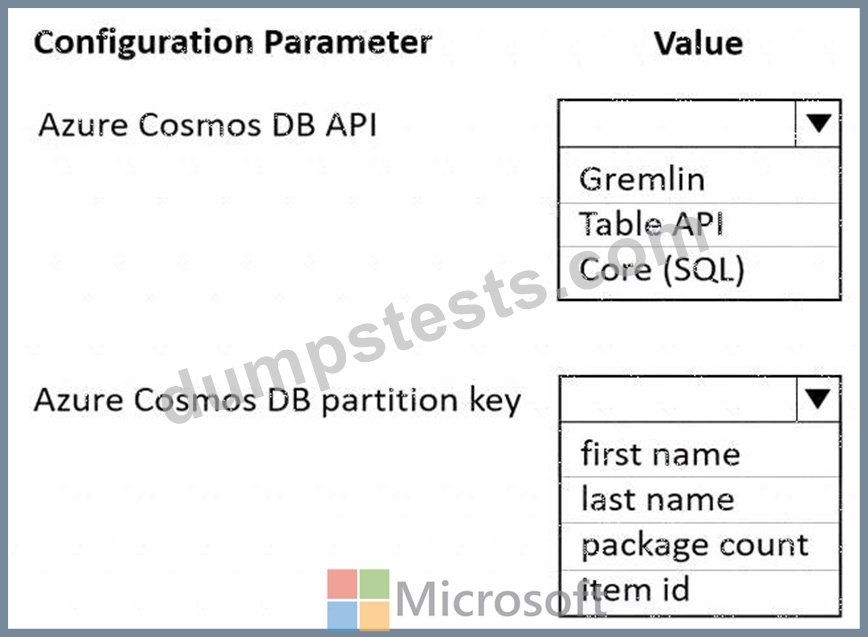
Answer:
Explanation: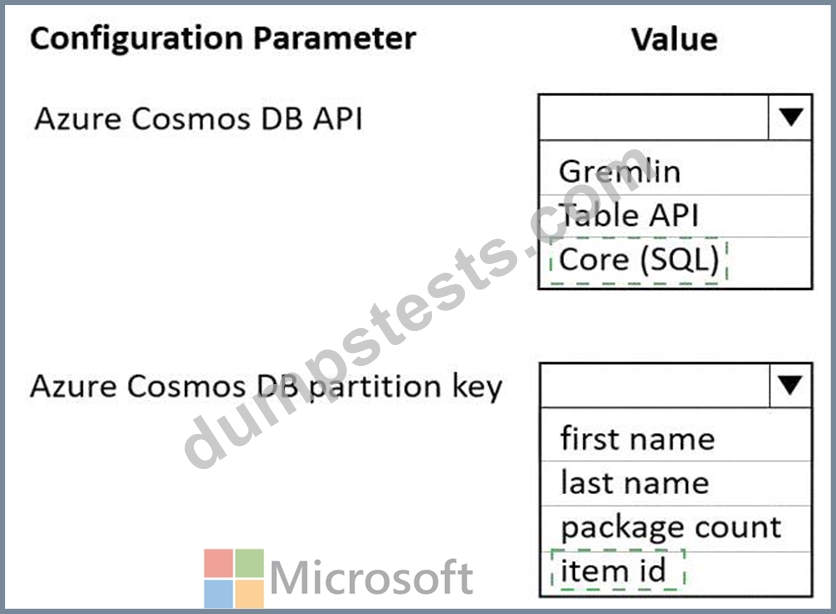
Explanation
Table Description automatically generated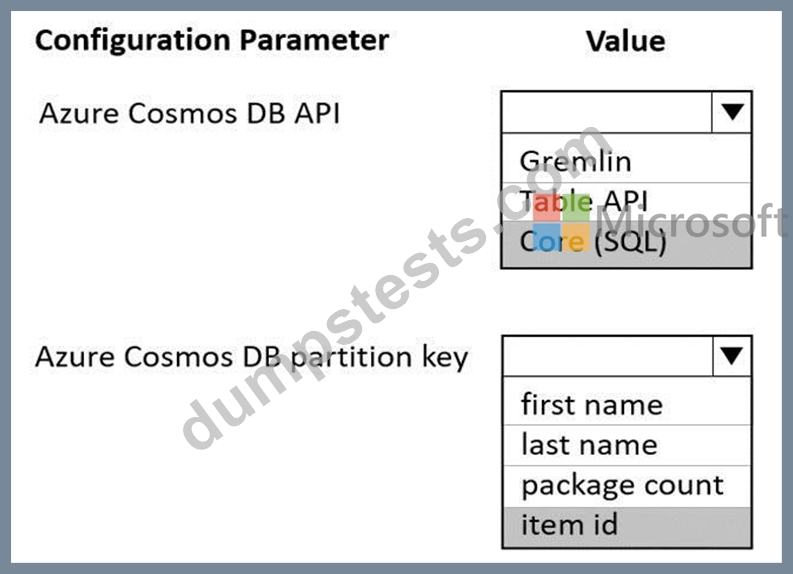
Box 1: Core (SQL)
Core(SQL) API stores data in document format. It offers the best end-to-end experience as we have full control over the interface, service, and the SDK client libraries. SQL API supports analytics and offers performance isolation between operational and analytical workloads.
Box 2: item id
item id is a unique identifier and is suitable for the partition key.
Reference:
https://docs.microsoft.com/en-us/azure/cosmos-db/choose-api
https://docs.microsoft.com/en-us/azure/cosmos-db/partitioning-overview
NEW QUESTION # 24
You are developing an ASP.NET Core website that uses Azure FrontDoor. The website is used to build custom weather data sets for researchers. Data sets are downloaded by users as Comma Separated Value (CSV) files. The data is refreshed every 10 hours.
Specific files must be purged from the FrontDoor cache based upon Response Header values.
You need to purge individual assets from the Front Door cache.
Which type of cache purge should you use?
- A. root domain
- B. single path
- C. wildcard
Answer: B
Explanation:
These formats are supported in the lists of paths to purge:
* Single path purge: Purge individual assets by specifying the full path of the asset (without the protocol and domain), with the file extension, for example, /pictures/strasbourg.png;
* Wildcard purge: Asterisk (*) may be used as a wildcard. Purge all folders, subfolders, and files under an endpoint with /* in the path or purge all subfolders and files under a specific folder by specifying the folder followed by /*, for example, /pictures/*.
* Root domain purge: Purge the root of the endpoint with "/" in the path.
Reference:
https://docs.microsoft.com/en-us/azure/frontdoor/front-door-caching
NEW QUESTION # 25
You are developing an application to use Azure Blob storage. You have configured Azure Blob storage to include change feeds.
A copy of your storage account must be created in another region. Data must be copied from the current storage account to the new storage account directly between the storage servers.
You need to create a copy of the storage account in another region and copy the data.
In which order should you perform the actions? To answer, move all actions from the list of actions to the answer area and arrange them in the correct order.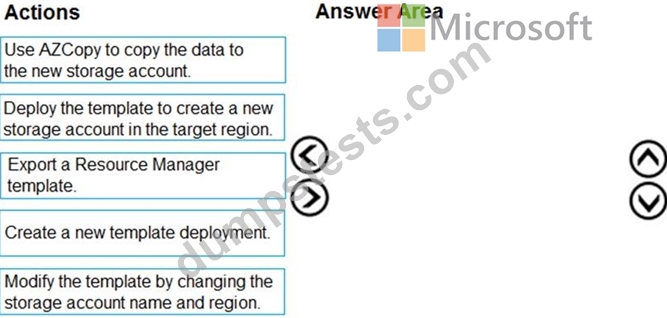
Answer:
Explanation: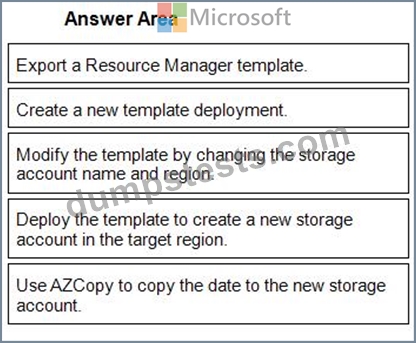
1 - Export a Resource Manager template.
2 - Create a new template deployment.
3 - Modify the template by changing the storage account name and region.
4 - Deploy the template to create a new storage account in the target region.
5 - Use AZCopy to copy the date to the new storage account.
NEW QUESTION # 26
You
are developing an Azure App Service hosted ASP.NET Core web app to deliver video on-demand streaming media. You enable an Azure Content Delivery Network (CDN) Standard for the web endpoint. Customer videos are downloaded from the web app by using the following example URL.:
http://www.contoso.com/content.mp4?quality=1
All media content must expire from the cache after one hour. Customer videos with varying quality must be delivered to the closest regional point of presence (POP) node.
You need to configure Azure CDN caching rules.
Which options should you use? To answer, select the appropriate options in the answer area.
NOTE: Each correct selection is worth one point.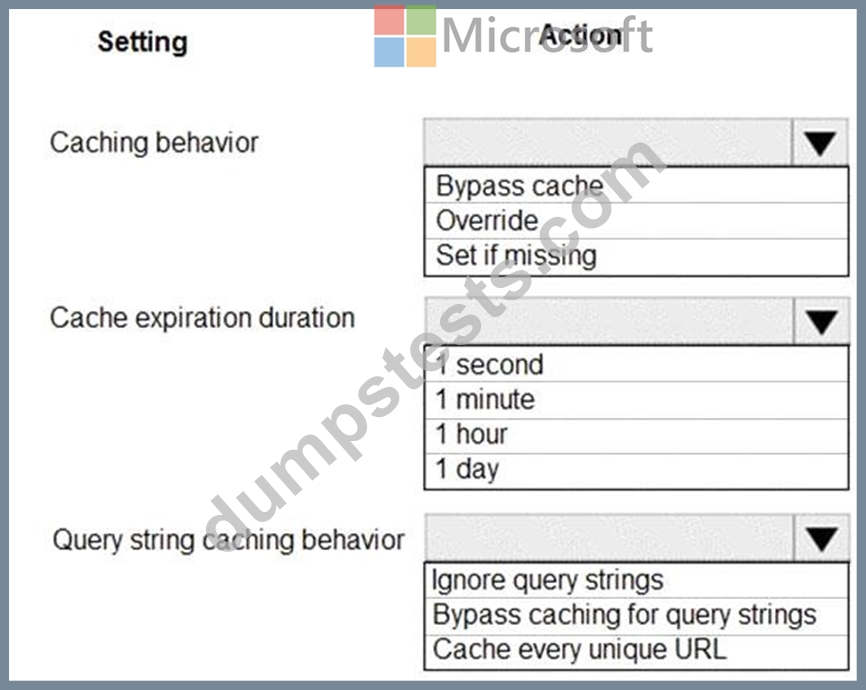
Answer:
Explanation: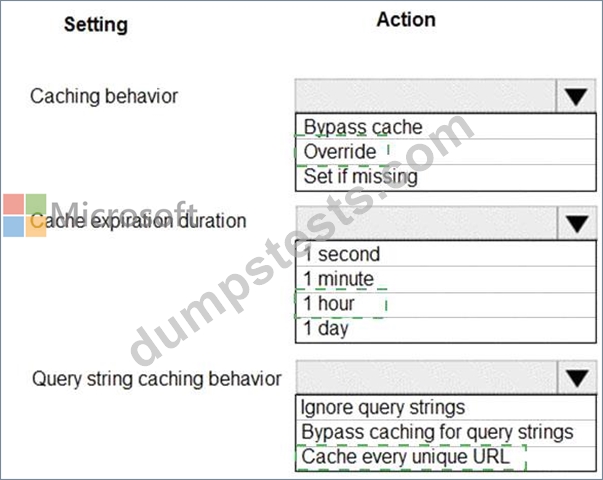
Explanation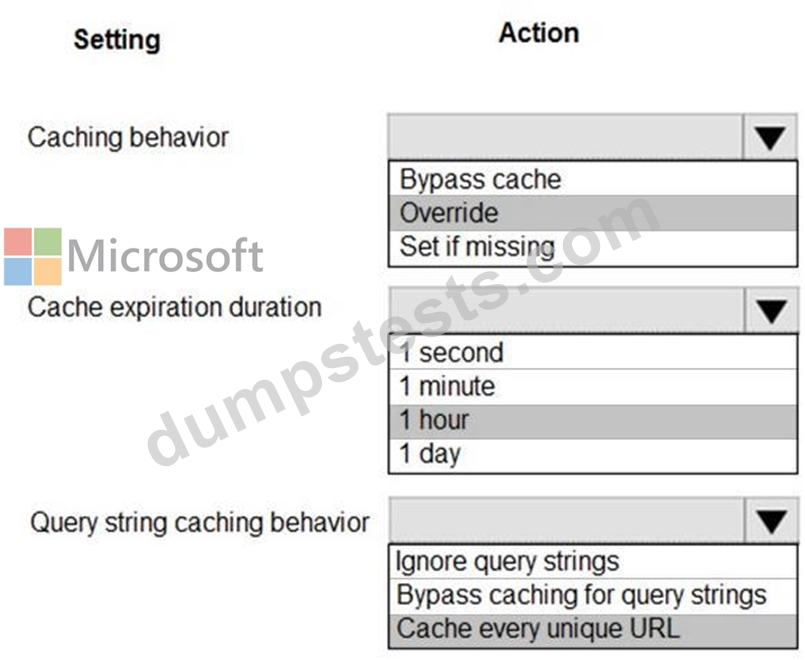
Box 1: Override
Override: Ignore origin-provided cache duration; use the provided cache duration instead. This will not override cache-control: no-cache.
Set if missing: Honor origin-provided cache-directive headers, if they exist; otherwise, use the provided cache duration.
Incorrect:
Bypass cache: Do not cache and ignore origin-provided cache-directive headers.
Box 2: 1 hour
All media content must expire from the cache after one hour.
Box 3: Cache every unique URL
Cache every unique URL: In this mode, each request with a unique URL, including the query string, is treated as a unique asset with its own cache. For example, the response from the origin server for a request for example.ashx?q=test1 is cached at the POP node and returned for subsequent caches with the same query string. A request for example.ashx?q=test2 is cached as a separate asset with its own time-to-live setting.
Reference:
https://docs.microsoft.com/en-us/azure/cdn/cdn-query-string
NEW QUESTION # 27
You
are developing an Azure App Service hosted ASP.NET Core web app to deliver video on-demand streaming media. You enable an Azure Content Delivery Network (CDN) Standard for the web endpoint. Customer videos are downloaded from the web app by using the following example URL.:
http://www.contoso.com/content.mp4?quality=1
All media content must expire from the cache after one hour. Customer videos with varying quality must be delivered to the closest regional point of presence (POP) node.
You need to configure Azure CDN caching rules.
Which options should you use? To answer, select the appropriate options in the answer area.
NOTE: Each correct selection is worth one point.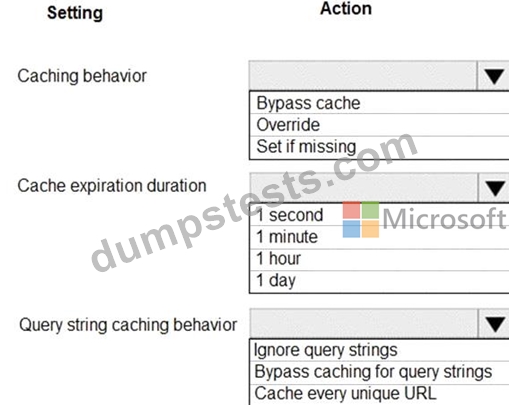
Answer:
Explanation: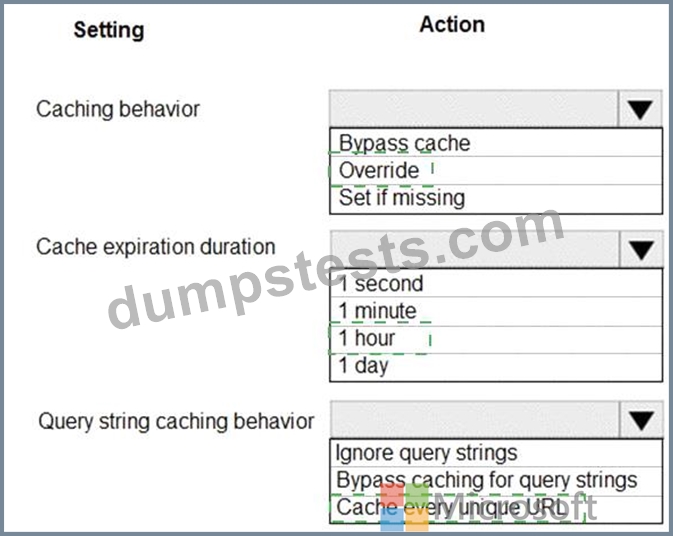
Explanation
Box 1: Override
Override: Ignore origin-provided cache duration; use the provided cache duration instead. This will not override cache-control: no-cache.
Set if missing: Honor origin-provided cache-directive headers, if they exist; otherwise, use the provided cache duration.
Incorrect:
Bypass cache: Do not cache and ignore origin-provided cache-directive headers.
Box 2: 1 hour
All media content must expire from the cache after one hour.
Box 3: Cache every unique URL
Cache every unique URL: In this mode, each request with a unique URL, including the query string, is treated as a unique asset with its own cache. For example, the response from the origin server for a request for example.ashx?q=test1 is cached at the POP node and returned for subsequent caches with the same query string. A request for example.ashx?q=test2 is cached as a separate asset with its own time-to-live setting.
Reference:
https://docs.microsoft.com/en-us/azure/cdn/cdn-query-string
NEW QUESTION # 28
You develop an application. You plan to host the application on a set of virtual machines (VMs) in Azure.
You need to configure Azure Monitor to collect logs from the application.
Which four actions should you perform in sequence? To answer, move the appropriate actions from the list of actions to the answer area and arrange them in the correct order.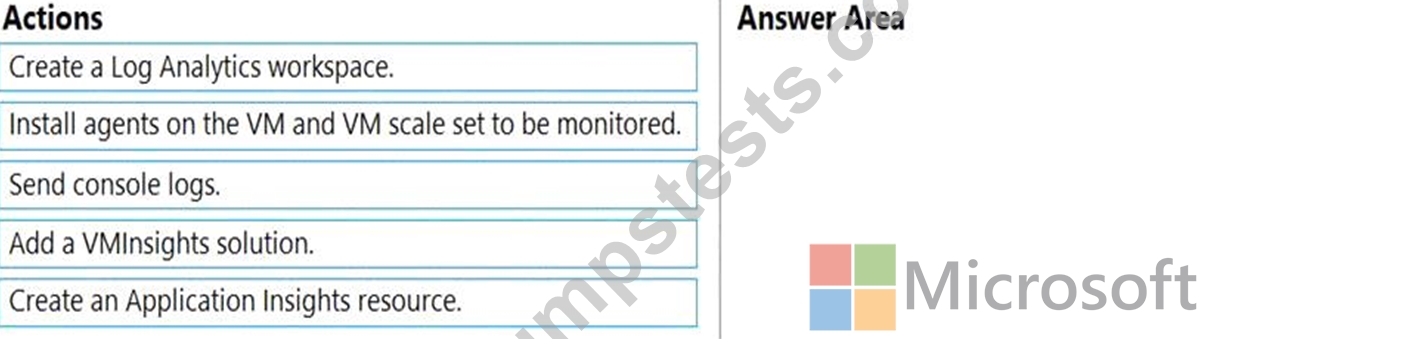
Answer:
Explanation: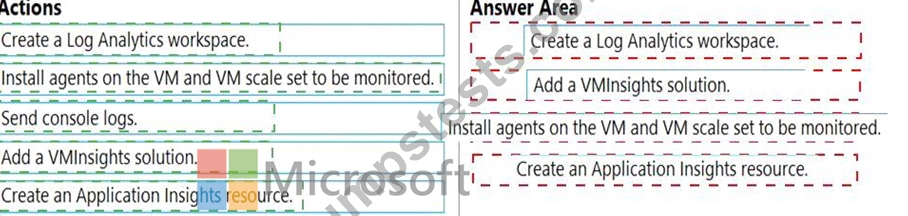
Explanation
Graphical user interface, text, application Description automatically generated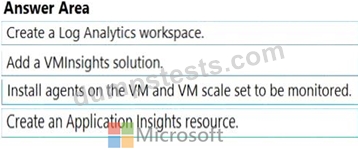
Step 1: Create a Log Analytics workspace.
First create the workspace.
Step 2: Add a VMInsights solution.
Before a Log Analytics workspace can be used with VM insights, it must have the VMInsights solution installed.
Step 3: Install agents on the VM and VM scale set to be monitored.
Prior to onboarding agents, you must create and configure a workspace. Install or update the Application Insights Agent as an extension for Azure virtual machines and VM scalet sets.
Step 4: Create an Application Insights resource
Sign in to the Azure portal, and create an Application Insights resource.
Graphical user interface, application, Word Description automatically generated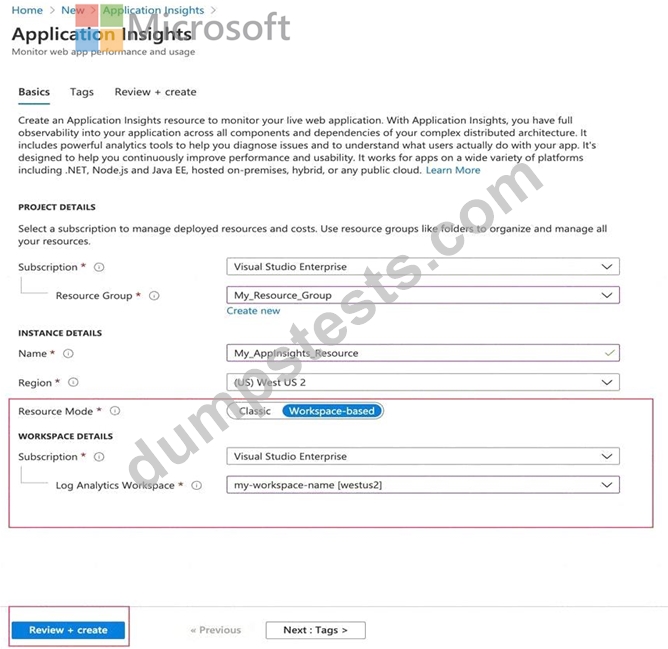
Once a workspace-based Application Insights resource has been created, configuring monitoring is relatively straightforward.
Reference:
https://docs.microsoft.com/en-us/azure/azure-monitor/vm/vminsights-configure-workspace
https://docs.microsoft.com/en-us/azure/azure-monitor/app/create-workspace-resource
NEW QUESTION # 29
You are configuring a new development environment for a Java application.
The environment requires a Virtual Machine Scale Set (VMSS), several storage accounts, and networking components.
The VMSS must not be created until the storage accounts have been successfully created and an associated load balancer and virtual network is configured.
How should you complete the Azure Resource Manager template? To answer, select the appropriate options in the answer area.
NOTE: Each correct selection is worth one point.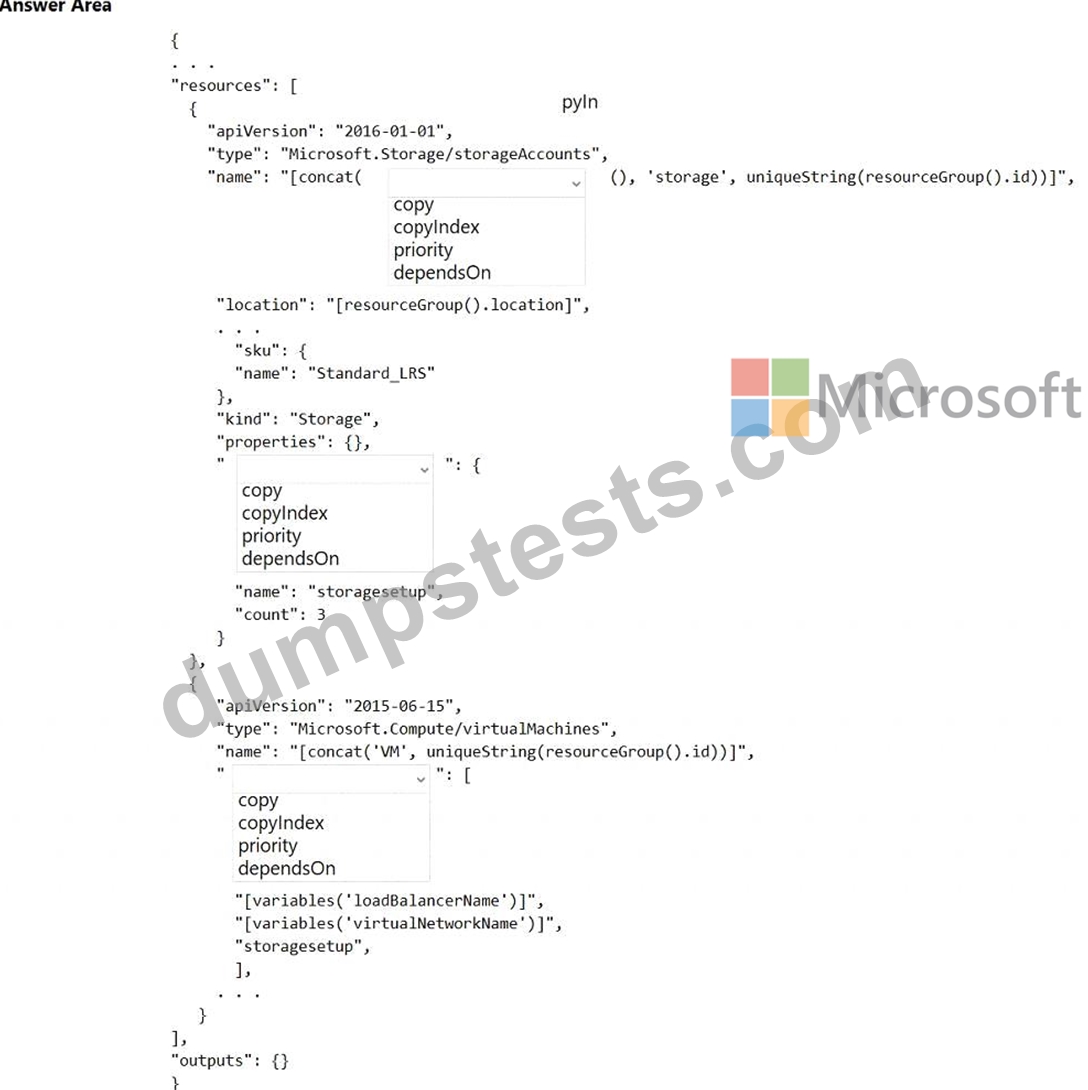
Answer:
Explanation: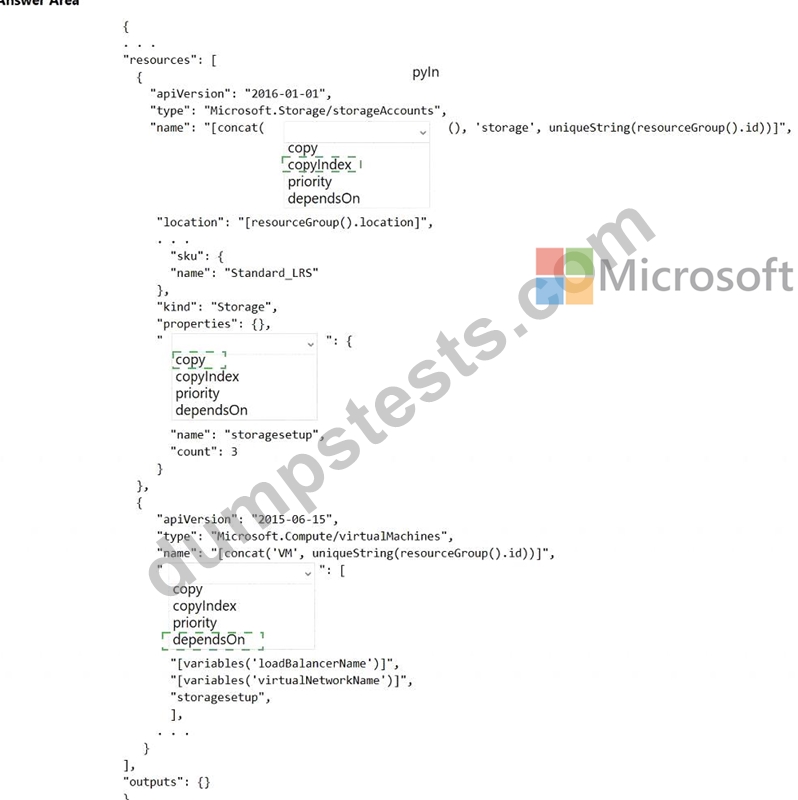
Explanation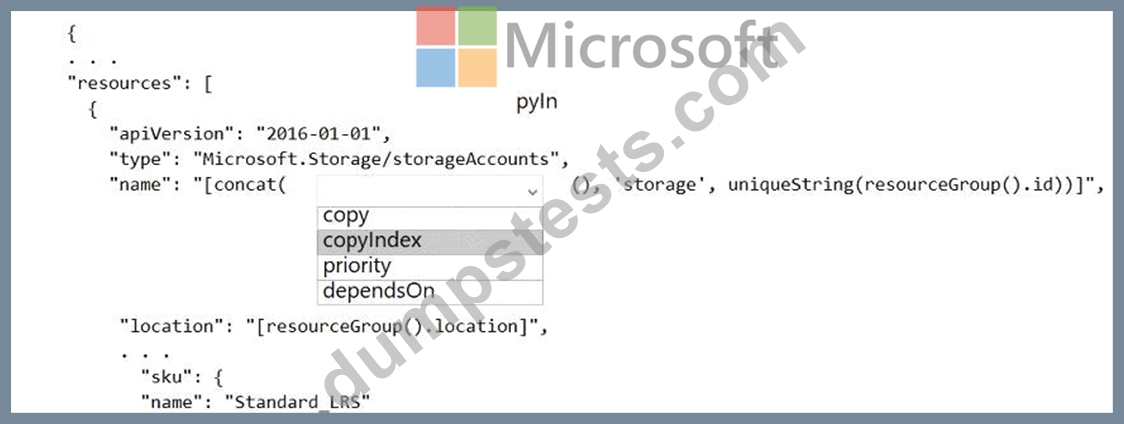
Box 1: copyIndex
Notice that the name of each resource includes the copyIndex() function, which returns the current iteration in the loop. copyIndex() is zero-based.
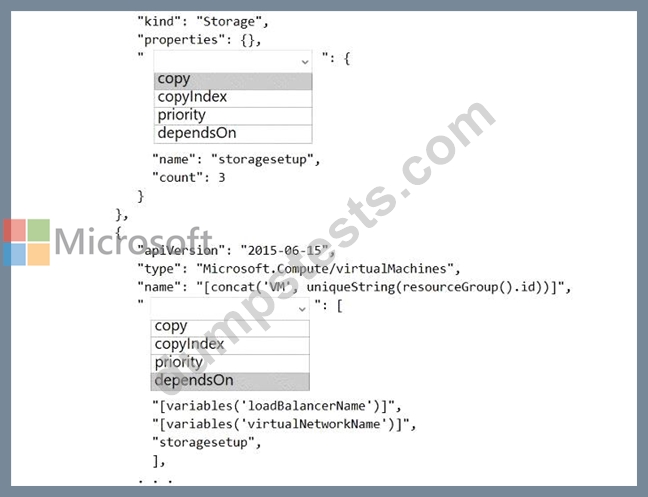
Box 2: copy
By adding the copy element to the resources section of your template, you can dynamically set the number of resources to deploy.
Box 3: dependsOn
Example:
"type": "Microsoft.Compute/virtualMachineScaleSets",
"apiVersion": "2020-06-01",
"name": "[variables('namingInfix')]",
"location": "[parameters('location')]",
"sku": {
"name": "[parameters('vmSku')]",
"tier": "Standard",
"capacity": "[parameters('instanceCount')]"
},
"dependsOn": [
"[resourceId('Microsoft.Network/loadBalancers', variables('loadBalancerName'))]",
"[resourceId('Microsoft.Network/virtualNetworks', variables('virtualNetworkName'))]"
],
Reference:
https://docs.microsoft.com/en-us/azure/azure-resource-manager/templates/copy-resources
https://docs.microsoft.com/en-us/azure/virtual-machine-scale-sets/quick-create-template-windows
NEW QUESTION # 30
You need to implement the Log policy.
How should you complete the EnsureLogging method in EventGridController.cs? To answer, select the appropriate options in the answer area.
NOTE: Each correct selection is worth one point.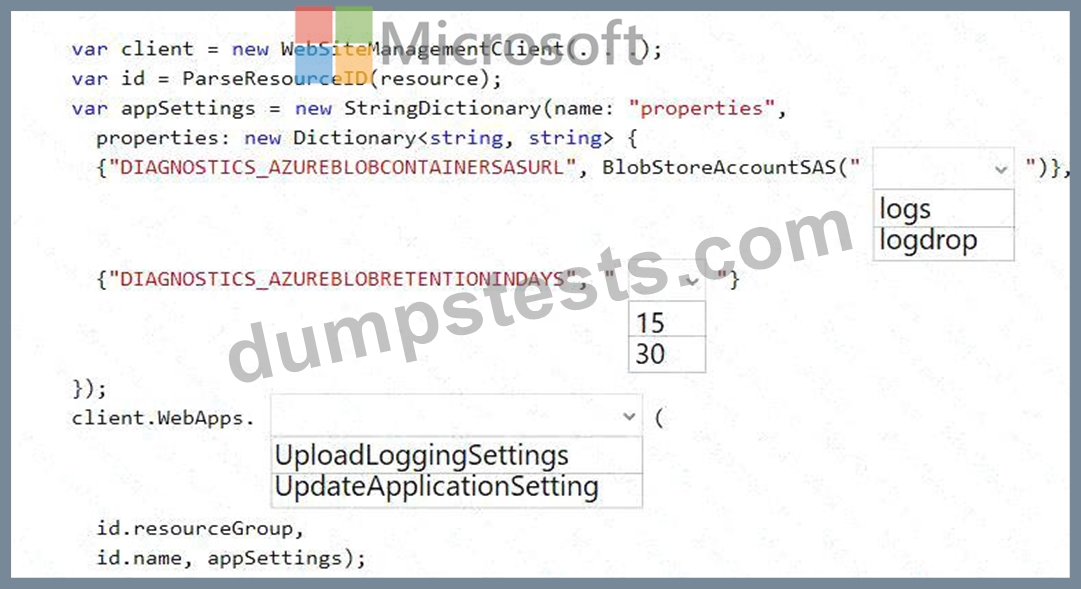
Answer:
Explanation: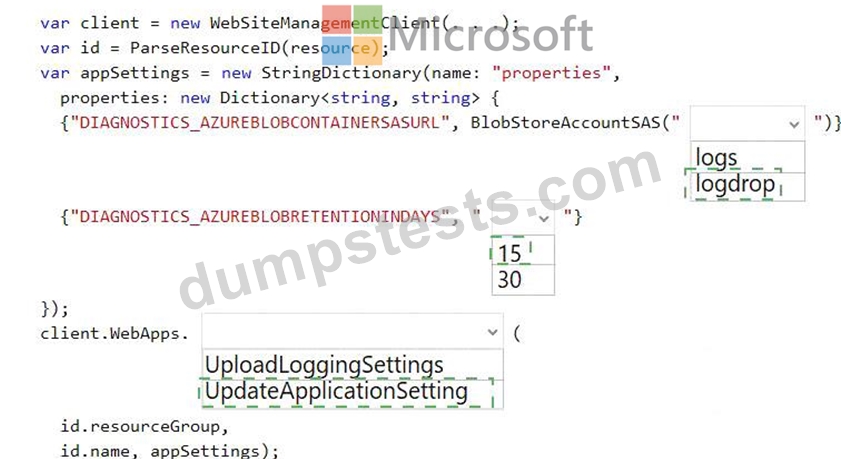
Explanation: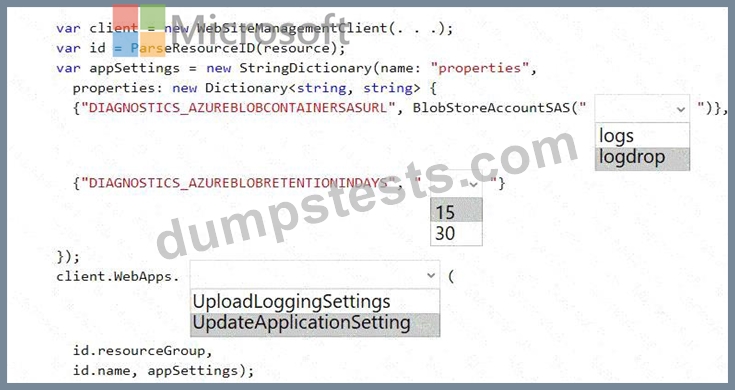
Box 1: logdrop
All log files should be saved to a container named logdrop.
Box 2: 15
Logs must remain in the container for 15 days.
Box 3: UpdateApplicationSettings
All Azure App Service Web Apps must write logs to Azure Blob storage.
Reference:
https://blog.hompus.nl/2017/05/29/adding-application-logging-blob-to-a-azure-web-app-service-using- powershell/
NEW QUESTION # 31
An organization deploys a Mob storage account. Users take multiple snapshots of the blob storage account over time.
You need to delete all snapshots or the blob storage account. You must not delete the blob storage account itself.
How should you complete the code segment? To answer select the appropriate options in the answer area.
NOTE: Each correct selection is worth one point.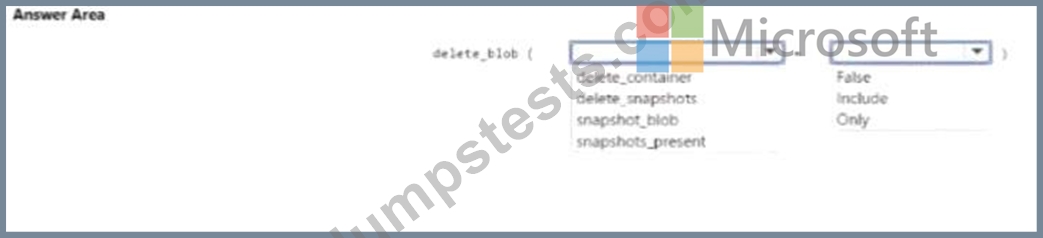
Answer:
Explanation: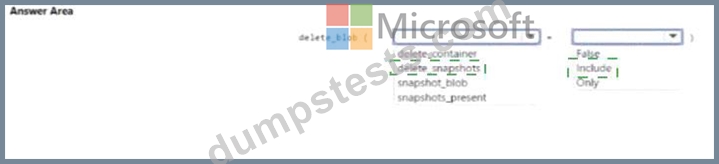
Explanation: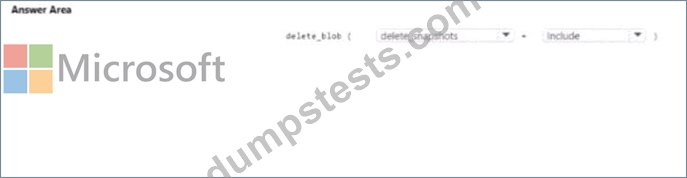
NEW QUESTION # 32
You need to configure the Account Kind, Replication, and Storage tier options for the corporate website's Azure Storage account.
How should you complete the configuration? To answer, select the appropriate options in the dialog box in the answer area.
NOTE: Each correct selection is worth one point.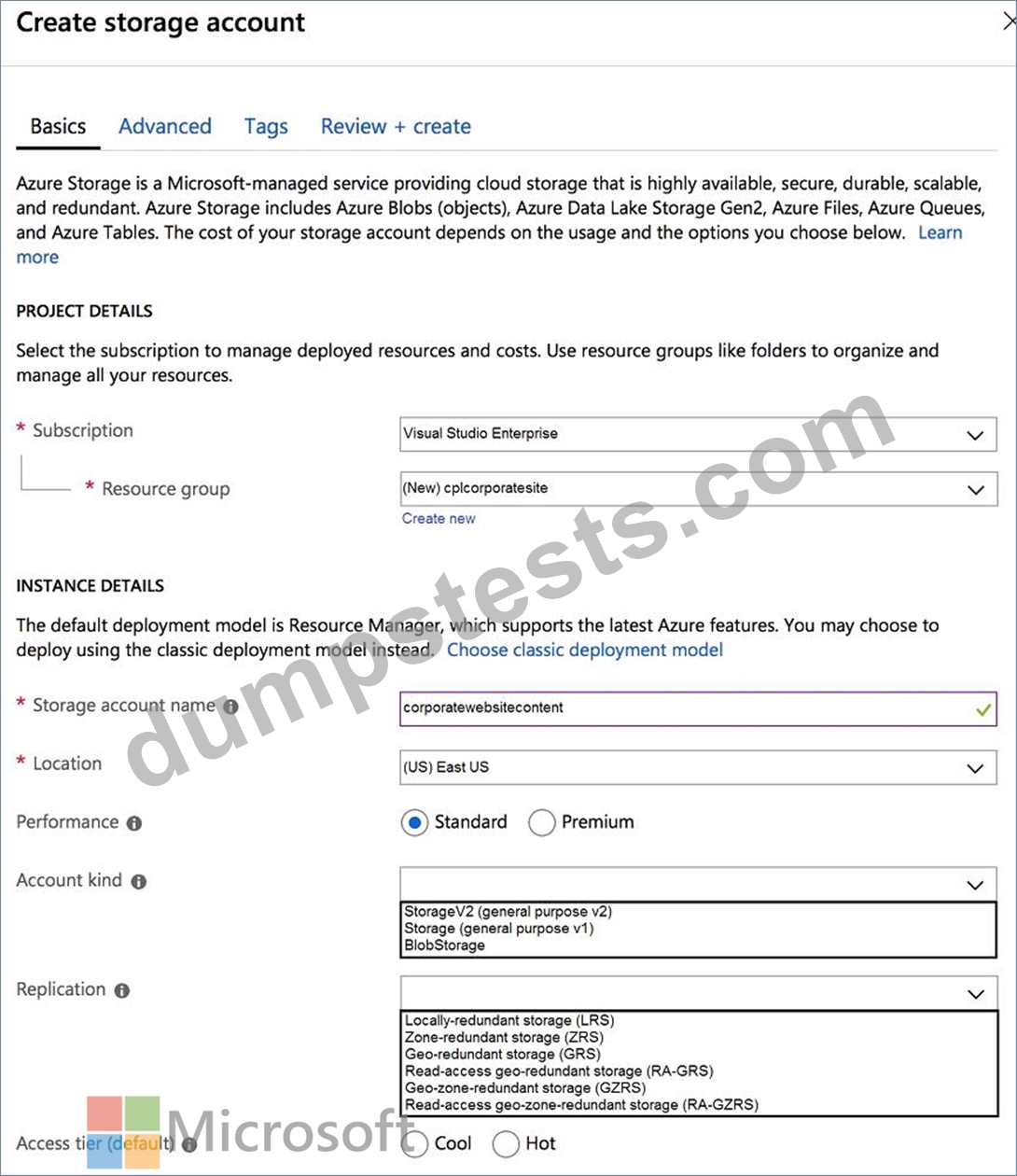
Answer:
Explanation: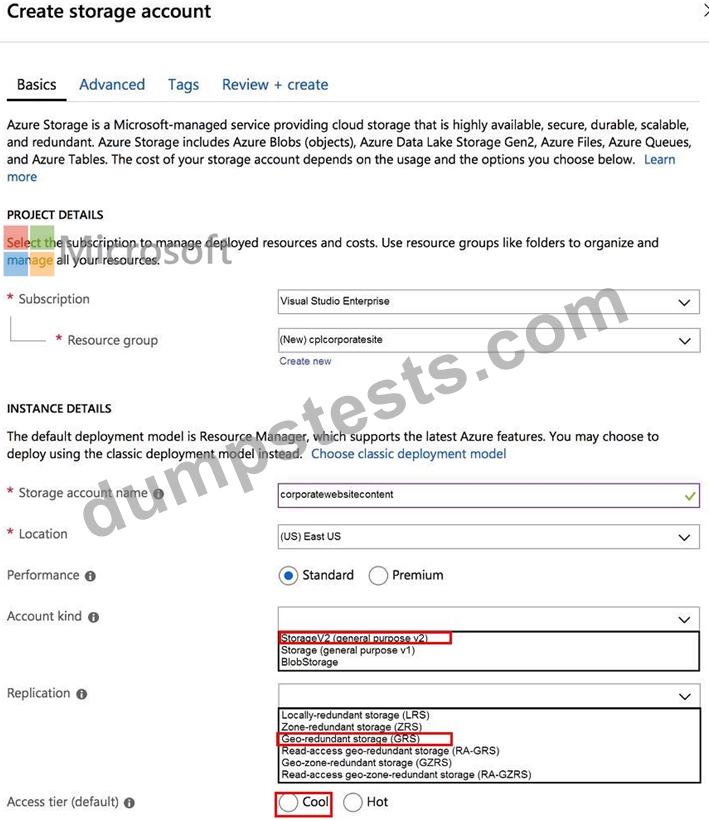
Reference:
https://docs.microsoft.com/en-us/azure/storage/common/storage-account-overview
https://docs.microsoft.com/en-us/azure/storage/common/storage-redundancy
https://docs.microsoft.com/en-us/azure/storage/blobs/storage-blob-storage-tiers?tabs=azure-portal
NEW QUESTION # 33
You have an Azure Batch project that processes and converts files and stores the files in Azure storage. You are developing a function to start the batch job.
You add the following parameters to the function.
You must ensure that converted files are placed in the container referenced by the outputContainerSasUrl parameter. Files which fail to convert are places in the container referenced by the failedContainerSasUrl parameter.
You need to ensure the files are correctly processed.
How should you complete the code segment? To answer, select the appropriate options in the answer area.
NOTE: Each correct selection is worth one point.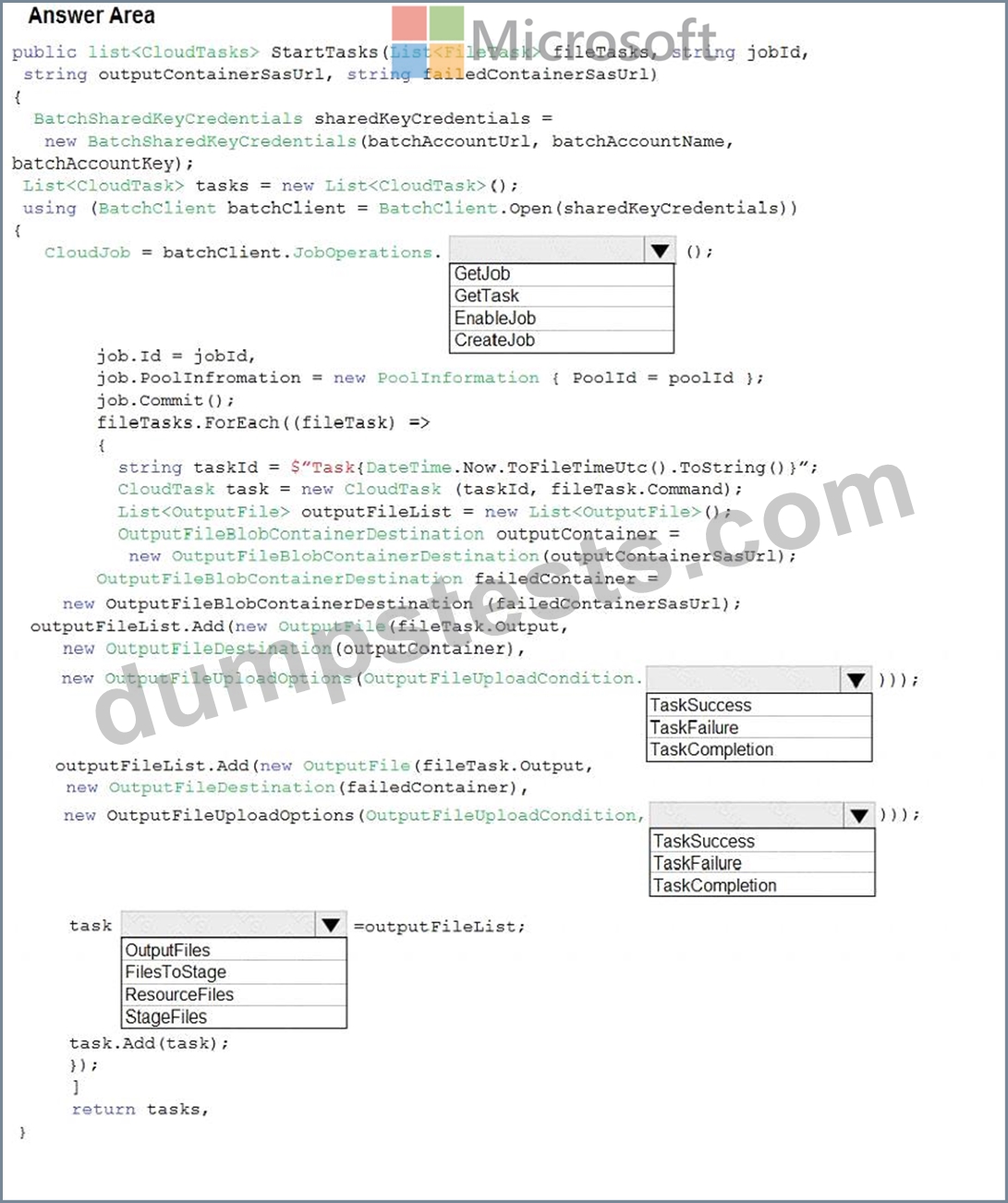
Answer:
Explanation: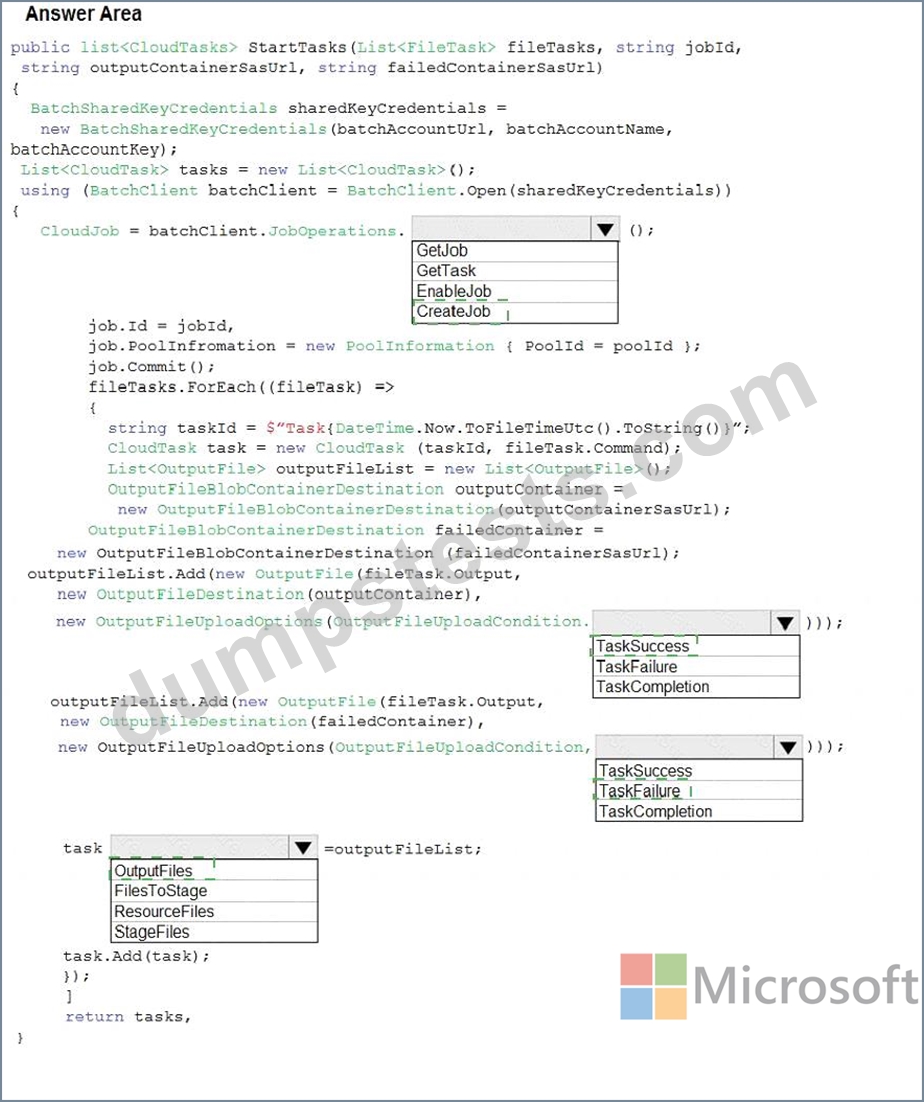
Explanation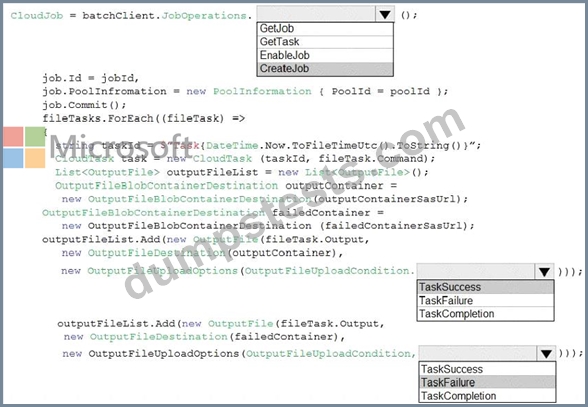
Box 1: CreateJob
Box 2: TaskSuccess
TaskSuccess: Upload the file(s) only after the task process exits with an exit code of 0.
Incorrect: TaskCompletion: Upload the file(s) after the task process exits, no matter what the exit code was.
Box 3: TaskFailure
TaskFailure:Upload the file(s) only after the task process exits with a nonzero exit code.
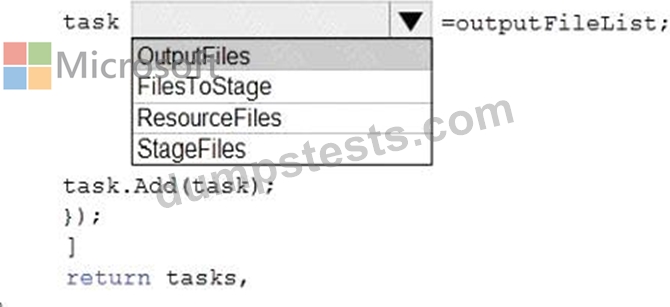
Box 4: OutputFiles
To specify output files for a task, create a collection of OutputFile objects and assign it to the CloudTask.OutputFiles property when you create the task.
References:
https://docs.microsoft.com/en-us/dotnet/api/microsoft.azure.batch.protocol.models.outputfileuploadcondition
https://docs.microsoft.com/en-us/azure/batch/batch-task-output-files
NEW QUESTION # 34
You are preparing to deploy a Python website to an Azure Web App using a container. The solution will use multiple containers in the same container group. The Dockerfile that builds the container is as follows: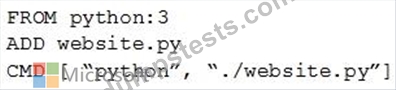
You build a container by using the following command. The Azure Container Registry instance named images is a private registry.
The user name and password for the registry is admin.
The Web App must always run the same version of the website regardless of future builds.
You need to create an Azure Web App to run the website.
How should you complete the commands? To answer, select the appropriate options in the answer area.
NOTE: Each correct selection is worth one point.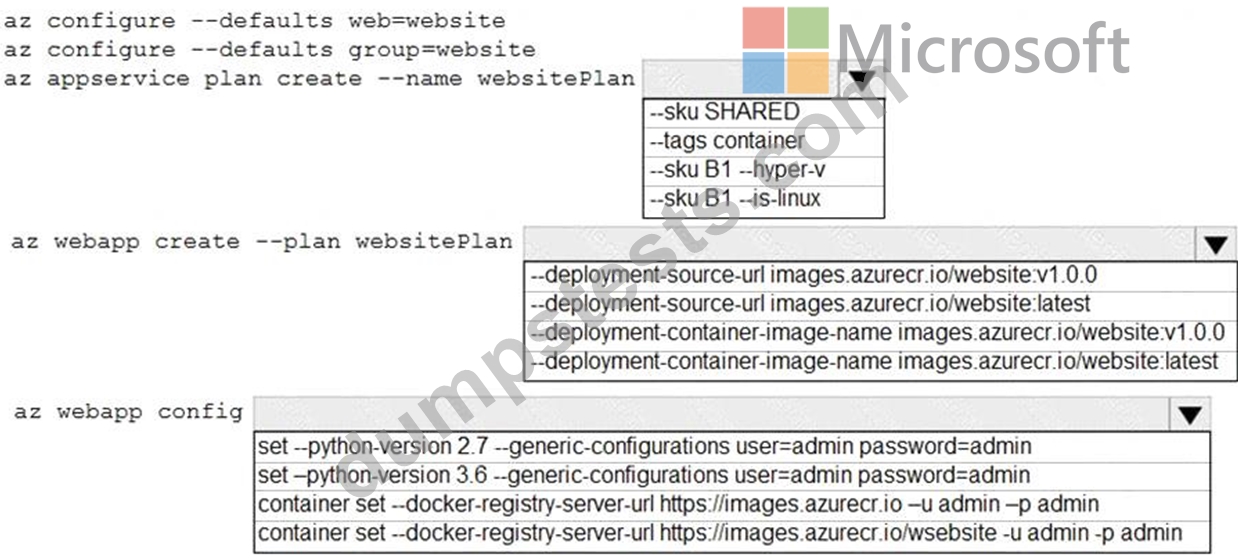
Answer:
Explanation: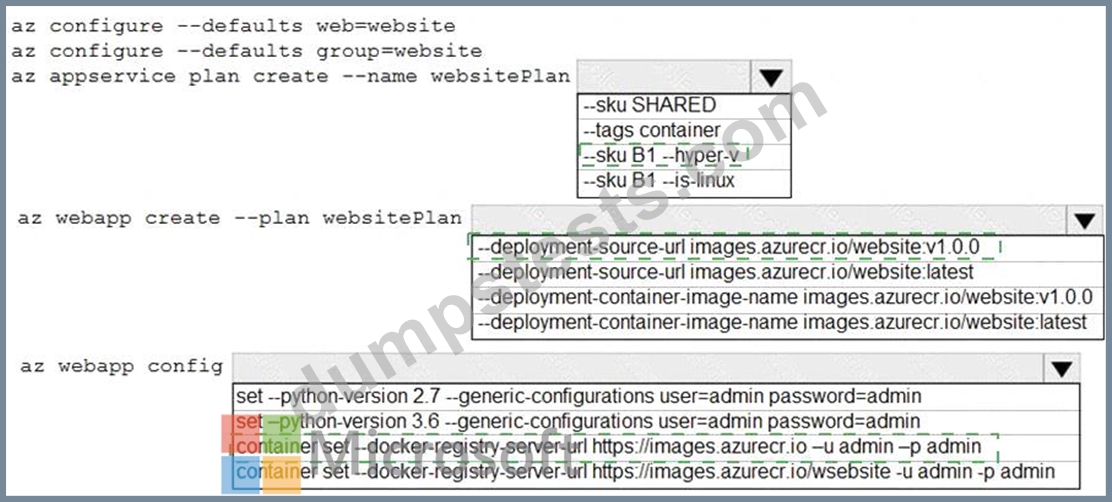
Explanation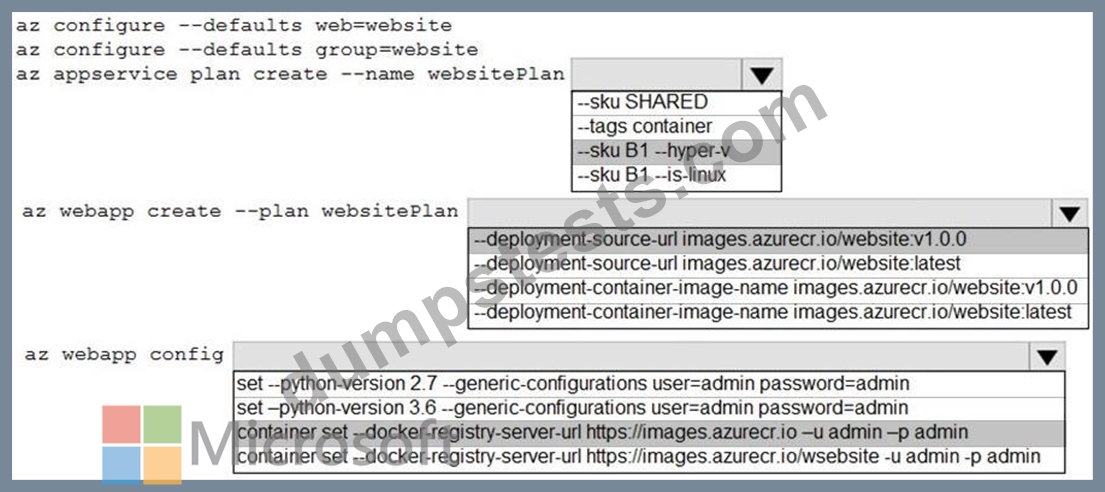
Box 1: --SKU B1 --hyper-v
--hyper-v
Host web app on Windows container.
Box 2: --deployment-source-url images.azurecr.io/website:v1.0.0
--deployment-source-url -u
Git repository URL to link with manual integration.
The Web App must always run the same version of the website regardless of future builds.
Incorrect:
--deployment-container-image-name -i
Linux only. Container image name from Docker Hub, e.g. publisher/image-name:tag.
Box 3: az webapp config container set -url https://images.azurecr.io -u admin -p admin az webapp config container set Set a web app container's settings.
Paremeter: --docker-registry-server-url -r
The container registry server url.
The Azure Container Registry instance named images is a private registry.
Example:
az webapp config container set --docker-registry-server-url https://{azure-container-registry-name}.azurecr.io Reference:
https://docs.microsoft.com/en-us/cli/azure/appservice/plan
NEW QUESTION # 35
You are developing an application to retrieve user profile information. The application will use the Microsoft Graph SDK.
The app must retrieve user profile information by using a Microsoft Graph API call.
You need to call the Microsoft Graph API from the application.
In which order should you perform the actions? To answer, move all actions from the list of actions to the answer area and arrange them in the correct order.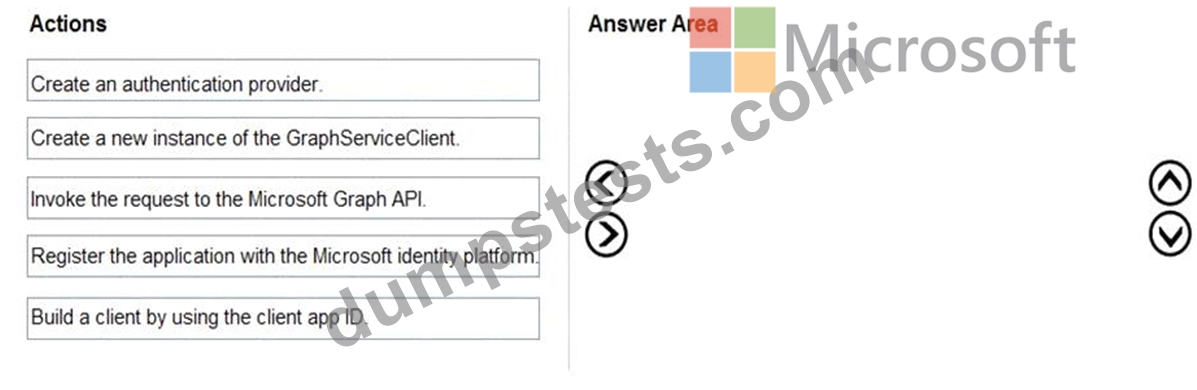
Answer:
Explanation: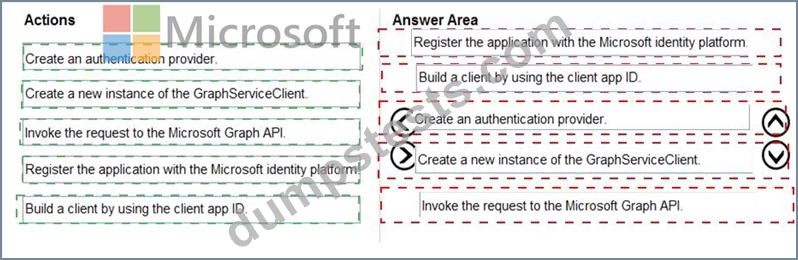
Explanation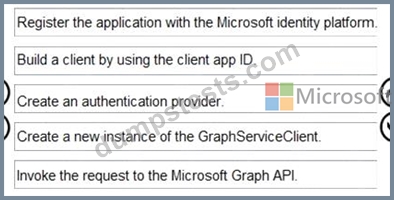
Table Description automatically generated
Step 1: Register the application with the Microsoft identity platform.
To authenticate with the Microsoft identity platform endpoint, you must first register your app at the Azure app registration portal Step 2: Build a client by using the client app ID Step 3: Create an authentication provider Create an authentication provider by passing in a client application and graph scopes.
Code example:
DeviceCodeProvider authProvider = new DeviceCodeProvider(publicClientApplication, graphScopes);
// Create a new instance of GraphServiceClient with the authentication provider.
GraphServiceClient graphClient = new GraphServiceClient(authProvider);
Step 4: Create a new instance of the GraphServiceClient
Step 5: Invoke the request to the Microsoft Graph API
Reference:
https://docs.microsoft.com/en-us/graph/auth-v2-service
https://docs.microsoft.com/en-us/graph/sdks/create-client
NEW QUESTION # 36
You develop a web application.
You need to register the application with an active Azure Active Directory (Azure AD) tenant.
Which three actions should you perform in sequence? To answer, move all actions from the list of actions to the answer area and arrange them in the correct order.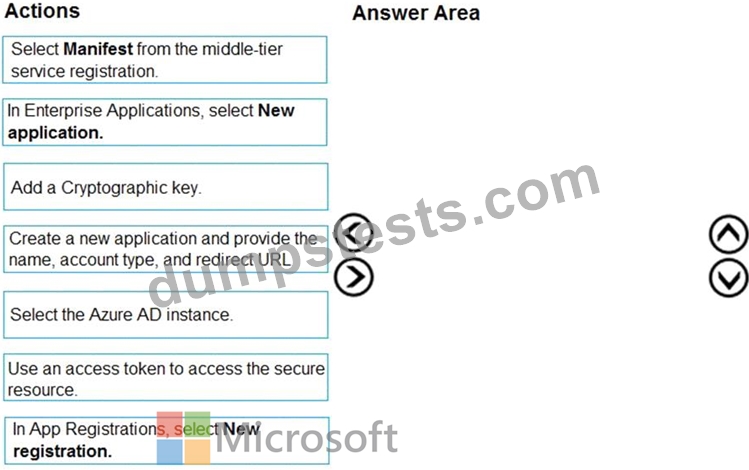
Answer:
Explanation: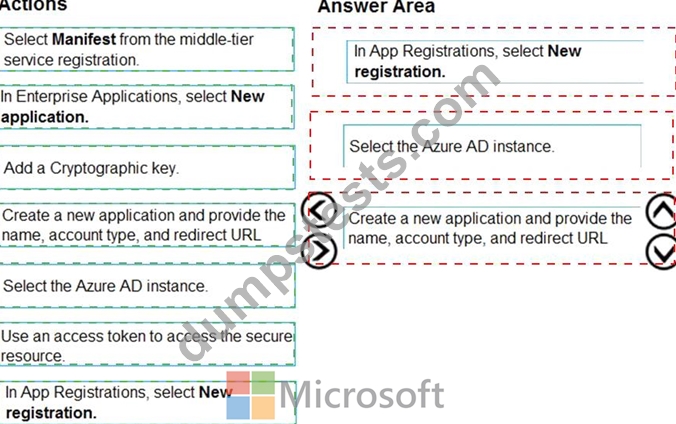
Explanation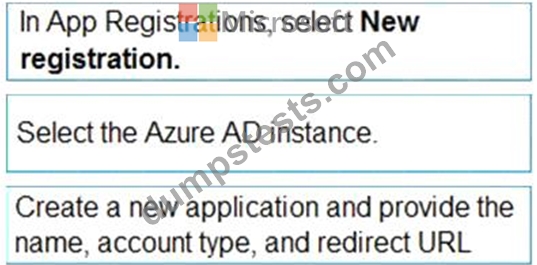
Register a new application using the Azure portal
Sign in to the Azure portal using either a work or school account or a personal Microsoft account.
If your account gives you access to more than one tenant, select your account in the upper right corner.
Set your portal session to the Azure AD tenant that you want.
Search for and select Azure Active Directory. Under Manage, select App registrations.
Select New registration. (Step 1)
In Register an application, enter a meaningful application name to display to users.
Specify who can use the application. Select the Azure AD instance. (Step 2) Under Redirect URI (optional), select the type of app you're building: Web or Public client (mobile & desktop). Then enter the redirect URI, or reply URL, for your application. (Step 3) When finished, select Register.
NEW QUESTION # 37
You are developing a new page for a website that uses Azure Cosmos DB for data storage. The feature uses documents that have the following format: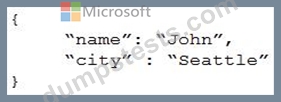
You must display data for the new page in a specific order. You create the following query for the page:
You need to configure a Cosmos DB policy to the support the query.
How should you configure the policy? To answer, drag the appropriate JSON segments to the correct locations. Each JSON segment may be used once, more than once, or not at all. You may need to drag the split bar between panes or scroll to view content.
NOTE: Each correct selection is worth one point.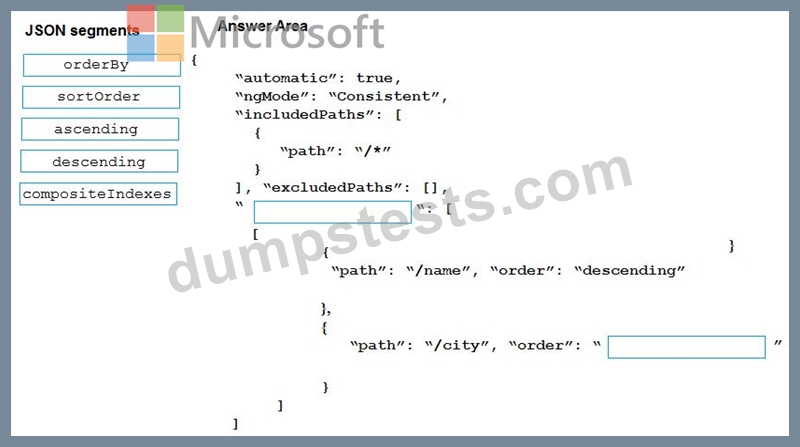
Answer:
Explanation: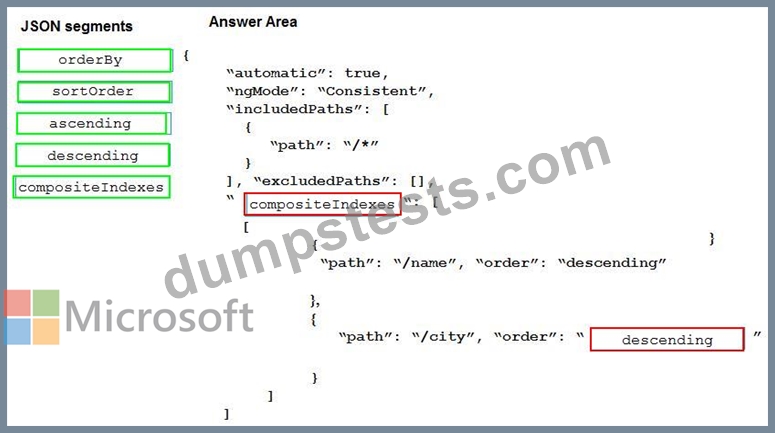
NEW QUESTION # 38
You are using Azure Front Door Service.
You are expecting inbound files to be compressed by using Brotli compression. You discover that inbound XML files are not compressed. The files are 9 megabytes (MB) in size.
You need to determine the root cause for the issue.
To answer, select the appropriate options in the answer area.
NOTE: Each correct selection is worth one point.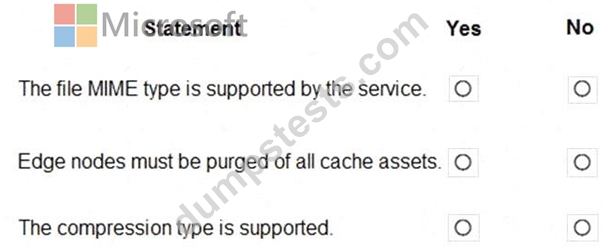
Answer:
Explanation: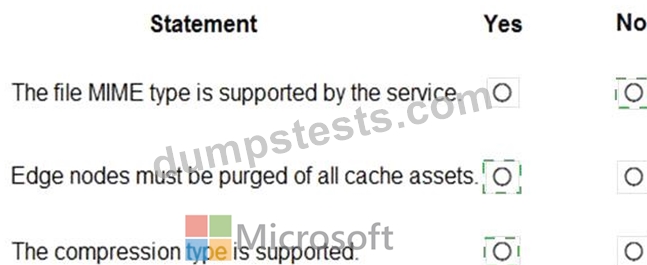
Explanation: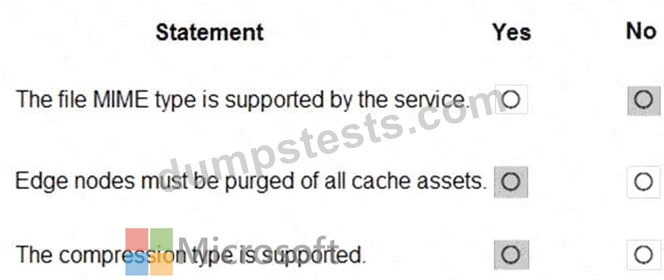
Box 1: No
Front Door can dynamically compress content on the edge, resulting in a smaller and faster response to your clients. All files are eligible for compression. However, a file must be of a MIME type that is eligible for compression list.
Box 2: No
Sometimes you may wish to purge cached content from all edge nodes and force them all to retrieve new updated assets. This might be due to updates to your web application, or to quickly update assets that contain incorrect information.
Box 3: Yes
These profiles support the following compression encodings: Gzip (GNU zip), Brotli Reference:
https://docs.microsoft.com/en-us/azure/frontdoor/front-door-caching
NEW QUESTION # 39
......
The AZ-204 exam covers a wide range of topics, including developing Azure compute solutions, developing Azure storage solutions, implementing Azure security, monitoring, troubleshooting, and optimizing Azure solutions, and connecting to and consuming Azure services and third-party services. AZ-204 exam is designed to test the developer's ability to design, develop, and implement solutions using Azure services and their knowledge of Azure development tools and technologies. AZ-204 exam is perfect for developers who want to demonstrate their skills in developing cloud-based applications and services using Microsoft Azure.
Microsoft AZ-204 certification is highly valued in the industry, as it demonstrates the candidate's expertise in building cloud-based solutions using Azure. Developing Solutions for Microsoft Azure certification is recognized worldwide and can open doors to new job opportunities and higher salaries. Moreover, Microsoft regularly updates its certification exams to reflect the latest industry trends and technologies, which means that certified professionals are always up-to-date with the latest developments.
Grab latest Amazon AZ-204 Dumps as PDF Updated: https://www.dumpstests.com/AZ-204-latest-test-dumps.html
Updated Official licence for AZ-204 Certified by AZ-204 Dumps PDF: https://drive.google.com/open?id=1zCQq_Rs94SjBhou1twysbP2cSLl-VWPF