

Free ARA-C01 Exam Study Guide for the NEW [Sep-2026] Dumps Test Engine
ARA-C01 PDF Dumps Extremely Quick Way Of Preparation
NEW QUESTION # 29
Which requirements indicate that a multi-account Snowflake strategy should be used? (Select TWO).
- A. A requirement to minimize complexity of changing database names across environments.
- B. A requirement for easy object promotion using zero-copy cloning.
- C. A requirement to use different Snowflake editions.
- D. A requirement to use Snowflake in a single cloud or region.
- E. A requirement to use RBAC to govern DevOps processes across environments.
Answer: B,C
Explanation:
A multi-account Snowflake strategy is appropriate when environments have fundamentally different requirements. Using different Snowflake editions (for example, Business Critical for production and Enterprise for non-production) requires separate accounts because edition is an account-level property (Answer A).
Zero-copy cloning is frequently used for fast environment refresh and object promotion, but cloning only works within a single account. To promote data between environments cleanly, many organizations use separate accounts combined with replication or sharing strategies, making multi-account design relevant when environment isolation and promotion workflows are required (Answer B).
Single-region usage, minimizing database name changes, and RBAC governance can all be handled within a single account. This question reinforces SnowPro Architect principles around environment isolation, governance, and account-level design decisions.
NEW QUESTION # 30
An Architect needs to meet a company requirement to ingest files from the company's AWS storage accounts into the company's Snowflake Google Cloud Platform (GCP) account. How can the ingestion of these files into the company's Snowflake account be initiated? (Select TWO).
- A. Configure AWS Simple Notification Service (SNS) to notify Snowpipe when new files have arrived in Amazon S3 storage.
- B. Create an AWS Lambda function to call the Snowpipe REST endpoint when new files have arrived in Amazon S3 storage.
- C. Configure the client application to call the Snowpipe REST endpoint when new files have arrived in Amazon S3 storage.
- D. Configure the client application to issue a COPY INTO <TABLE> command to Snowflake when new files have arrived in Amazon S3 Glacier storage.
- E. Configure the client application to call the Snowpipe REST endpoint when new files have arrived in Amazon S3 Glacier storage.
Answer: A,C
NEW QUESTION # 31
A table, EMP_ TBL has three records as shown: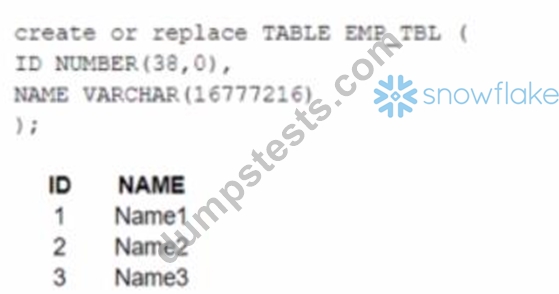
The following variables are set for the session:
Which SELECT statements will retrieve all three records? (Select TWO).
- A. SELECT * FROM $tb1_ref WHERE $col_ref IN ($var1, Svar2, Svar3);
- B. SELECT * FROM identifier($tbl_ref) WHERE ID IN Cvarl','var2','var3');
- C. SELECT * FROM EMP_TBL WHERE identifier(Scol_ref) IN ('Namel','Name2', 'Name3');
- D. Select * FROM Stbl_ref WHERE Scol_ref IN ('Name1','Nam2','Name3');
- E. SELECT * FROM identifier<Stbl_ref> WHERE NAME IN ($var1, $var2, $var3);
Answer: A,C
Explanation:
The correct answer is B and E because they use the correct syntax and values for the identifier function and the session variables.
The identifier function allows you to use a variable or expression as an identifier (such as a table name or column name) in a SQL statement. It takes a single argument and returns it as an identifier. For example, identifier($tbl_ref) returns EMP_TBL as an identifier.
The session variables are set using the SET command and can be referenced using the $ sign. For example, $var1 returns Name1 as a value.
Option A is incorrect because it uses Stbl_ref and Scol_ref, which are not valid session variables or identifiers. They should be $tbl_ref and $col_ref instead.
Option C is incorrect because it uses identifier<Stbl_ref>, which is not a valid syntax for the identifier function. It should be identifier($tbl_ref) instead.
Option D is incorrect because it uses Cvarl, var2, and var3, which are not valid session variables or values. They should be $var1, $var2, and $var3 instead. Reference:
Snowflake Documentation: Identifier Function
Snowflake Documentation: Session Variables
Snowflake Learning: SnowPro Advanced: Architect Exam Study Guide
NEW QUESTION # 32
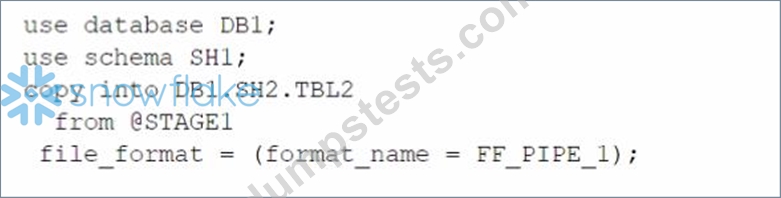
Based on the architecture in the image, how can the data from DB1 be copied into TBL2? (Select TWO).
- A.
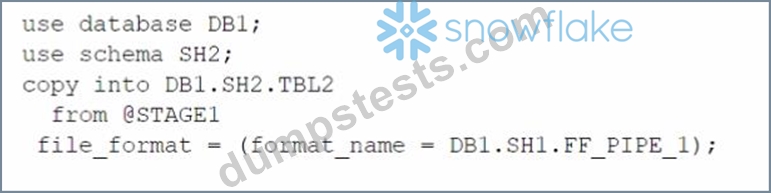
- B.

- C.
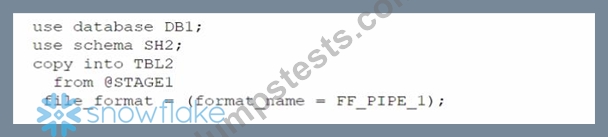
- D.
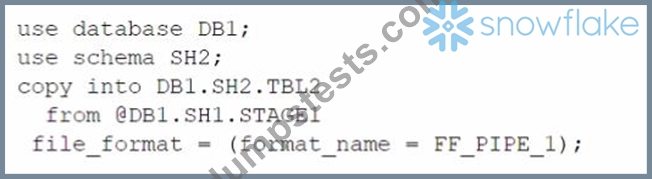
- E.
Answer: B,C
Explanation:
The architecture in the image shows a Snowflake data platform with two databases, DB1 and DB2, and two schemas, SH1 and SH2. DB1 contains a table TBL1 and a stage STAGE1. DB2 contains a table TBL2. The image also shows a snippet of code written in SQL language that copies data from STAGE1 to TBL2 using a file format FF PIPE 1.
To copy data from DB1 to TBL2, there are two possible options among the choices given:
Option B: Use a named external stage that references STAGE1. This option requires creating an external stage object in DB2.SH2 that points to the same location as STAGE1 in DB1.SH1. The external stage can be created using the CREATE STAGE command with the URL parameter specifying the location of STAGE11. For example:
SQLAI-generated code. Review and use carefully. More info on FAQ.
use database DB2;
use schema SH2;
create stage EXT_STAGE1
url = @DB1.SH1.STAGE1;
Then, the data can be copied from the external stage to TBL2 using the COPY INTO command with the FROM parameter specifying the external stage name and the FILE FORMAT parameter specifying the file format name2. For example:
SQLAI-generated code. Review and use carefully. More info on FAQ.
copy into TBL2
from @EXT_STAGE1
file format = (format name = DB1.SH1.FF PIPE 1);
Option E: Use a cross-database query to select data from TBL1 and insert into TBL2. This option requires using the INSERT INTO command with the SELECT clause to query data from TBL1 in DB1.SH1 and insert it into TBL2 in DB2.SH2. The query must use the fully-qualified names of the tables, including the database and schema names3. For example:
SQLAI-generated code. Review and use carefully. More info on FAQ.
use database DB2;
use schema SH2;
insert into TBL2
select * from DB1.SH1.TBL1;
The other options are not valid because:
Option A: It uses an invalid syntax for the COPY INTO command. The FROM parameter cannot specify a table name, only a stage name or a file location2.
Option C: It uses an invalid syntax for the COPY INTO command. The FILE FORMAT parameter cannot specify a stage name, only a file format name or options2.
Option D: It uses an invalid syntax for the CREATE STAGE command. The URL parameter cannot specify a table name, only a file location1.
Reference:
1: CREATE STAGE | Snowflake Documentation
2: COPY INTO table | Snowflake Documentation
3: Cross-database Queries | Snowflake Documentation
NEW QUESTION # 33
Which of the following are characteristics of Snowflake's parameter hierarchy?
- A. Session parameters override virtual warehouse parameters.
- B. Table parameters override virtual warehouse parameters.
- C. Virtual warehouse parameters override user parameters.
- D. Schema parameters override account parameters.
Answer: C
Explanation:
In Snowflake's parameter hierarchy, virtual warehouse parameters take precedence over user parameters. This hierarchy is designed to ensure that settings at the virtual warehouse level, which typically reflect the requirements of a specific workload or set of queries, override the preferences set at the individual user level. This helps maintain consistent performance and resource utilization as specified by the administrators managing the virtual warehouses.
Reference: Snowflake documentation on parameter hierarchy, found in the SnowPro Advanced: Architect learning materials.
NEW QUESTION # 34
A company is following the Data Mesh principles, including domain separation, and chose one Snowflake account for its data platform.
An Architect created two data domains to produce two data products. The Architect needs a third data domain that will use both of the data products to create an aggregate data product. The read access to the data products will be granted through a separate role.
Based on the Data Mesh principles, how should the third domain be configured to create the aggregate product if it has been granted the two read roles?
- A. Use secondary roles for all users.
- B. Request that the two data domains share data using the Data Exchange.
- C. Create a hierarchy between the two read roles.
- D. Request a technical ETL user with the sysadmin role.
Answer: B
Explanation:
In the scenario described, where a third data domain needs access to two existing data products in a Snowflake account structured according to Data Mesh principles, the best approach is to utilize Snowflake's Data Exchange functionality. Option D is correct as it facilitates the sharing and governance of data across different domains efficiently and securely. Data Exchange allows domains to publish and subscribe to live data products, enabling real-time data collaboration and access management in a governed manner. This approach is in line with Data Mesh principles, which advocate for decentralized data ownership and architecture, enhancing agility and scalability across the organization.References:
* Snowflake Documentation on Data Exchange
* Articles on Data Mesh Principles in Data Management
NEW QUESTION # 35
A stream stores data with the same columns as the source data but with additional columns.
What are those additional columns?
- A. METADATA$ROW_ID
- B. METADATA$ACTION
- C. METADATA$DELETE
- D. METADATA$ISUPDATE
Answer: A,B,D
NEW QUESTION # 36
An Architect is troubleshooting a query with poor performance using the QUERY_HIST0RY function. The Architect observes that the COMPILATIONJHME is greater than the EXECUTIONJTIME.
What is the reason for this?
- A. The query is processing a very large dataset.
- B. The query is reading from remote storage.
- C. The query has overly complex logic.
- D. The query is queued for execution.
Answer: C
Explanation:
Compilation time is the time it takes for the optimizer to create an optimal query plan for the efficient execution of the query. It also involves some pruning of partition files, making the query execution efficient2 If the compilation time is greater than the execution time, it means that the optimizer spent more time analyzing the query than actually running it. This could indicate that the query has overly complex logic, such as multiple joins, subqueries, aggregations, or expressions. The complexity of the query could also affect the size and quality of the query plan, which could impact the performance of the query3 To reduce the compilation time, the Architect can try to simplify the query logic, use views or common table expressions (CTEs) to break down the query into smaller parts, or use hints to guide the optimizer. The Architect can also use the EXPLAIN command to examine the query plan and identify potential bottlenecks or inefficiencies4 References:
1: SnowPro Advanced: Architect | Study Guide 5
2: Snowflake Documentation | Query Profile Overview 6
3: Understanding Why Compilation Time in Snowflake Can Be Higher than Execution Time 7
4: Snowflake Documentation | Optimizing Query Performance 8
SnowPro Advanced: Architect | Study Guide
Query Profile Overview
Understanding Why Compilation Time in Snowflake Can Be Higher than Execution Time Optimizing Query Performance
NEW QUESTION # 37
A large table is accessed by multiple teams using point-lookup queries on different columns. Query performance is poor.
What can be done to ensure good performance for all teams?
- A. Build multiple materialized views with cluster keys on each column.
- B. Build materialized views and allow Snowflake to replace the base table.
- C. Use the search optimization service on the underlying table.
- D. Create clustering keys using a combination of all lookup columns.
Answer: C
Explanation:
When multiple teams perform selective point-lookups on different columns of the same large table, traditional clustering is not effective because a table can have only one clustering key. Creating a composite clustering key across many columns often leads to poor clustering depth and limited pruning benefits.
The Search Optimization Service (SOS) is specifically designed for this scenario (Answer C). It enables fast point-lookups across multiple columns without requiring table reclustering. SOS maintains additional search access paths that accelerate highly selective predicates and is ideal when queries vary across many lookup columns.
Materialized views introduce additional storage, maintenance overhead, and operational complexity, and Snowflake does not automatically replace base tables with materialized views. This question tests an architect' s ability to choose the right optimization technique for multi-access-path workloads, a core SnowPro Architect competency.
=========
NEW QUESTION # 38
A Snowflake Architect created a new data share and would like to verify that only specific records in secure views are visible within the data share by the consumers.
What is the recommended way to validate data accessibility by the consumers?
- A. Alter the share settings as shown below, in order to impersonate a specific consumer account.
alter share sales share set accounts = 'Consumerl' share restrictions = true - B. Set the session parameter called SIMULATED_DATA_SHARING_C0NSUMER as shown below in order to impersonate the consumer accounts.
alter session set simulated_data_sharing_consumer - 'Consumer Acctl* - C. Create a row access policy as shown below and assign it to the data share.
create or replace row access policy rap_acct as (acct_id varchar) returns boolean -> case when 'acctl_role' = current_role() then true else false end; - D. Create reader accounts as shown below and impersonate the consumers by logging in with their credentials.
create managed account reader_acctl admin_name = userl , adroin_password 'Sdfed43da!44T , type = reader;
Answer: B
Explanation:
The SIMULATED_DATA_SHARING_CONSUMER session parameter allows a data provider to simulate the data access of a consumer account without creating a reader account or logging in with the consumer credentials. This parameter can be used to validate the data accessibility by the consumers in a data share, especially when using secure views or secure UDFs that filter data based on the current account or role. By setting this parameter to the name of a consumer account, the data provider can see the same data as the consumer would see when querying the shared database. This is a convenient and efficient way to test the data sharing functionality and ensure that only the intended data is visible to the consumers.
Reference:
Using the SIMULATED_DATA_SHARING_CONSUMER Session Parameter
SnowPro Advanced: Architect Exam Study Guide
NEW QUESTION # 39
A user can change object parameters using which of the following roles?
- A. SYSADMIN, SECURITYADMIN
- B. ACCOUNTADMIN, USER with PRIVILEGE
- C. ACCOUNTADMIN, SECURITYADMIN
- D. SECURITYADMIN, USER with PRIVILEGE
Answer: B
Explanation:
According to the Snowflake documentation, object parameters are parameters that can be set on individual objects such as databases, schemas, tables, and stages. Object parameters can be set by users with the appropriate privileges on the objects. For example, to set the object parameter AUTO_REFRESH on a table, the user must have the MODIFY privilege on the table. The ACCOUNTADMIN role has the highest level of privileges on all objects in the account, so it can set any object parameter on any object. However, other roles, such as SECURITYADMIN or SYSADMIN, do not have the same level of privileges on all objects, so they cannot set object parameters on objects they do not own or have the required privileges on. Therefore, the correct answer is C. ACCOUNTADMIN, USER with PRIVILEGE.
References:
* Parameters | Snowflake Documentation
* Object Parameters | Snowflake Documentation
* Object Privileges | Snowflake Documentation
NEW QUESTION # 40
A company is using a Snowflake account in Azure. The account has SAML SSO set up using ADFS as a SCIM identity provider. To validate Private Link connectivity, an Architect performed the following steps:
* Confirmed Private Link URLs are working by logging in with a username/password account
* Verified DNS resolution by running nslookups against Private Link URLs
* Validated connectivity using SnowCD
* Disabled public access using a network policy set to use the company's IP address range However, the following error message is received when using SSO to log into the company account:
IP XX.XXX.XX.XX is not allowed to access snowflake. Contact your local security administrator.
What steps should the Architect take to resolve this error and ensure that the account is accessed using only Private Link? (Choose two.)
- A. Update the configuration of the Azure AD SSO to use the Private Link URLs.
- B. Open a case with Snowflake Support to authorize the Private Link URLs' access to the account.
- C. Generate a new SCIM access token using system$generate_scim_access_token and save it to Azure AD.
- D. Alter the Azure security integration to use the Private Link URLs.
- E. Add the IP address in the error message to the allowed list in the network policy.
Answer: A,E
Explanation:
Explanation
The error message indicates that the IP address in the error message is not allowed to access Snowflake because it is not in the allowed list of the network policy. The network policy is a feature that allows restricting access to Snowflake based on IP addresses or ranges. To resolve this error, the Architect should take the following steps:
* Add the IP address in the error message to the allowed list in the network policy. This will allow the IP address to access Snowflake using the Private Link URLs. Alternatively, the Architect can disable the network policy if it is not required for security reasons.
* Update the configuration of the Azure AD SSO to use the Private Link URLs. This will ensure that the SSO authentication process uses the Private Link URLs instead of the public URLs. The configuration can be updated by following the steps in the Azure documentation1.
These two steps should resolve the error and ensure that the account is accessed using only Private Link. The other options are not necessary or relevant for this scenario. Altering the Azure security integration to use the Private Link URLs is not required because the security integration is used for SCIM provisioning, not for SSO authentication. Generating a new SCIM access token using system$generate_scim_access_token and saving it to Azure AD is not required because the SCIM access token is used for SCIM provisioning, not for SSO authentication. Opening a case with Snowflake Support to authorize the Private Link URLs' access to the account is not required because the authorization can be done by the account administrator using the SYSTEM$AUTHORIZE_PRIVATELINK function2.
NEW QUESTION # 41
What considerations need to be taken when using database cloning as a tool for data lifecycle management in a development environment? (Select TWO).
- A. The clone inherits all granted privileges of all child objects in the source object, excluding the database.
- B. The clone inherits all granted privileges of all child objects in the source object, including the database.
- C. Any pipes in the source referring to external stages are not cloned.
- D. Any pipes in the source referring to internal stages are not cloned.
- E. Any pipes in the source are not cloned.
Answer: C,E
NEW QUESTION # 42
What Snowflake features should be leveraged when modeling using Data Vault?
- A. Data needs to be pre-partitioned to obtain a superior data access performance
- B. Snowflake's support of multi-table inserts into the data model's Data Vault tables
- C. Scaling up the virtual warehouses will support parallel processing of new source loads
- D. Snowflake's ability to hash keys so that hash key joins can run faster than integer joins
Answer: B
Explanation:
These two features are relevant for modeling using Data Vault on Snowflake. Data Vault is a data modeling approach that organizes data into hubs, links, and satellites. Data Vault is designed to enable high scalability, flexibility, and performance for data integration and analytics. Snowflake is a cloud data platform that supports various data modeling techniques, including Data Vault. Snowflake provides some features that can enhance the Data Vault modeling, such as:
Snowflake's support of multi-table inserts into the data model's Data Vault tables. Multi-table inserts (MTI) are a feature that allows inserting data from a single query into multiple tables in a single DML statement. MTI can improve the performance and efficiency of loading data into Data Vault tables, especially for real-time or near-real-time data integration. MTI can also reduce the complexity and maintenance of the loading code, as well as the data duplication and latency12.
Scaling up the virtual warehouses will support parallel processing of new source loads. Virtual warehouses are a feature that allows provisioning compute resources on demand for data processing. Virtual warehouses can be scaled up or down by changing the size of the warehouse, which determines the number of servers in the warehouse. Scaling up the virtual warehouses can improve the performance and concurrency of processing new source loads into Data Vault tables, especially for large or complex data sets. Scaling up the virtual warehouses can also leverage the parallelism and distribution of Snowflake's architecture, which can optimize the data loading and querying34.
Reference:
Snowflake Documentation: Multi-table Inserts
Snowflake Blog: Tips for Optimizing the Data Vault Architecture on Snowflake Snowflake Documentation: Virtual Warehouses Snowflake Blog: Building a Real-Time Data Vault in Snowflake
NEW QUESTION # 43
An Architect is designing a disaster recovery plan for a global fraud reporting system. The plan must support near real-time systems using Snowflake data, operate near regional centers with fully redundant failover, and must not be publicly accessible.
Which steps must the Architect take? (Select THREE).
- A. Establish multiple Snowflake accounts in each required region with independent data sets.
- B. Create multiple replicating Snowflake Standard edition accounts.
- C. Establish one Snowflake account using a Business Critical edition or higher.
- D. Set up Secure Data Sharing among all Snowflake accounts in the organization.
- E. Create a Snowflake connection object.
- F. Create a failover group for the fraud data for each regional account.
Answer: A,C,F
Explanation:
Mission-critical, near real-time systems with strict availability and security requirements require advanced Snowflake features. Business Critical edition (or higher) is required to support failover groups and cross- region replication with higher SLA guarantees and compliance capabilities (Answer B). To meet regional proximity and redundancy requirements, multiple Snowflake accounts must be deployed in each required region, ensuring independence and isolation between regional environments (Answer C).
Failover groups are the core Snowflake mechanism for disaster recovery. They replicate selected databases, schemas, and roles across accounts and allow controlled promotion of secondary accounts to primary during failover events (Answer F). Secure Data Sharing alone does not provide DR or replication, and connection objects are unrelated to availability or redundancy.
This design aligns with SnowPro Architect best practices for multi-region disaster recovery, enabling low- latency regional access, controlled failover, and strong isolation without exposing systems to the public internet.
=========
NEW QUESTION # 44
A large manufacturing company runs a dozen individual Snowflake accounts across its business divisions. The company wants to increase the level of data sharing to support supply chain optimizations and increase its purchasing leverage with multiple vendors.
The company's Snowflake Architects need to design a solution that would allow the business divisions to decide what to share, while minimizing the level of effort spent on configuration and management. Most of the company divisions use Snowflake accounts in the same cloud deployments with a few exceptions for European-based divisions.
According to Snowflake recommended best practice, how should these requirements be met?
- A. Migrate the European accounts in the global region and manage shares in a connected graph architecture. Deploy a Data Exchange.
- B. Deploy a Private Data Exchange and use replication to allow European data shares in the Exchange.
- C. Deploy a Private Data Exchange in combination with data shares for the European accounts.
- D. Deploy to the Snowflake Marketplace making sure that invoker_share() is used in all secure views.
Answer: C
Explanation:
According to Snowflake recommended best practice, the requirements of the large manufacturing company should be met by deploying a Private Data Exchange in combination with data shares for the European accounts. A Private Data Exchange is a feature of the Snowflake Data Cloud platform that enables secure and governed sharing of data between organizations. It allows Snowflake customers to create their own data hub and invite other parts of their organization or external partners to access and contribute data sets. A Private Data Exchange provides centralized management, granular access control, and data usage metrics for the data shared in the exchange1. A data share is a secure and direct way of sharing data between Snowflake accounts without having to copy or move the data. A data share allows the data provider to grant privileges on selected objects in their account to one or more data consumers in other accounts2. By using a Private Data Exchange in combination with data shares, the company can achieve the following benefits:
The business divisions can decide what data to share and publish it to the Private Data Exchange, where it can be discovered and accessed by other members of the exchange. This reduces the effort and complexity of managing multiple data sharing relationships and configurations.
The company can leverage the existing Snowflake accounts in the same cloud deployments to create the Private Data Exchange and invite the members to join. This minimizes the migration and setup costs and leverages the existing Snowflake features and security.
The company can use data shares to share data with the European accounts that are in different regions or cloud platforms. This allows the company to comply with the regional and regulatory requirements for data sovereignty and privacy, while still enabling data collaboration across the organization.
The company can use the Snowflake Data Cloud platform to perform data analysis and transformation on the shared data, as well as integrate with other data sources and applications. This enables the company to optimize its supply chain and increase its purchasing leverage with multiple vendors.
The other options are incorrect because they do not meet the requirements or follow the best practices. Option A is incorrect because migrating the European accounts to the global region may violate the data sovereignty and privacy regulations, and deploying a Data Exchange may not provide the level of control and management that the company needs. Option C is incorrect because deploying to the Snowflake Marketplace may expose the company's data to unwanted consumers, and using invoker_share() in secure views may not provide the desired level of security and governance. Option D is incorrect because using replication to allow European data shares in the Exchange may incur additional costs and complexity, and may not be necessary if data shares can be used instead. Reference: Private Data Exchange | Snowflake Documentation, Introduction to Secure Data Sharing | Snowflake Documentation
NEW QUESTION # 45
An Architect is designing an architecture that must meet the following requirements:
* Use Tri-Secret Secure
* Share some information stored in a view with another Snowflake customer
* Hide portions of sensitive information in columns
* Use zero-copy cloning to refresh non-production from production
Which design elements must be implemented? (Select THREE).
- A. Use Dynamic Data Masking
- B. Use the Enterprise edition of Snowflake
- C. Define row access policies
- D. Use the Business Critical edition of Snowflake
- E. Create a secure view
- F. Create a materialized view
Answer: A,D,E
Explanation:
Tri-Secret Secure is only available in Snowflake Business Critical edition or higher, making that edition mandatory to satisfy the first requirement (Answer B). Secure views are required when sharing data with another Snowflake customer to ensure that underlying table data, logic, and metadata are protected and governed during Secure Data Sharing (Answer C). To hide or reveal portions of sensitive data at query time based on role or policy, Dynamic Data Masking is the appropriate Snowflake feature (Answer E).
Row access policies control row-level visibility but do not mask column values. The Enterprise edition does not support Tri-Secret Secure, making it insufficient for the stated requirements. Materialized views are unrelated to security or data masking and introduce unnecessary storage overhead.
This question integrates multiple SnowPro Architect domains-security, governance, sharing, and environment management-and tests the architect's ability to select the minimal set of Snowflake features that collectively meet complex compliance and operational requirements.
=========
NEW QUESTION # 46
For authentication, snowflake Kafka connector relies on:
- A. username/password
- B. key pair authentication
- C. Both key pair authentication and username/password
Answer: B
NEW QUESTION # 47
An Architect needs to design a Snowflake account and database strategy to store and analyze large amounts of structured and semi-structured dat a. There are many business units and departments within the company. The requirements are scalability, security, and cost efficiency.
What design should be used?
- A. Set up separate Snowflake accounts and databases for each department or business unit, to ensure data isolation and security.
- B. Create a single Snowflake account and database for all data storage and analysis needs, regardless of data volume or complexity.
- C. Use a centralized Snowflake database for core business data, and use separate databases for departmental or project-specific data.
- D. Use Snowflake's data lake functionality to store and analyze all data in a central location, without the need for structured schemas or indexes
Answer: C
Explanation:
The best design to store and analyze large amounts of structured and semi-structured data for different business units and departments is to use a centralized Snowflake database for core business data, and use separate databases for departmental or project-specific data. This design allows for scalability, security, and cost efficiency by leveraging Snowflake's features such as:
Database cloning: Cloning a database creates a zero-copy clone that shares the same data files as the original database, but can be modified independently. This reduces storage costs and enables fast and consistent data replication for different purposes.
Database sharing: Sharing a database allows granting secure and governed access to a subset of data in a database to other Snowflake accounts or consumers. This enables data collaboration and monetization across different business units or external partners.
Warehouse scaling: Scaling a warehouse allows adjusting the size and concurrency of a warehouse to match the performance and cost requirements of different workloads. This enables optimal resource utilization and flexibility for different data analysis needs. Reference: Snowflake Documentation: Database Cloning, Snowflake Documentation: Database Sharing, [Snowflake Documentation: Warehouse Scaling]
NEW QUESTION # 48
How can the Snowflake context functions be used to help determine whether a user is authorized to see data that has column-level security enforced? (Select TWO).
- A. Set masking policy conditions using is_role_in_session targeting the role in use for the current account.
- B. Set masking policy conditions using invoker_role targeting the executing role in a SQL statement.
- C. Assign the accountadmin role to the user who is executing the object.
- D. Set masking policy conditions using current_role targeting the role in use for the current session.
- E. Determine if there are ownership privileges on the masking policy that would allow the use of any function.
Answer: B,D
Explanation:
Snowflake context functions are functions that return information about the current session, user, role, warehouse, database, schema, or object. They can be used to help determine whether a user is authorized to see data that has column-level security enforced by setting masking policy conditions based on the context functions. The following context functions are relevant for column-level security:
* current_role: This function returns the name of the role in use for the current session. It can be used to set masking policy conditions that target the current session and are not affected by the execution context of the SQL statement. For example, a masking policy condition using current_role can allow or deny access to a column based on the role that the user activated in the session.
* invoker_role: This function returns the name of the executing role in a SQL statement. It can be used to set masking policy conditions that target the executing role and are affected by the execution context of the SQL statement. For example, a masking policy condition using invoker_role can allow or deny access to a column based on the role that the user specified in the SQL statement, such as using the AS ROLE clause or a stored procedure.
* is_role_in_session: This function returns TRUE if the user's current role in the session (i.e. the role returned by current_role) inherits the privileges of the specified role. It can be used to set masking policy conditions that involve role hierarchy and privilege inheritance. For example, a masking policy condition using is_role_in_session can allow or deny access to a column based on whether the user's current role is a lower privilege role in the specified role hierarchy.
The other options are not valid ways to use the Snowflake context functions for column-level security:
* Set masking policy conditions using is_role_in_session targeting the role in use for the current account.
This option is incorrect because is_role_in_session does not target the role in use for the current account, but rather the role in use for the current session. Also, the current account is not a role, but rather a logical entity that contains users, roles, warehouses, databases, and other objects.
* Determine if there are ownership privileges on the masking policy that would allow the use of any function. This option is incorrect because ownership privileges on the masking policy do not affect the use of any function, but rather the ability to create, alter, or drop the masking policy. Also, this is not a way to use the Snowflake context functions, but rather a way to check the privileges on the masking policy object.
* Assign the accountadmin role to the user who is executing the object. This option is incorrect because assigning the accountadmin role to the user who is executing the object does not involve using the Snowflake context functions, but rather granting the highest-level role to the user. Also, this is not a recommended practice for column-level security, as it would give the user full access to all objects and data in the account, which could compromise data security and governance.
References:
* Context Functions
* Advanced Column-level Security topics
* Snowflake Data Governance: Column Level Security Overview
* Data Security Snowflake Part 2 - Column Level Security
NEW QUESTION # 49
You have created a reader account for sharing data. who will pay for the compute usage of the account
- A. Provider
- B. Consumer
Answer: A
NEW QUESTION # 50
Arrange in order of performance(least to high)
1. External Table
2. External Table with partitioning
3. Materialized View Vs External table
4. Directly querying a file from the stage
- A. 1,2,3,4
- B. 3,2,4,1
- C. 4,3,2,1
- D. 1,2,4,3
Answer: A
NEW QUESTION # 51
While using joins, non-equality join predicates might result in significantly slower processing speeds and should be avoided if possible.
- A. FALSE
- B. TRUE
Answer: B
NEW QUESTION # 52
......
Enhance your career with ARA-C01 PDF Dumps - True Snowflake Exam Questions: https://www.dumpstests.com/ARA-C01-latest-test-dumps.html
Download ARA-C01 Dumps (2026) - Free PDF Exam Demo: https://drive.google.com/open?id=1TCAvG0Lshz5nGdr7btbqTJzcLKBKCF0O