

DumpsTests HPE6-A86 Exam Questions | Real HPE6-A86 Practice Dumps
Verified HPE6-A86 Exam Dumps Q&As - Provide HPE6-A86 with Correct Answers
NEW QUESTION # 65
What is the primary purpose of load balancing algorithms in LAGs?
- A. To increase the number of physical links in the LAG.
- B. To distribute network traffic evenly across aggregated links.
- C. To establish redundant connections for fault tolerance.
- D. To prioritize certain types of traffic over others.
Answer: B
NEW QUESTION # 66
You are checking the interface details for an access point that cannot reach HPE Aruba Networking Central.
After reviewing the following output, which statement is true?
Interface 1/1/16 is down
Admin state is up
State information: Waiting for link
Link state: down for 5 seconds
Link transitions: 0
Description:
Hardware: Ethernet, MAC Address: 38:bd:7a:6d:73:7f
MTU 1500
Type 1GbT
Full-duplex
qos trust dscp
Speed 0 Mb/s
Auto-negotiation is on
Energy-Efficient Ethernet is disabled
Flow-control: off
Error-control: off
MDI mode: none
VLAN Mode: native-untagged
Native VLAN: 10
Allowed VLAN List: 10,20,30
Rate collection interval: 300 seconds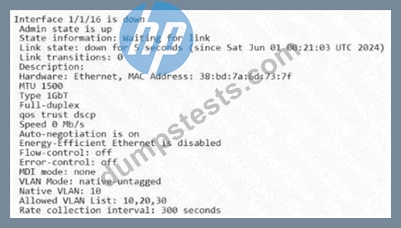
- A. Layer 2 QoS markings from the AP will be trusted.
- B. The interface has been administratively disabled.
- C. VLANs 10, 20, and 30 are 802.1Q tagged.
- D. The link on interface 1/1/16 is not established.
Answer: D
Explanation:
The correct answer is D. The link on interface 1/1/16 is not established. The output clearly states Interface 1/1
/16 is down, Admin state is up, and State information: Waiting for link. This means the port is enabled administratively, but the physical link is not up. HPE Aruba Networking AOS-CX show interface documentation displays these fields to show operational and administrative interface status, including examples where the interface is down while the admin state remains up. Option A is incorrect because the output says qos trust dscp, which trusts Layer 3 DSCP markings, not Layer 2 CoS markings. Option B is incorrect because Admin state is up; an administratively disabled interface would be shut down. Option C is incorrect because the output shows VLAN Mode: native-untagged and Native VLAN: 10; native VLAN 10 is untagged, while the allowed VLAN list shows VLANs permitted on the trunk. Since the port is waiting for link, the immediate verified issue is that the physical link is not established
NEW QUESTION # 67
A Network Operator is configuring QoS on an HPE Aruba Networking CX switch. The operator needs to classify traffic based on the application being used, such as distinguishing between HTTP and FTP traffic.
Which of the following is used to identify the application at Layer 4 for QoS classification?
- A. MAC address
- B. VLAN ID
- C. TCP or UDP port number
- D. IP address
Answer: C
NEW QUESTION # 68
Which statement describes static routing?
- A. suitable for basic L3 networks
- B. scalable to any size
- C. unpredictable routing behavior
- D. supports automatic failure throughout the entire network
Answer: A
Explanation:
Static routing is commonly used in simple or small Layer 3 environments where routes do not change frequently. It provides straightforward and predictable routing behavior without the complexity of dynamic routing protocols.
NEW QUESTION # 69
A Solutions Architect is presenting the HPE Aruba Networking switching portfolio to a customer.
The customer needs to understand the primary software differentiator of the AOS-CX operating system. Which feature is a core component and key differentiator of the AOS-CX software architecture?
- A. A proprietary command-line interface that is unique to each switch model.
- B. A microservices-based, database-driven architecture.
- C. A monolithic kernel that combines all processes into a single software image.
- D. Its exclusive support for the EIGRP routing protocol.
Answer: B
NEW QUESTION # 70
A Network Technician is configuring an access layer switch (ALS) to connect to a core switch.
The connection uses two physical links that need to be bundled into a Link Aggregation Group (LAG) for increased bandwidth and redundancy. The LAG will function as a VLAN trunk to carry both Staff (VLAN 100) and Guest (VLAN 200) traffic. The technician must also enable RSTP for loop prevention.
Initial State:
* The switch is in its factory default state, connected via the console.
* The physical links are on ports 1/1/47 and 1/1/48.
Required Configuration:
* Create VLAN 100 and VLAN 200.
* Enable Rapid Spanning Tree Protocol (RSTP).
* Create LAG interface `lag 1`.
* Configure `lag 1` to use LACP (active mode).
* Add ports 1/1/47 and 1/1/48 to `lag 1`.
* Configure `lag 1` as a VLAN trunk, allowing VLANs 100 and 200.
* Enable the physical ports and the LAG interface.
Which configuration set correctly implements all the specified Layer 2 requirements?
- A. vlan 100
vlan 200
interface lag 1
no shutdown
vlan trunk allowed 100,200
interface 1/1/47-1/1/48
no shutdown
lag 1 - B. spanning-tree mode rstp
vlan 100,200
interface lag 1
no shutdown
vlan trunk allowed 100,200
lacp mode active
interface 1/1/47-1/1/48
no shutdown
lag 1 - C. spanning-tree
vlan 100,200
interface 1/1/47-1/1/48
no shutdown
lacp group 1 mode active
interface lag 1
no shutdown
vlan trunk allowed 100,200 - D. spanning-tree mode mstp
vlan 100,200
interface lag 1
no shutdown
vlan access 100
vlan trunk allowed 200
interface 1/1/47-1/1/48
no shutdown
lag 1
Answer: B
NEW QUESTION # 71
Which statement about out-of-band management is true?
- A. Provides better security and reliability than in-band management.
- B. Prone to congestion issues from user network traffic.
- C. Simpler to implement than in-band management.
- D. It shares the same network path as user data.
Answer: A
Explanation:
Out-of-band management uses a separate dedicated management network, isolated from production user traffic. This improves both security and reliability because management access remains available even if the main data network experiences congestion or failures.
NEW QUESTION # 72
What is a characteristic of a static route?
- A. Must be manually configured
- B. Responsive to network changes
- C. High processing overhead
- D. Automatically learned
Answer: A
Explanation:
The correct answer is A. Must be manually configured. HPE Aruba Networking AOS-CX documentation states that static routes are manually configured in the routing table. A static route defines a destination network and the next-hop address or exit interface that the switch should use to forward traffic. Static routes are useful in small, simple, or predictable networks because they are straightforward and do not require a dynamic routing protocol to exchange route information. Option B is incorrect because automatically learned routes are associated with dynamic routing protocols, such as OSPF or BGP, not static routing. Option C is incorrect because static routes usually have low processing overhead compared to dynamic routing protocols, since the switch does not need to run neighbor discovery, exchange routing updates, or calculate topology changes. Option D is incorrect because static routes do not automatically respond to network topology changes unless supported by an additional tracking mechanism or manually changed by an administrator.
Therefore, the defining characteristic of a static route is manual configuration.
NEW QUESTION # 73
Which is an example of half-duplex communication?
- A. Telephone system
- B. FM radio broadcast
- C. Fibre-optic pair
- D. Push-to-talk radio
Answer: D
Explanation:
Push-to-talk radios operate in half-duplex mode, allowing communication in only one direction at a time while the other party waits to respond.
NEW QUESTION # 74
You have configured the following on a Core-1 HPE Aruba Networking CX switch for primary and secondary ISP connectivity:
Core-1(config)# ip route 0.0.0.0/0 10.1.251.2
Core-1(config)# ip route 0.0.0.0/0 10.1.252.2 distance 10
The default route via 10.1.251.2 stopped working, and no failover happened. The ISP reported a broken fiber on the path of an upstream device.
In what condition should the route fail over to the 10.1.252.2 router?
- A. When the default route graceful-restart timer expires.
- B. When the BFD session terminates on 10.1.251.2.
- C. When uplink-failure-detection enables the 10.1.252.2 route.
- D. When 10.1.251.2 is no longer in the routing table.
Answer: D
Explanation:
The correct answer is D. When 10.1.251.2 is no longer in the routing table. The configuration shows two static default routes to the same destination, 0.0.0.0/0. The first route uses the default administrative distance, while the second route has a higher administrative distance of 10, making it a floating static route. HPE Aruba Networking AOS-CX documentation for static routing states that the distance option sets the administrative distance associated with a static route, with a default of 1 and a range of 1-255. Because lower administrative distance is preferred, the route through 10.1.251.2 remains active as long as it is valid in the routing table. The backup route through 10.1.252.2 becomes active only when the preferred route is removed or no longer installed. A remote upstream fiber break might not remove the directly reachable next hop from the routing table, which explains why failover did not occur. BFD tracking could improve failure detection, but the condition for this configured floating static route to take over is loss of the primary route from the routing table.
NEW QUESTION # 75
A new firewall for the default gateway is connected to an HPE Aruba Networking CX 6300 switch. The security administrator has requested that you configure the Layer 3 switch without a bridged port.
How can this be done on an HPE Aruba Networking switch?
- A. interface 1/1/1
no routing
vlan access 1
ip address 10.10.10.1/29
no shutdown - B. interface 1/1/1
no routing
ip address 10.10.10.1/29
no shutdown - C. interface 1/1/1
routing
ip address 10.10.10.1/29
no shutdown - D. interface 1/1/1
routing
vlan access 1
ip address 10.10.10.1/29
no shutdown
Answer: C
Explanation:
The correct answer is D. To configure a physical interface as a Layer 3 routed port on an HPE Aruba Networking CX 6300 switch, the interface must be placed in routing mode and assigned an IP address directly. This creates a routed interface rather than a bridged Layer 2 port. HPE Aruba Networking AOS-CX examples show routed physical interfaces configured with routing, followed by an ip address, and then no shutdown. The same examples contrast this with Layer 2 ports, which use no routing and VLAN commands such as vlan access or vlan trunk. Option A is incorrect because no routing makes the interface a Layer 2 interface, so assigning an IP address directly is not the correct routed-port configuration. Options B and C are incorrect because vlan access 1 configures the port as a bridged access port. The requirement specifically says the switch should be configured without a bridged port, so the correct CX configuration is a routed physical interface using routing with the IP address configured directly on the port.
NEW QUESTION # 76
Which user group exists by default on a CX 6100 series switch?
- A. managers
- B. root
- C. administrators
- D. super-users
Answer: B
Explanation:
CX 6100 series switches have a default user account named "root" with full administrative privileges for initial access and configuration.
NEW QUESTION # 77
A Network Operator is responsible for automating configuration tasks across dozens of HPE Aruba Networking CX switches. The operator prefers to use scripts to push consistent configurations rather than manually configuring each device.
Which management features of AOS-CX are specifically designed to facilitate this kind of automation and programmability? (Choose 2.)
- A. A Java-based graphical configuration tool.
- B. A simplified feature set that cannot be scripted.
- C. A built-in Python interpreter on the switch.
- D. A proprietary, encrypted management protocol.
- E. A full-featured REST API.
Answer: C,E
NEW QUESTION # 78
A Network Technician needs to limit the number of devices that can connect to a specific switch port. The goal is to allow only the first two devices that connect to the port to gain access, and any subsequent devices should be blocked.
Which port security configuration would accomplish this?
- A. `port-security client-limit 2`
- B. `port-security mac-address sticky`
- C. `port-security violation shutdown`
- D. `port-security enable`
Answer: A
NEW QUESTION # 79
Which user group exists by default on an HPE Aruba Networking CX 6400 Series switch?
- A. reporting
- B. auditors
- C. read-only
- D. restricted
Answer: B
Explanation:
The correct answer is C. auditors. HPE Aruba Networking AOS-CX documentation for the 6200, 6300, and
6400 switch series identifies three built-in user groups: administrators, operators, and auditors. These built-in groups have fixed privileges. The administrators group has full privileges, including full CLI access, firmware upgrades, configuration viewing, configuration changes, and user account management. The operators group has no switch configuration privileges and is mainly limited to basic display-only access and viewing nonsensitive configuration information. The auditors group is restricted to audit-related functions. Since the question asks which user group exists by default on a CX 6400 Series switch, "auditors" is the only listed option that matches the HPE Aruba Networking AOS-CX built-in groups. The other options-read-only, restricted, and reporting-are not listed as default built-in AOS-CX user groups for the CX 6400 platform.
This makes option C the verified answer.
NEW QUESTION # 80
What is the method for setting up an HPE Aruba Networking CX 8100 switch using an Android device, and which is recommended for ease of use?
- A. Connect the USB Bluetooth adapter to the switch's USB-A port.
- B. Connect the Android phone to the switch's USB-C port.
- C. Connect the USB Bluetooth adapter to the switch's USB-C port.
- D. Connect the Android phone to the switch mgmt port using the RJ45 adapter.
Answer: A
Explanation:
An HPE Aruba Networking CX 8100 can be set up from an Android device using a USB Bluetooth adapter connected to the switch, allowing a wireless console-style connection. Using the switch's USB-A port is the recommended approach because it is the standard port for USB accessories and is typically the simplest method for initial setup.
NEW QUESTION # 81
A Solutions Architect is designing a network automation solution for a large campus environment running HPE Aruba Networking CX switches. The customer wants to be able to use scripts to monitor and configure the switches in a programmatic way.
Which built-in software capability of AOS-CX is specifically designed for this type of on-box automation?
- A. A network analysis module powered by machine learning.
- B. A graphical traffic-flow visualization tool.
- C. The ability to run third-party containerized applications.
- D. A full-featured Python interpreter and REST API.
Answer: D
NEW QUESTION # 82
A four-member CX 6200F VSF configuration is being planned to replace the current 5412R switch. The customer has an open-source network management solution and requires an answer to how they can monitor the switch stack.
- A. The SNMP service will be enabled by default for each members OOBM port for queries.
- B. The SNMP service on the Conductor switch will respond to all SNMP queries for the stack.
- C. The SNMP service must be enabled on mgmt VRF for each VSF member for queries.
- D. The SNMP service will respond to queries and stack them on both Conductor and Standby members.
Answer: B
Explanation:
In a VSF stack, the switches operate as a single logical device for management. SNMP queries are handled through the active control-plane switch, so the Conductor responds on behalf of the entire stack, allowing the monitoring system to poll the stack as one device.
NEW QUESTION # 83
Which firewall port needs to be opened between your Network Monitoring System and CX switches to collect monitoring data using SNMP?
- A. UDP 161
- B. TCP 162
- C. UDP 1157
- D. TCP 1156
Answer: A
Explanation:
SNMP polling uses UDP port 161, which must be open between the Network Monitoring System and the CX switches to allow the collection of monitoring data.
NEW QUESTION # 84
You are about to start the initial configuration of an HPE Aruba Networking CX 6200M switch.
How would you connect to the switch to configure the SVI static IP address?
- A. Connect using the Aruba Discovery mobile app.
- B. Connect using the RJ-45 management port.
- C. Connect using the RJ-45 console port.
- D. Connect using the Bluetooth adapter.
Answer: C
NEW QUESTION # 85
A senior network engineer has requested you update the CX 6100 OS image for the ZTP deployment. Select the correct statement for the task requirement.
- A. You must change the desired software version in the Aruba Active to match the CX switch version.
- B. You must change the desired software version for the unprovisioned switches group in HPE Aruba Networking Central.
- C. You must download the desired software version from ASP and host the file on a TFTP server.
- D. You must change the desired software URL for the ASP path and correct the DHCP options.
Answer: B
Explanation:
For ZTP deployments, the desired OS version for unprovisioned CX 6100 switches is configured in Aruba Central, ensuring that switches automatically download and install the correct software during initial provisioning.
NEW QUESTION # 86
You have added the configuration below, but your auditor cannot execute 'view the software version' on the switch. What is the issue with the configuration you have applied?
- A. The first command in the permit CLI list was overwritten.
- B. The word audit is system-reserved and cannot be used.
- C. 'show version' is not a supported command for CX switches.
- D. The command "enable" needs to be included as the first entry.
Answer: A
Explanation:
Both permit statements use sequence number 10. On CX switches, entering another command with the same sequence number replaces the previous entry. As a result, the show version command was overwritten by the show run command.
NEW QUESTION # 87
......
Get Top-Rated HP HPE6-A86 Exam Dumps Now: https://www.dumpstests.com/HPE6-A86-latest-test-dumps.html
Pass Your HPE6-A86 Dumps Free Latest HP Practice Tests: https://drive.google.com/open?id=1VjHd5SL6sPD_l0mPVm3KyrmBPbUJDWv9