

AZ-304 Training & Certification Get Latest Azure Solutions Architect Expert Updated on Dec 07, 2021
Certification Training for AZ-304 Exam Dumps Test Engine
AZ-304: Microsoft Azure Architect Design Exam Certified Professional salary
The average salary of a AZ-304: Microsoft Azure Architect Design Exam Certified Expert in
- Europe - 90,547 EURO
- United State - 120,000 USD
- India - 20,00,327 INR
- England - 90,532 POUND
Who is the target audience for the Microsoft AZ-304 exam?
The applicants for this certification exam are the Azure Solution Architects with intermediate-level skills in the domain of Azure administration. These professionals have a good understanding of DevOps processes and Azure development. They are also responsible for translating the business needs into scalable, reliable, and secure Cloud solutions. Additionally, they can advise the stakeholders and collaborate with the Cloud DBAs and Cloud administrators to implement solutions.
What career paths can a person choose after passing the Microsoft AZ-304 exam?
The professionals who want to boost their career in the field of Microsoft Azure should consider obtaining the Microsoft Certified: Azure Solutions Architect Expert certification. There are many job roles that they can explore and there is also room for rapid career growth with this certificate. Some positions that these specialists can apply for include a Microsoft Solution Architect, a Cloud Architect, a Product Manager, a Senior Azure Architect, an O365 Solution Architect, a .Net Solution Architect, etc. The potential salary averages $110,000 while some can earn as high as $170,000 per year.
NEW QUESTION 60
You have an Azure SQL database named DB1.
You need to recommend a data security solution for DB1. the solution must meet the following requirements:
* When helpdesk supervisors query DS1. they must see the full number of each credit card.
* When helpdesk operators Query DB1. they must see only the last four digits of each credit card number
* A column named Credit Rating must never appear in plain text within the database system, and only client applications must be able to decrypt the Credit Rating column.
What should you include in the recommendation To answer, select the appropriate options in the answer area.
NOTE: Each correct selection is worth one point.
Answer:
Explanation:
Explanation
Box 1: Dynamic data masking
Dynamic data masking helps prevent unauthorized access to sensitive data by enabling customers to designate how much of the sensitive data to reveal with minimal impact on the application layer. It's a policy-based security feature that hides the sensitive data in the result set of a query over designated database fields, while the data in the database is not changed.
Box 2: Always encrypted
Data stored in the database is protected even if the entire machine is compromised, for example by malware.
Always Encrypted leverages client-side encryption: a database driver inside an application transparently encrypts data, before sending the data to the database. Similarly, the driver decrypts encrypted data retrieved in query results.
Reference:
https://azure.microsoft.com/en-us/blog/transparent-data-encryption-or-always-encrypted/
NEW QUESTION 61
You need to recommend a solution to generate a monthly report of all the new Azure Resource Manager resource deployment in your subscription. What should you include in the recommendation?
- A. Azure Monitor metrics
- B. Azure Advisor
- C. Azure Activity Log
- D. Azure Monitor action groups
Answer: C
Explanation:
Explanation
Activity logs are kept for 90 days. You can query for any range of dates, as long as the starting date isn't more than 90 days in the past.
Through activity logs, you can determine:
* what operations were taken on the resources in your subscription
* who started the operation
* when the operation occurred
* the status of the operation
* the values of other properties that might help you research the operation Reference:
https://docs.microsoft.com/en-us/azure/azure-resource-manager/management/view-activity-logs
NEW QUESTION 62
You need to recommend a solution for the data store of the historical transaction query system.
What should you include in the recommendation? To answer, select the appropriate options in the answer area.
NOTE: Each correct selection is worth one point.
Answer:
Explanation:
NEW QUESTION 63
You need to recommend a solution for data of the historical transaction query system.
What should you include in the recommendation? To answer, Select the appropriate or options in the answer area.
NOTE: Each correct selection is worth one point
Answer:
Explanation:
Explanation
NEW QUESTION 64
You have an Azure virtual machine named VM1 that runs Windows Server 2019 and contains 500 GB of data files.
You are designing a solution that will use Azure Data Factory to transform the data files, and then load the files to Azure Data Lake Storage.
What should you deploy on VM1 to support the design?
- A. the Azure Pipelines agent
- B. the Azure File Sync agent
- C. the self-hosted integration runtime
- D. the On-premises data gateway
Answer: C
Explanation:
The integration runtime (IR) is the compute infrastructure that Azure Data Factory uses to provide data- integration capabilities across different network environments. For details about IR, see Integration runtime overview.
A self-hosted integration runtime can run copy activities between a cloud data store and a data store in a private network. It also can dispatch transform activities against compute resources in an on-premises network or an Azure virtual network. The installation of a self-hosted integration runtime needs an on-premises machine or a virtual machine inside a private network.
Reference:
https://docs.microsoft.com/en-us/azure/data-factory/create-self-hosted-integration-runtime
NEW QUESTION 65
You are designing a solution that will host 20 different web application.
You need to recommend a solution to secure the web applications with a firewall that protects against common web-based attacks including SQL injection, cross-site attacks, and session hijacks. The solution must minimize costs.
Which Azure feature should you recommend?
- A. Azure Application Gateway
- B. Azure Bastion
- C. Azure Firewall
- D. Azure AD Application Proxy
Answer: A
NEW QUESTION 66
You have an Azure Active Directory (Azure AD) tenant and Windows 10 devices.
You configure a conditional access policy as shown in the exhibit. (Click the Exhibit tab.)
What is the result of the policy?
- A. Users will be prompted for multi-factor authentication (MFA) only when they sign in from devices that are joined to Azure AD.
- B. All users will be able to sign in without using multi-factor authentication (MFA).
- C. All users will always be prompted for multi-factor authentication (MFA).
- D. Users will be prompted for multi-factor authentication (MFA) only when they sign in from devices that are NOT joined to Azure AD.
Answer: B
Explanation:
Explanation
https://docs.microsoft.com/en-us/azure/active-directory/authentication/tutorial-enable-azure-mfa "Conditional Access policies can be set to Report-only if you want to see how the configuration would impact users, or Off if you don't want to the use policy right now. As a test group of users was targeted for this tutorial, lets enable the policy and then test Azure AD Multi-Factor Authentication.
NEW QUESTION 67
You need to recommend an Azure Storage Account configuration for two applications named Application1 and Applications. The configuration must meet the following requirements:
* Storage for Application1 must provide the highest possible transaction rates and the lowest possible latency.
* Storage for Application2 must provide the lowest possible storage costs per GB.
* Storage for both applications must be optimized for uploads and downloads.
* Storage for both applications must be available in an event of datacenter failure.
What should you recommend ? To answer, select the appropriate options in the answer area NOTE: Each correct selection is worth one point
Answer:
Explanation:
Reference:
https://docs.microsoft.com/en-us/azure/storage/common/storage-account-overview
https://docs.microsoft.com/en-us/azure/storage/common/storage-redundancy
NEW QUESTION 68
You need to design a solution for securing access to the historical transaction data.
What should you include in the solution? To answer, select the appropriate options in the answer area.
NOTE: Each correct selection is worth one point.
Answer:
Explanation:
NEW QUESTION 69
You are designing a cost-optimized solution that uses Azure Batch to run two types of jobs on Linux nodes.
The first job type will consist of short-running tasks for a development environment. The second jot type will consist of long-running Message Passing Interface (MPI) applications for a production environment that requires timely job completion.
You need to recommend the pool type and node type for each job type. The solution must minimize compute charges and leverage Azure Hybrid Benefit whenever possible.
What should you recommend? To answer, select the appropriate options in the answer area.
NOTE: Each correct selection is worth one point.
Answer:
Explanation:
Explanation
Box 1: User subscription and low-priority virtual machines
Azure Batch offers low-priority virtual machines (VMs) to reduce the cost of Batch workloads. Low-priority VMs make new types of Batch workloads possible by enabling a large amount of compute power to be used for a very low cost.
Some examples of batch processing use cases well suited to use low-priority VMs are:
Development and testing: In particular, if large-scale solutions are being developed, significant savings can be realized. All types of testing can benefit, but large-scale load testing and regression testing are great uses.
Supplementing on-demand capacity.
Flexible job execution time.
Box 2: Batch service and dedicate virtual machines
Reference:
https://docs.microsoft.com/en-us/azure/batch/batch-low-pri-vms
NEW QUESTION 70
You have an on-premises Hyper-V cluster. The cluster contains Hyper-V hosts that run Windows Server 2016 Datacenter. The hosts are licensed under a Microsoft Enterprise Agreement that has Software Assurance.
The Hyper-V cluster contains 30 virtual machines that run Windows Server 2012 R2. Each virtual machine runs a different workload. The workloads have predictable consumption patterns.
You plan to replace the virtual machines with Azure virtual machines that run Windows Server 2016. The virtual machines will be sized according to the consumption pattern of each workload.
You need to recommend a solution to minimize the compute costs of the Azure virtual machines.
Which two recommendations should you include in the solution? Each correct answer presents part of the solution.
NOTE: Each correct selection is worth one point.
- A. Create a lab in Azure DevTest Labs and place the Azure virtual machines in the lab.
- B. Activate Azure Hybrid Benefit for the Azure virtual machines.
- C. Configure a spending limit in the Azure account center.
- D. Create a virtual machine scale set that uses autoscaling.
- E. Purchase Azure Reserved Virtual Machine Instances for the Azure virtual machines.
Answer: B,E
Explanation:
C: For customers with Software Assurance, Azure Hybrid Benefit for Windows Server allows you to use your on-premises Windows Server licenses and run Windows virtual machines on Azure at a reduced cost. You can use Azure Hybrid Benefit for Windows Server to deploy new virtual machines with Windows OS.
D: With Azure Reserved VM Instances (RIs) you reserve virtual machines in advance and save up to 80 percent.
Reference:
https://azure.microsoft.com/en-us/pricing/reserved-vm-instances/
https://docs.microsoft.com/en-us/azure/virtual-machines/windows/hybrid-use-benefit-licensing
NEW QUESTION 71
Note: This question is part of a series of questions that present the same scenario. Each question in the series contains a unique solution that might meet the stated goals. Some question sets might have more than one correct solution, while others might not have a correct solution.
After you answer a question in this section, you will NOT be able to return to it. As a result, these questions will not appear in the review screen.
Your company has deployed several virtual machines (VMs) on-premises and to Azure. Azure ExpressRoute has been deployed and configured for on-premises to Azure connectivity.
Several VMs are exhibiting network connectivity issues.
You need to analyze the network traffic to determine whether packets are being allowed or denied to the VMs.
Solution: Install and configure the Microsoft Monitoring Agent and the Dependency Agent on all VMs. Use the Wire Data solution in Azure Monitor to analyze the network traffic.
Does the solution meet the goal?
- A. No
- B. Yes
Answer: A
Explanation:
Explanation
Instead use Azure Network Watcher to run IP flow verify to analyze the network traffic.
Note: Wire Data looks at network data at the application level, not down at the TCP transport layer. The solution doesn't look at individual ACKs and SYNs.
Reference:
https://docs.microsoft.com/en-us/azure/network-watcher/network-watcher-monitoring-overview
https://docs.microsoft.com/en-us/azure/network-watcher/network-watcher-ip-flow-verify-overview
NEW QUESTION 72
You are building an application that will run in a virtual machine (VM). The application will use Azure Managed Identity.
The application uses Azure Key Vault, Azure SQL Database, and Azure Cosmos DB.
You need to ensure the application can use secure credentials to access these services.
Which authentication method should you recommend? To answer, select the appropriate options in the answer area.
NOTE: Each correct selection is worth one point.
Answer:
Explanation:
Explanation
Note: Managed identities for Azure resources is the new name for the service formerly known as Managed Service Identity (MSI).
Reference:
https://docs.microsoft.com/en-us/azure/active-directory/managed-identities-azure-resources/overview
NEW QUESTION 73
You need to design an Azure policy that will implement the following functionality:
* For new resources, assign tags and values that match the tags and values of the resource group to which the resources are deployed.
* For existing resources, identify whether the tags and values match the tags and values of the resource group that contains the resources.
* For any non-compliant resources, trigger auto-generated remediation tasks to create missing tags and values.
The solution must use the principle of least privilege.
What should you include in the design? To answer, select the appropriate options in the answer area.
NOTE: Each correct selection is worth one point.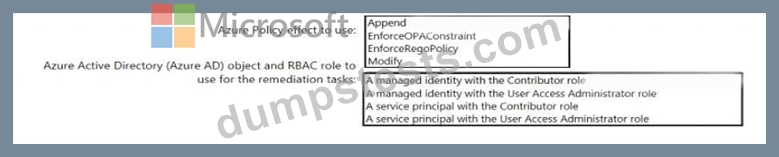
Answer:
Explanation:
Explanation
Box 1: Modify
Modify is used to add, update, or remove properties or tags on a resource during creation or update. A common example is updating tags on resources such as costCenter. Existing non-compliant resources can be remediated with a remediation task. A single Modify rule can have any number of operations.
Box 2: A managed identity with the Contributor role
* Managed identity
How remediation security works: When Azure Policy runs the template in the deployIfNotExists policy definition, it does so using a managed identity. Azure Policy creates a managed identity for each assignment, but must have details about what roles to grant the managed identity.
* Contributor role
The Contributor role grants the required access to apply tags to any entity.
Reference:
https://docs.microsoft.com/en-us/azure/governance/policy/concepts/effects
https://docs.microsoft.com/en-us/azure/governance/policy/how-to/remediate-resources
https://docs.microsoft.com/en-us/azure/azure-resource-manager/management/tag-resources
NEW QUESTION 74
You have an Azure subscription.
You need to recommend a solution to provide developers with the ability to provision Azure virtual machines. The solution must meet the following requirements:
Only allow the creation of the virtual machines in specific regions.
Only allow the creation of specific sizes of virtual machines.
What should include in the recommendation?
- A. conditional access policies
- B. role-based access control (RBAC)
- C. Azure Policy
- D. Azure Resource Manager templates
Answer: C
Explanation:
https://docs.microsoft.com/en-us/azure/governance/policy/tutorials/create-and-manage
NEW QUESTION 75
......
Step by Step Guide to Prepare for AZ-304 Exam: https://www.dumpstests.com/AZ-304-latest-test-dumps.html
Azure Solutions Architect Expert AZ-304 Real Exam Questions and Answers FREE Updated: https://drive.google.com/open?id=1YXFqjn6YkIpgXNtHajNk1mfRJoFHeolm