

Associate-Cloud-Engineer Exam Info and Free Practice Test All-in-One Exam Guide May-2022
Pass Google Associate-Cloud-Engineer Actual Free Exam Q&As Updated Dump May 27, 2022
NEW QUESTION 39
You created several resources in multiple Google Cloud projects. All projects are linked to different billing accounts. To better estimate future charges, you want to have a single visual representation of all costs incurred. You want to include new cost data as soon as possible. What should you do?
- A. Use the Reports view in the Cloud Billing Console to view the desired cost information.
- B. Fill all resources in the Pricing Calculator to get an estimate of the monthly cost.
- C. Configure Billing Data Export to BigQuery and visualize the data in Data Studio.
- D. Visit the Cost Table page to get a CSV export and visualize it using Data Studio.
Answer: C
Explanation:
Reference:
https://cloud.google.com/billing/docs/how-to/visualize-data
NEW QUESTION 40
You work in a small company where everyone should be able to view all resources of a specific project. You want to grant them access following Google's recommended practices. What should you do?
- A. Create a script that uses "gcloud projects add-iam-policy-binding" for all users' email addresses and the Project Viewer role.
- B. Create a new Google Group and add all members to the group. Use "gcloud iam roles create" with the Project Viewer role and Group email address.
- C. Create a script that uses "gcloud iam roles create" for all users' email addresses and the Project Viewer role.
- D. Create a new Google Group and add all users to the group. Use "gcloud projects add-iam-policy- binding" with the Project Viewer role and Group email address.
Answer: D
Explanation:
A is not correct because groups are recommended over individual assignments.
B is not correct because this command is to create roles, not to assign them.
C is correct because Google recommends to use groups where possible.
D is not correct because this command is to create roles, not to assign them.
https://cloud.google.com/sdk/gcloud/reference/iam/
NEW QUESTION 41
You are monitoring an application and receive user feedback that a specific error is spiking. You notice that the error is caused by a Service Account having insufficient permissions. You are able to solve the problem but want to be notified if the problem recurs. What should you do?
- A. Grant Project Owner access to the Service Account.
- B. Create a custom log-based metrics for the specific error to be used in an Alerting Policy.
- C. In the Log Viewer, filter the logs on severity `Error' and the name of the Service Account.
- D. Create a sink to BigQuery to export all the logs.
Create a Data Studio dashboard on the exported logs.
Answer: C
Explanation:
https://cloud.google.com/logging/docs/view/advanced-queries8E6BA412E7DB6A14A62CC68E5EB6DAE3
NEW QUESTION 42
You are using Container Registry to centrally store your company's container images in a separate project. In another project, you want to create a Google Kubernetes Engine (GKE) cluster. You want to ensure that Kubernetes can download images from Container Registry. What should you do?
- A. In the project where the images are stored, grant the Storage Object Viewer IAM role to the service account used by the Kubernetes nodes.
- B. Create a service account, and give it access to Cloud Storage. Create a P12 key for this service account and use it as an imagePullSecrets in Kubernetes.
- C. Configure the ACLs on each image in Cloud Storage to give read-only access to the default Compute Engine service account.
- D. When you create the GKE cluster, choose the Allow full access to all Cloud APIsoption under
'Access scopes'.
Answer: B
Explanation:
Explanation
NEW QUESTION 43
You need to configure optimal data storage for files stored in Cloud Storage for minimal cost. The files are used in a mission-critical analytics pipeline that is used continually. The users are in Boston, MA (United States). What should you do?
- A. Configure regional storage for the region closest to the users.
Configure a Nearline storage class - B. Configure dual-regional storage for the dual region closest to the users.
Configure a Nearline storage class - C. Configure dual-regional storage for the dual region closest to the users.
Configure a Standard storage class - D. Configure regional storage for the region closest to the users.
Configure a Standard storage class
Answer: D
NEW QUESTION 44
You need to produce a list of the enabled Google Cloud Platform APIs for a GCP project using the gcloud command line in the Cloud Shell. The project name is my-project. What should you do?
- A. Run gcloud projects describe <project ID> to verify the project value, and then run gcloud services list
--available. - B. Run gcloud projects list to get the project ID, and then run gcloud services list --project <project ID>.
- C. Run gcloud info to view the account value, and then run gcloud services list --account <Account>.
- D. Run gcloud init to set the current project to my-project, and then run gcloud services list --available.
Answer: B
NEW QUESTION 45
You have downloaded and installed the gcloud command line interface (CLI) and have authenticated with your Google Account. Most of your Compute Engine instances in your project run in the europe-west1-d zone. You want to avoid having to specify this zone with each CLI command when managing these instances. What should you do?
- A. In the CLI installation directory, create a file called default.conf containing zone=europe-west1-d.
- B. Create a Metadata entry on the Compute Engine page with key compute/zone and value europe-west1-d.
- C. In the Settings page for Compute Engine under Default location, set the zone to europe-west1-d.
- D. Set the europe-west1-d zone as the default zone using the gcloud config subcommand.
Answer: A
Explanation:
Reference:
https://cloud.google.com/compute/docs/gcloud-compute
NEW QUESTION 46
You are building an application that will run in your data center. The application will use Google Cloud Platform (GCP) services like AutoML. You created a service account that has appropriate access to AutoML. You need to enable authentication to the APIs from your on-premises environment. What should you do?
- A. Use service account credentials in your on-premises application.
- B. Use gcloud to create a key file for the service account that has appropriate permissions.
- C. Set up direct interconnect between your data center and Google Cloud Platform to enable authentication for your on-premises applications.
- D. Go to the IAM & admin console, grant a user account permissions similar to the service account permissions, and use this user account for authentication from your data center.
Answer: B
Explanation:
Reference:
https://cloud.google.com/vision/automl/docs/before-you-begin
NEW QUESTION 47
Your company has a Google Cloud Platform project that uses BigQuery for data warehousing. Your data science team changes frequently and has few members. You need to allow members of this team to perform queries. You want to follow Google-recommended practices. What should you do?
- A. 1. Create an IAM entry for each data scientist's user account.2. Assign the BigQuery jobUser role to the group.
- B. 1. Create an IAM entry for each data scientist's user account.2. Assign the BigQuery dataViewer user role to the group.
- C. 1. Create a dedicated Google group in Cloud Identity.2. Add each data scientist's user account to the group.3. Assign the BigQuery dataViewer user role to the group.
- D. 1. Create a dedicated Google group in Cloud Identity.2. Add each data scientist's user account to the group.3. Assign the BigQuery jobUser role to the group.
Answer: C
Explanation:
Reference:
https://cloud.google.com/bigquery/docs/cloud-sql-federated-queries
NEW QUESTION 48
You've deployed a microservice called myapp1to a Google Kubernetes Engine cluster using the YAML file specified below: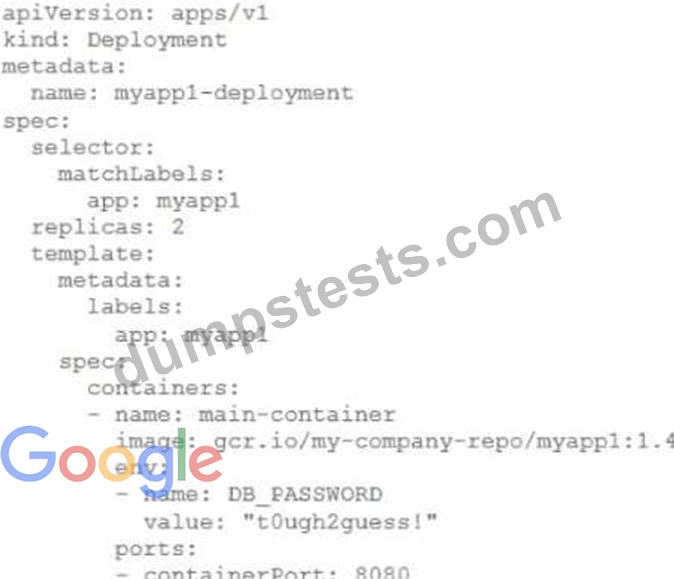
You need to refactor this configuration so that the database password is not stored in plain text. You want to follow Google-recommended practices. What should you do?
- A. Store the database password inside the Docker image of the container, not in the YAML file.
- B. Store the database password inside a Secret object. Modify the YAML file to populate the DB_PASSWORD environment variable from the Secret.
- C. Store the database password inside a ConfigMap object. Modify the YAML file to populate the DB_PASSWORD environment variable from the ConfigMap.
- D. Store the database password in a file inside a Kubernetes persistent volume, and use a persistent volume claim to mount the volume to the container.
Answer: C
NEW QUESTION 49
Every employee of your company has a Google account. Your operational team needs to manage a large number of instances on Compute Engine. Each member of this team needs only administrative access to the servers. Your security team wants to ensure that the deployment of credentials is operationally efficient and must be able to determine who accessed a given instance. What should you do?
- A. Ask each member of the team to generate a new SSH key pair and to send you their public key. Use a configuration management tool to deploy those keys on each instance.
- B. Ask each member of the team to generate a new SSH key pair and to add the public key to their Google account. Grant the "compute.osAdminLogin" role to the Google group corresponding to this team.
- C. Generate a new SSH key pair. Give the private key to each member of your team. Configure the public key as a project-wide public SSH key in your Cloud Platform project and allow project-wide public SSH keys on each instance.
- D. Generate a new SSH key pair. Give the private key to each member of your team. Configure the public key in the metadata of each instance.
Answer: C
Explanation:
Explanation/Reference: https://cloud.google.com/compute/docs/instances/adding-removing-ssh-keys
NEW QUESTION 50
Which of the following IP address would you specify to define a CIDR range that will apply to all the destination addresses?
- A. 10.0.0.0/8
- B. 0.0.0.0/0
- C. 172.16.0.0/12
- D. 192.168.0.0/16
Answer: B
NEW QUESTION 51
You're trying to create a new Compute Engine instance with the Cloud SDK using the createcommand from the compute group and the instances sub-group. You've forgotten some of the flags and want to look them up using the man pages. Which command will display the documentation you need?
- A. man gcloud_compute_instances_create
- B. man compute_instances_create
- C. man gcloud compute instances create
- D. man gcloud-compute-instances-create
Answer: A
NEW QUESTION 52
You have an instance group that you want to load balance. You want the load balancer to terminate the client SSL session. The instance group is used to serve a public web application over HTTPS. You want to follow Google-recommended practices. What should you do?
- A. Configure an external SSL proxy load balancer.
- B. Configure an HTTP(S) load balancer.
- C. Configure an internal TCP load balancer.
- D. Configure an external TCP proxy load balancer.
Answer: B
Explanation:
Reference:
https://cloud.google.com/load-balancing/docs/https/
NEW QUESTION 53
You are working with a Cloud SQL MySQL database at your company. You need to retain a month-end copy of the database for three years for audit purposes. What should you do?
- A. Convert the automatic first-of-the-month backup to an export file Write the export file to a Coldline class Cloud Storage bucket
- B. Save file automatic first-of-the- month backup for three years Store the backup file in an Archive class Cloud Storage bucket
- C. Set up an export job for the first of the month Write the export file to an Archive class Cloud Storage bucket
- D. Set up an on-demand backup tor the first of the month Write the backup to an Archive class Cloud Storage bucket
Answer: B
NEW QUESTION 54
You are given a project with a single virtual private cloud (VPC) and a single subnetwork in the us-central1 region. There is a Compute Engine instance hosting an application in this subnetwork. You need to deploy a new instance in the same project in the europe-west1 region. This new instance needs access to the application. You want to follow Google-recommended practices. What should you do?
- A. 1. Create a VPC and a subnetwork in europe-west1.
2. Expose the application with an internal load balancer.
3. Create the new instance in the new subnetwork and use the load balancer's address as the endpoint. - B. 1. Create a VPC and a subnetwork in europe-west1.
2. Peer the 2 VPCs.
3. Create the new instance in the new subnetwork and use the first instance's private address as the endpoint. - C. 1. Create a subnetwork in the same VPC, in europe-west1.
2. Use Cloud VPN to connect the two subnetworks.
3. Create the new instance in the new subnetwork and use the first instance's private address as the endpoint. - D. 1. Create a subnetwork in the same VPC, in europe-west1.
2. Create the new instance in the new subnetwork and use the first instance's private address as the endpoint.
Answer: D
NEW QUESTION 55
Your company runs its Linux workloads on Compute Engine instances. Your company will be working with a new operations partner that does not use Google Accounts. You need to grant access to the instances to your operations partner so they can maintain the installed tooling. What should you do?
- A. Tag all the instances with the same network tag. Create a firewall rule in the VPC to grant TCP access on port 22 for traffic from the operations partner to instances with the network tag.
- B. Ask the operations partner to generate SSH key pairs, and add the public keys to the VM instances.
- C. Enable Cloud IAP for the Compute Engine instances, and add the operations partner as a Cloud IAP Tunnel User.
- D. Set up Cloud VPN between your Google Cloud VPC and the internal network of the operations partner.
Answer: A
NEW QUESTION 56
You have a Compute Engine instance hosting an application used between 9 AM and 6 PM on weekdays. You want to back up this instance daily for disaster recovery purposes. You want to keep the backups for 30 days. You want the Google-recommended solution with the least management overhead and the least number of services. What should you do?
- A. 1. Create a bash script in the instance that copies the content of the disk to Cloud Storage.
2. Create a bash script in the instance that deletes data older than 30 days in the backup Cloud Storage bucket.
3. Configure the instance's crontab to execute these scripts daily at 1:00 AM. - B. 1. In the Cloud Console, go to the Compute Engine Disks page and select your instance's disk.
2. In the Snapshot Schedule section, select Create Schedule and configure the following parameters:
- Schedule frequency: Daily
- Start time: 1:00 AM ?2:00 AM
- Autodelete snapshots after 30 days - C. 1. Update your instances' metadata to add the following value: snapshot-schedule: 0 1 * * *
2. Update your instances' metadata to add the following value: snapshot-retention: 30 - D. 1. Create a Cloud Function that creates a snapshot of your instance's disk.
2. Create a Cloud Function that deletes snapshots that are older than 30 days.
3. Use Cloud Scheduler to trigger both Cloud Functions daily at 1:00 AM.
Answer: B
NEW QUESTION 57
Your company runs one batch process in an on-premises server that takes around 30 hours to complete. The task runs monthly, can be performed offline, and must be restarted if interrupted. You want to migrate this workload to the cloud while minimizing cost. What should you do?
- A. Migrate the workload to a Compute Engine Preemptible VM.
- B. Create an Instance Template with Preemptible VMs On. Create a Managed Instance Group from the template and adjust Target CPU Utilization. Migrate the workload.
- C. Migrate the workload to a Google Kubernetes Engine cluster with Preemptible nodes.
- D. Migrate the workload to a Compute Engine VM. Start and stop the instance as needed.
Answer: C
Explanation:
Explanation/Reference: https://cloud.google.com/kubernetes-engine/docs/tutorials/migrating-node-pool
NEW QUESTION 58
You are managing several Google Cloud Platform (GCP) projects and need access to all logs for the past 60 days. You want to be able to explore and quickly analyze the log contents. You want to follow Google- recommended practices to obtain the combined logs for all projects. What should you do?
- A. Configure a Cloud Scheduler job to read from Stackdriver and store the logs in BigQuery. Configure the table expiration to 60 days.
- B. Create a Stackdriver Logging Export with a Sink destination to Cloud Storage. Create a lifecycle rule to delete objects after 60 days.
- C. Navigate to Stackdriver Logging and select resource.labels.project_id="*"
- D. Create a Stackdriver Logging Export with a Sink destination to a BigQuery dataset. Configure the table expiration to 60 days.
Answer: D
Explanation:
Explanation/Reference: https://cloud.google.com/blog/products/gcp/best-practices-for-working-with-google-cloud-audit- logging
NEW QUESTION 59
A retail company has sensors placed in its physical retail stores. The sensors send messages over HTTP when customers interact with in-store product displays. A Solutions Architect needs to implement a system for processing those sensor messages; the results must be available for the Data Analysis team.
Which architecture should be used to meet these requirements?
- A. Implement an Amazon API Gateway to server as the HTTP endpoint. Have the API Gateway trigger an AWS Lambda function to process the messages, and save the results to an Amazon DynamoDB table.
- B. Use Amazon Route 53 to direct incoming sensor messages to a Lambda function to process the message and save the results to a Amazon DynamoDB table.
- C. Use AWS Direct Connect to connect sensors to DynamoDB so that data can be written directly to a DynamoDB table where it can be accessed by the Data Analysis team.
- D. Create an Amazon EC2 instance to server as the HTTP endpoint and to process the messages. Save the results to Amazon S3 for the Data Analysis team to download.
Answer: A
NEW QUESTION 60
Your organization uses Active Directory (AD) to manage user identities. Each user uses this identity for federated access to various on-premises systems. Your security team has adopted a policy that requires users to log into Google Cloud with their AD identity instead of their own login.
You want to follow the Google-recommended practices to implement this policy.
What should you do?
- A. Sync Identities in the Google Admin console, and then enable Oauth for single sign-on
- B. Sync identities with Cloud Directory Sync, and then copy passwords to allow simplified login with the same credentials.
- C. Sync identities with 3rd party LDAP sync, and then copy passwords to allow simplified login with (he same credentials
- D. Sync Identities with Cloud Directory Sync, and then enable SAML for single sign-on
Answer: D
NEW QUESTION 61
Your organization is a financial company that needs to store audit log files for 3 years. Your organization has hundreds of Google Cloud projects. You need to implement a cost-effective approach for log file retention.
What should you do?
- A. Create an export to the sink that saves logs from Cloud Audit to a Coldline Storage bucket.
- B. Create an export to the sink that saves logs from Cloud Audit to BigQuery.
- C. Write a custom script that uses logging API to copy the logs from Stackdriver logs to BigQuery.
- D. Export these logs to Cloud Pub/Sub and write a Cloud Dataflow pipeline to store logs to Cloud SQL.
Answer: B
Explanation:
Explanation/Reference: https://cloud.google.com/logging/docs/audit/
NEW QUESTION 62
......
Online Questions - Valid Practice Associate-Cloud-Engineer Exam Dumps Test Questions: https://www.dumpstests.com/Associate-Cloud-Engineer-latest-test-dumps.html
Latest Associate-Cloud-Engineer Actual Free Exam Updated 245 Questions: https://drive.google.com/open?id=1w9SFNB9jo-gLPd7mamUHdXKdvd3mWVV8