

[Apr-2026] FCSS_NST_SE-7.6 Questions - Truly Beneficial For Your Fortinet Exam
Download Fortinet FCSS_NST_SE-7.6 Sample Questions
NEW QUESTION # 41
Refer to the exhibit, which shows the partial output of command diagnose debug rating.
In this exhibit, which FDS server will the FortiGate algorithm choose?
- A. 66.117.56.37
- B. 208.91.112.194
- C. 64.26.151.37
- D. 209.22.147.36
Answer: C
NEW QUESTION # 42
Which statement about parallel path processing is correct (PPP)?
- A. Software configuration has no impact on PPP.
- B. Only FortiGate hardware configurations affect the path that a packet takes.
- C. PPP chooses from a group of parallel options lo identity the optimal path tor processing a packet.
- D. PPP does not apply to packets that are part of an already established session.
Answer: C
NEW QUESTION # 43
Refer to the exhibit, which shows partial outputs from two routing debug commands.
Which change must an administrator make on FortiGate to route web traffic from internal users to the internet, using ECMP?
- A. Set preserve-session-route to enable.
- B. Set the priority of the static default route using port2 to 1.
- C. Set the priority of the static default route using port1 to 10.
- D. Set snat-route-change to enable.
Answer: C
NEW QUESTION # 44
Exhibit.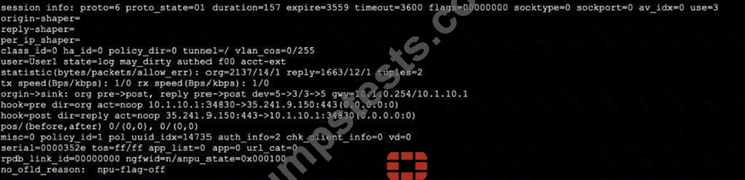
Refer to the exhibit, which shows the output of a session. Which two statements are true? (Choose Iwo.)
- A. The session is being inspected using flow inspection.
- B. The TCP session has been successfully established.
- C. The session was initiated from an authenticated user.
- D. The session is being offloaded.
Answer: B,C
NEW QUESTION # 45
Exhibit.
Refer to the exhibit, which shows the output of get system ha status.
NGFW-1 and NGFW-2 have been up for a week.
Which two statements about the output are true? (Choose two.)
- A. If port 7 becomes disconnected on the secondary, both FortiGate devices will elect itself as primary.
- B. If a configuration change is made to the primary FortiGate at this time, the secondary will initiate a synchronization reset.
- C. If FGVM...649 is rebooted. FGVM...650 will become the primary and retain that role, even after FGVM...649 rejoins the cluster.
- D. If no action is taken, the primary FortiGate will leave the cluster because of the current sync status.
Answer: A,C
NEW QUESTION # 46
Refer to the exhibit, which shows the partial output of FortiOS kernel slabs.
Which statement is true?
- A. The total slab size of the ip_session slab is 3600 kB and is associated with the user space.
- B. The total slab size of the sctp_session slab is 0 kB and is associated with the user space.
- C. The total slab size of the ip6_session slab is 1300 kB and is associated with the kernel.
- D. The total slab size of the tcp_session slab is 7500 kB and is associated with the kernel.
Answer: D
NEW QUESTION # 47
A FortiGate administrator is troubleshooting a VPN that is failing to establish.
As a first step, the administrator is attempting to sniff the traffic using the command:
# diagnose sniffer packet any ''udp port 500 or udp port 4500 or esp'' 4 After several minutes there is still no output. What is the most Likely reason for this?
- A. The VPN is configured to use IKE over TCP
- B. The ISP is blocking all VPN traffic.
- C. esp is not a valid sniffer argument.
- D. Mismatched IKE versions are detected on the VPN peers
Answer: A
Explanation:
The administrator is running a packet sniffer with the filter 'udp port 500 or udp port 4500 or esp'. The result is "no output," even though the VPN is attempting to establish (failing).
* A. The VPN is configured to use IKE over TCP:
* Standard IPsec IKE negotiation uses UDP port 500 (IKE) and UDP port 4500 (NAT-T).
* However, if IKEv2 over TCP (RFC 8229) or Fortinet's proprietary IKE over TCP is configured (often used to bypass firewalls that block UDP), the traffic will use TCP (often port 4500 or 443).
* The sniffer filter explicitly looks for udp or esp (IP Protocol 50).
* If the traffic is encapsulated in TCP, it matches tcp protocol, not udp or esp (raw ESP). Therefore, the sniffer sees zero packets matching the filter.
* Why other options are incorrect:
* B: esp is a valid argument for diagnose sniffer packet. It is equivalent to filtering for IP protocol
50.
* C: If the ISP were blocking traffic, the sniffer (running on the local FortiGate) would still see the outbound packets generated by the FortiGate trying to initiate the connection. "No output" implies the local device isn't even generating packets matching that filter.
* D: Mismatched IKE versions would still generate IKE negotiation packets (proposals/errors) that would be captured by the sniffer.
Reference:
FortiGate Security 7.6 Study Guide (IPsec VPN): "IKEv2 over TCP is available for environments where UDP 500/4500 is blocked. When enabled, IKE and ESP packets are encapsulated in TCP headers."
NEW QUESTION # 48
Which exchange lakes care of DoS protection in IKEv2?
- A. IKE_Req_INIT
- B. IKE_SA_NIT
- C. IKE_Auth
- D. Create_CHILD_SA
Answer: A
NEW QUESTION # 49
Refer to the exhibit showing a debug output.
An administrator deployed FSSO in DC Agent Mode but FSSO is failing on FortiGate. Pinging FortiGate from where the collector agent is deployed is successful.
The administrator then produces the debug output shown in the exhibit.
What could be causing this error message?
- A. The collector agent preshared password is mismatched.
- B. The FortiGate and the collector agent are using different TCP ports.
- C. The FortiGate cannot resolve the active directory server name.
- D. The TCP port 445 is blocked between FortiGate and collector agent.
Answer: B
NEW QUESTION # 50
Refer to the exhibit.
An IPsec VPN tunnel is dropping, as shown by the debug output.
Analyzing the debug output, what could be causing the tunnel to go down?
- A. The tunnel drops during rekey negotiation.
- B. The tunnel drops after the timer expires.
- C. Dead Peer Detection is not receiving its acknowledge packet.
- D. Phase 2 drops but Phase 1 is up.
Answer: C
NEW QUESTION # 51
Refer to the exhibit.
Which three pieces of information does the diagnose sys top command provide? (Choose three.)
- A. If the neweli daemon continues to be in the R state, it will need to be manually restarted.
- B. The miglogd daemon is running on CPU core ID 0.
- C. The cmdbsvr process is occupying 2.4% of the total user memory space.
- D. The miglogd daemon would be on top of the list, if the administrator pressed m on the keyboard.
- E. The diagnose sys top command has been running for 18 minutes.
Answer: B,C,D
NEW QUESTION # 52
Which statement about IKEv2 is true?
- A. Both IKEv1 and IKEv2 share the feature of asymmetric authentication.
- B. IKEv1 and IKEv2 use same TCP port but run on different UDP ports.
- C. IKEv1 and IKEv2 share the concept of phase1 and phase2.
- D. IKEv1 and IKEv2 have enough of the header format in common that both versions can run over the same UDP port.
Answer: C
Explanation:
IKEv1 (Internet Key Exchange version 1) and IKEv2 are protocols used for establishing IPsec VPN tunnels, and both protocols share the conceptual division into two phases, as clearly described in Fortinet VPN documentation:
* Phase 1 handles negotiation and establishment of a secure IKE Security Association (SA) between peers.
* Phase 2 negotiates parameters for the IPsec Security Association, which secures actual data traffic between peers.
While IKEv2 streamlines and improves upon IKEv1 by merging some message exchanges and simplifying configuration, it maintains the same core two-phase concept: Phase 1 (IKE SA) and Phase 2 (IPsec SA). This is a foundational VPN concept referenced widely in both IKEv1 and IKEv2 literature.
Other statements are incorrect:
* Asymmetric authentication is possible, but not mandatory for both.
* Both protocols commonly use UDP port 500, sometimes 4500 for NAT traversal, but they are not designed to run on TCP.
* The protocol feature compatibility over TCP/UDP is not correctly described in the other options.
Reference:
FortiOS Administration Guide: IPsec VPN, "IKEv1 vs. IKEv2 Concepts and Phase Negotiations" RFCs and Fortinet VPN solution guides on phase structure
NEW QUESTION # 53
Which two statements about an auxiliary session ate true? (Choose two.)
- A. With the auxiliary session setting disabled, for each traffic path. FortiGate uses the same auxiliary session.
- B. With the auxiliary session setting enabled. ECMP traffic is accelerated to the NP6 processor.
- C. With the auxiliary session selling disabled, only auxiliary sessions are offloaded.
- D. With the auxiliary session setting enabled. Iwo sessions are created in case of routing change.
Answer: B,D
NEW QUESTION # 54
Which two statements about Security Fabric communications are true? (Choose two.)
- A. FortiTelemetry must be manually enabled on the FortiGate interface.
- B. FortiTelemetry and Neighbor Discovery both operate using TCP.
- C. The default port for Neighbor Discovery can be modified.
- D. By default, the downstream FortiGate establishes a connection with the upstream FortiGate using TCP port 8013.
Answer: A,D
NEW QUESTION # 55
Refer to the exhibits.
An administrator Is expecting to receive advertised route 8.8.8.8/32 from FGT-A. On FGT-B, they confirm that the route is being advertised and received, however, the route is not being injected into the routing table.
What is the most likely cause of this issue?
- A. FGT-B is configured with a prefix list denying the 8.8.8.8/32 network to be injected into the routing table.
- B. A batter route to the 8.8.8.8/32 network exists in the routing table.
- C. FGT-8 is configured with a distribution list denying the 8.8.8.8/32 network to be injected into the routing table.
- D. The administrator has misconfigured redistribution of routes on FGT-A.
Answer: A
Explanation:
The 8.8.8.8/32 route is visible in the OSPF database on FGT-B but not installed into the routing table-the most likely explanation is that FGT-B is filtering it from being installed.
NEW QUESTION # 56
Refer to the exhibit.
A partial output of diagnose npu up6 port-list on FortiGate 2000E is shown.
An administrator is unable to analyze traffic flowing between port1 and port17 using the diagnose sniffer command.
Which two commands allow the administrator to view the traffic? (Choose two.)
- A.

- B.

- C.

- D.

Answer: C,D
Explanation:
The administrator cannot see traffic in the sniffer because it is being offloaded to the NPU (NP6). To view the traffic, offloading must be disabled so packets pass through the CPU.
* B. config firewall policy ... set auto-asic-offload disable: This is the recommended method to troubleshoot specific traffic. By disabling ASIC offloading in the relevant firewall policies (Policies 5 and 17 in the exhibit), traffic is forced to the CPU and becomes visible to the sniffer.
* C. diagnose npu np6 fastpath disable 1: This command temporarily disables the fastpath processing on the specific NP6 processor (ID 1) handling the ports. This forces all traffic handled by that NPU to the CPU, allowing the sniffer to capture it.
* Incorrect Options: Option A uses invalid syntax (port-list disable is not a valid command). Option D (config system npu) is not the standard method for granular troubleshooting.
NEW QUESTION # 57
Exhibit.
Refer to the exhibit, which shows the output of get system ha status.
NGFW-1 and NGFW-2 have been up for a week.
Which two statements about the output are true? (Choose two.)
- A. If port 7 becomes disconnected on the secondary, both FortiGate devices will elect itself as primary.
- B. If a configuration change is made to the primary FortiGate at this time, the secondary will initiate a synchronization reset.
- C. If FGVM...649 is rebooted. FGVM...650 will become the primary and retain that role, even after FGVM...649 rejoins the cluster.
- D. If no action is taken, the primary FortiGate will leave the cluster because of the current sync status.
Answer: A,C
Explanation:
FortiGate HA Troubleshooting and Synchronization Guides
Fortinet Admin Guide: HA Primary Role Retention, Cluster Break-up Due to Out-of-Sync Status
NEW QUESTION # 58
Refer to the exhibit.
The output of diagnose sys session list command is shown.
If the HA ID for the primary device is 9, what happens if the primary fails and the secondary becomes the primary?
- A. The session is synchronized with the secondary device, however, because application control is applied.
the session is marked dirty and has to be reevaluated after failover. - B. The session continues to permit traffic on the new primary device after failover. without requiring the client to restart the session with the server.
- C. The session state is preserved but the kernel will re-evaluate the session because the routing information will be flushed
- D. The session will be removed from the session table of the secondary device because the TCP session is not yet fully established.
Answer: B
Explanation:
The output of the diagnose sys session list command provides the critical evidence needed to determine the behavior during a failover:
Session Synchronization (synced):
The most important indicator in the exhibit is the synced flag located in the state= line (state=may_dirty synced none app_ntf).
In FortiOS HA (High Availability), the synced flag confirms that this specific session has been successfully synchronized from the primary device to the secondary (backup) device.
Session synchronization (Session Pickup) ensures that if the primary unit fails, the secondary unit already has the session in its table and can resume traffic processing immediately.
TCP State (proto_state=01):
The output shows proto=6 (TCP) and proto_state=01.
In the FortiGate session table, proto_state=01 for TCP indicates that the session is in the ESTABLISHED state (post-three-way handshake).
This invalidates Option B, which claims the TCP session is not fully established.
Failover Outcome:
Because the session is ESTABLISHED and SYNCED, the secondary device will seamlessly take over the session upon primary failure.
The traffic continues to flow through the new primary without requiring the user/client to restart the connection. This is the primary function of HA Session Pickup.
Why other options are incorrect:
A: While the output shows app_ntf (Application Control notification) and may_dirty, the presence of the synced flag overrides this concern regarding failover. If the session type were not supported for failover (e.g., certain proxy sessions in older versions), it would not be marked as synced. Since it is synced, it persists.
B: As noted, proto_state=01 means established, not "not fully established".
D: While the kernel updates routing tables, the purpose of syncing the session is to preserve the state so it does not need to be re-evaluated as a new packet would, preventing traffic drops.
Reference:
FortiGate Security 7.6 Study Guide (High Availability): "If session pickup is enabled, the primary unit synchronizes its session table... to the backup unit. If the primary unit fails, the backup unit... continues to process the sessions with no interruption."
NEW QUESTION # 59
Refer to the exhibit.
Partial output of the fssod daemon real-time debug command is shown. Which two conclusions can you draw from the output? (Choose two answers)
- A. FortiGate is frequently polling the workstation in case the user has logged out.
- B. FSSO cannot verify if the user is still logged in.
- C. FSSO is using agentless polling mode to detect logon events.
- D. Fortinet Single Sign-On (FSSO) is using DC Agent mode to detect logon events.
- E. FortiGate polled this event through TCP port 8000.
Answer: B,C
Explanation:
The debug command diagnose debug application fssod -1 reveals the internal processing of the FortiGate Single Sign-On daemon.
* Option D (Agentless Polling): The output shows event_id=4768. Event ID 4768 (Kerberos TGT Request) is a Windows Event Log entry. The presence of specific Event IDs in the fssod debug, rather than a generic logon notification, indicates that the system is reading (polling) the Security Event Logs from the Domain Controller. This is characteristic of Agentless Polling Mode (or Collector Agent Polling Mode), where the FortiGate or Collector scrapes logs. In contrast, DC Agent mode intercepts logon calls directly and would typically provide more complete information, including the workstation name.
* Option A (Verification): Crucially, the output shows workstation=,, indicating the workstation name field is empty. In Polling Mode, certain Event IDs (like 4768) often do not contain the source workstation's hostname. Without the workstation name, the FortiGate (or Collector) cannot perform a workstation check (WMI/Registry poll) to verify if the user is still logged in. It essentially has to rely on the "dead entry timeout" because active verification is impossible without the target machine's name.
Option B is incorrect because DC Agents reliably capture workstation names. Option C is incorrect because the system cannot poll a workstation it cannot identify.
NEW QUESTION # 60
Exhibit.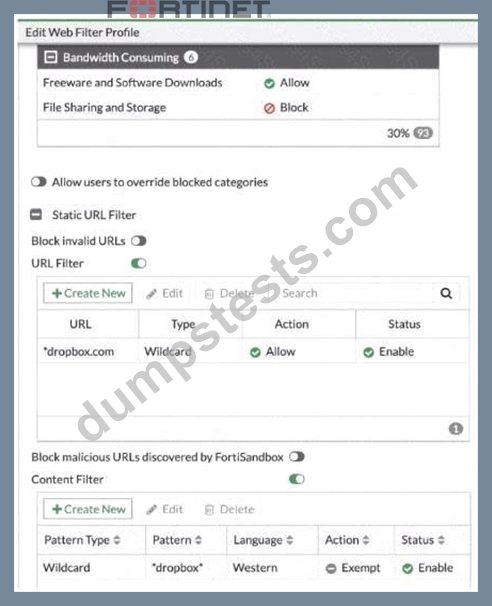
Refer to the exhibit, which shows a partial web fillet profile configuration.
Which action does FortiGate lake if a user attempts to access www. dropbox. com, which is categorized as File Sharing and Storage?
- A. FortiGate blocks the connection as an invalid URL.
- B. FortiGate exempts the connection, based on the Web Content Filter configuration.
- C. FortiGate allows the connection, based on the URL Filter configuration.
- D. FortiGate blocks the connection, based on the FortiGuard category based filter configuration.
Answer: D
Explanation:
https://community.fortinet.com/t5/FortiGate/Technical-Tip-FortiGate-Static-URL-filter-actions-explained/ta-p
/206632
NEW QUESTION # 61
Consider the scenario where the server name indication (SNI) does not match either the common name (CN) or any of the subject alternative names (SAN) in the server certificate.
Which action will FortiGate take when using the default settings for SSL certificate inspection?
- A. FortiGate uses the SNI from the user's web browser.
- B. FortiGate closes the connection because this represents an invalid SSL/TLS configuration.
- C. FortiGate uses the first entry listed in the SAN field in the server certificate.
- D. FortiGate uses the CN information from the Subject field in the server certificate.
Answer: D
NEW QUESTION # 62
Refer to the exhibit, which shows a partial output of a real-time LDAP debug.
What two conclusions can you draw from the output? (Choose two.)
- A. FortiOS collects the user group information.
- B. FortiOS performs a bind to the LDAP server using the user's credentials.
- C. The user was found in the LDAP tree, whose root is TAC.ottawa.fortinet.com.
- D. FortiOS is performing the second step (Search Request) in the LDAP authentication process.
Answer: C,D
NEW QUESTION # 63
Refer to the exhibit.
Which three pieces of information does the diagnose sys top command provide? (Choose three.)
- A. If the neweli daemon continues to be in the R state, it will need to be manually restarted.
- B. The miglogd daemon is running on CPU core ID 0.
- C. The cmdbsvr process is occupying 2.4% of the total user memory space.
- D. The miglogd daemon would be on top of the list, if the administrator pressed m on the keyboard.
- E. The diagnose sys top command has been running for 18 minutes.
Answer: B,C,D
Explanation:
https://community.fortinet.com/t5/FortiGate/Technical-Tip-Using-the-diagnose-sys-top-CLI-command/ta-p
/190238
NEW QUESTION # 64
Refer to the exhibit.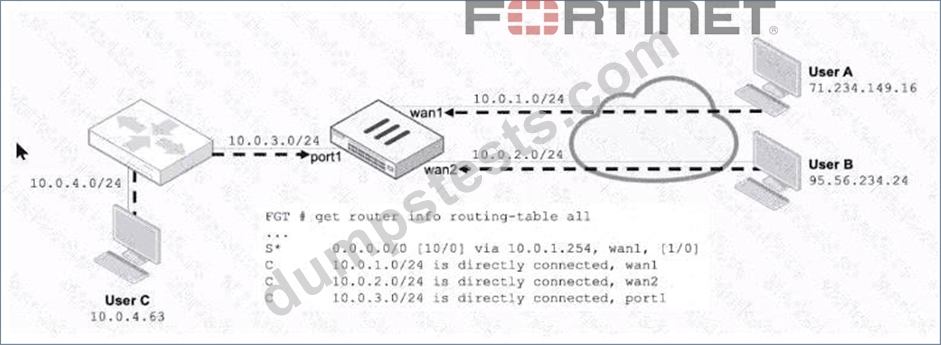
Assuming a default configuration, which three statements are true? (Choose three.)
- A. User B: Fail. There is no route to 95.56.234.24 using wan2 in the routing table.
- B. User C: Fail. There is no route to 10.0.4.63 using port1 in the touting table.
- C. Strict RPF is enabled by default.
- D. User A: Pass. The default static route through wan1 passes the RPF check regardless of the source IP address.
- E. User B: Pass. FortiGate will use asymmetric routing using wan1 to reply to traffic for 95.56.234.24.
Answer: A,B,D
Explanation:
References:
Fortinet Technical Note: RPF Default Configuration and Routing Table Matching FortiGate Administration Guide: Routing and Asymmetric Routing Controls Community Knowledgebase: Route Lookups and RPF Enforcement on FortiOS
NEW QUESTION # 65
What are two reasons that an OSPF router does not have any type 5 tank-state advertisements (LSAs) In its link-stale database (LSD6)? (Choose two.)
- A. IP protocol 89 is blocked between the local router and its peer.
- B. The local router is located in a stub area
- C. The peer of the local router is using a prefix-list-out. configuration to prevent all type 5 LSAs to be advertised.
- D. There is no autonomous system border router (ASBR) in the network,
Answer: B,D
Explanation:
To understand why Type 5 LSAs (AS External LSAs) are missing from the Link-State Database (LSDB), we must look at how OSPF generates and propagates them:
* A. There is no autonomous system border router (ASBR) in the network:
* Reason: Type 5 LSAs are exclusively generated by an ASBR to advertise routes redistributed from other protocols (like Static, BGP, or RIP) into the OSPF domain. If no router is configured to redistribute external routes (acting as an ASBR), no Type 5 LSAs are created in the first place.
* C. The local router is located in a stub area:
* Reason: By definition, a Stub Area (and a Totally Stubby Area) prevents Type 5 LSAs from entering. The Area Border Router (ABR) connecting the stub area to the backbone filters out all Type 5 LSAs to reduce the size of the LSDB and routing table for routers inside that area.
Instead, a default route is usually injected.
* Why other options are incorrect:
* B: While database filtering exists, standard prefix-list filtering typically affects the routing table (RIB) generation, not the underlying LSDB propagation of Type 5 LSAs, or it is less common than the architectural reasons (Stub/No ASBR).
* D: IP Protocol 89 is the transport for OSPF itself. If this were blocked, the OSPF adjacency would not form at all, meaning the router would receive no LSAs (Type 1, 2, etc.), not specifically just Type 5.
Reference:
FortiGate Security 7.6 Study Guide (OSPF): "Type 5 LSAs are generated by ASBRs... Stub areas do not allow Type 5 LSAs; they are replaced by a default route."
NEW QUESTION # 66
......
Fortinet FCSS_NST_SE-7.6 Exam Syllabus Topics:
| Topic | Details |
|---|---|
| Topic 1 |
|
| Topic 2 |
|
| Topic 3 |
|
| Topic 4 |
|
| Topic 5 |
|
Truly Beneficial For Your Fortinet Exam: https://www.dumpstests.com/FCSS_NST_SE-7.6-latest-test-dumps.html
Real FCSS_NST_SE-7.6 Exam Questions and Answers FREE: https://drive.google.com/open?id=1oXfWwwLVKeP-yIq6kXpx4izQi-pFa8Nw