

100% Updated Microsoft AZ-120 Enterprise PDF Dumps
Use Valid Exam AZ-120 by DumpsTests Books For Free Website
The Microsoft AZ-120: Planning and Administering Microsoft Azure for SAP Workloads exam is the main requirement for getting the Microsoft Certified: Azure for SAP Workloads Specialty certification. There are no other related tests that are associated with this certificate.
NEW QUESTION 61
You have an on-premises SAP environment. Application servers run on SUSE Linux Enterprise Server (SLES) servers. Databases run on SLES servers that have Oracle installed.
You need to recommend a solution to migrate the environment to Azure. The solution must use currently deployed technologies whenever possible and support high availability.
What should you include in the recommendation? To answer, select the appropriate options in the answer area.
NOTE: Each correct selection is worth one point.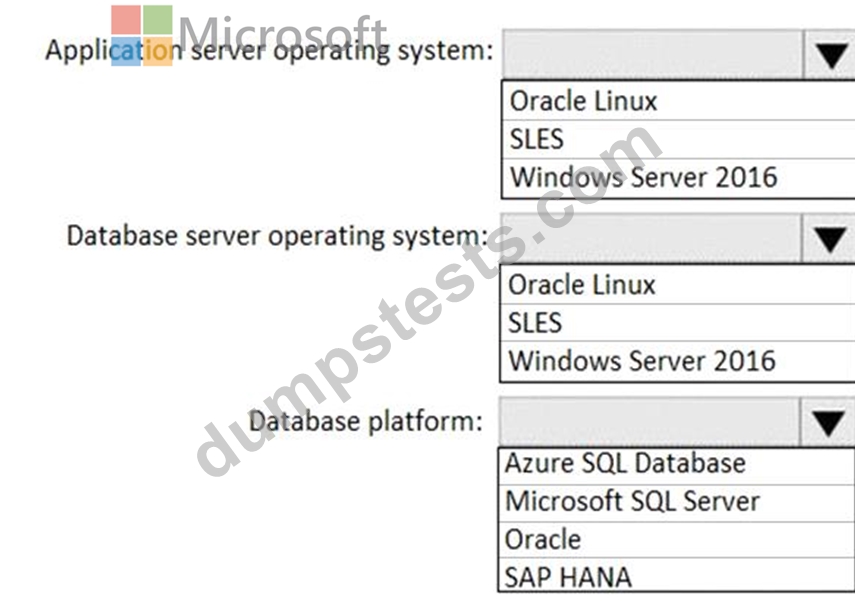
Answer:
Explanation: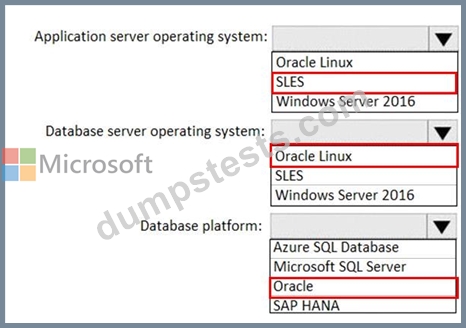
NEW QUESTION 62
Your on-premises network contains an Active Directory domain.
You have an SAP environment on Azure that runs on SUSE Linux Enterprise Server (SLES) servers.
You configure the SLES servers to use domain controllers as their NTP servers and their DNS servers.
You need to join the SLES servers to the Active Directory domain.
Which three actions should you perform in sequence? To answer, move the appropriate actions from the list of actions to the answer area and arrange them in the correct order.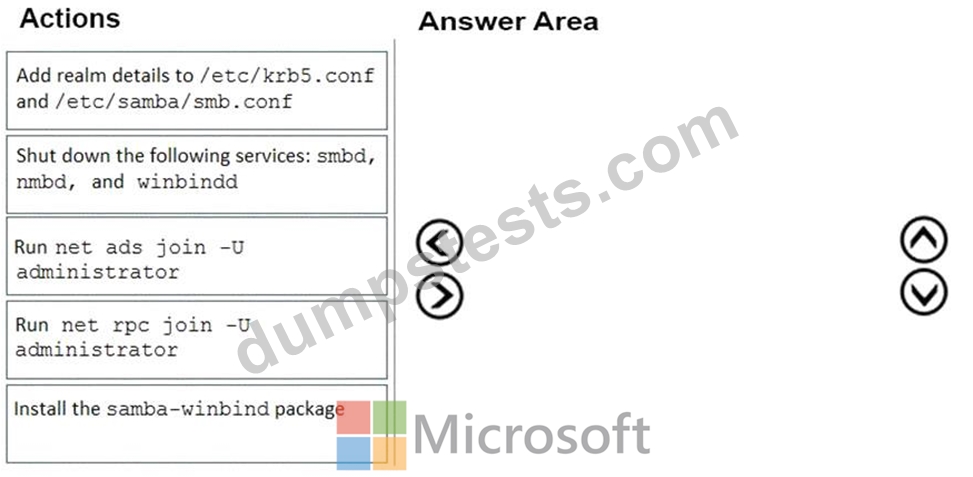
Answer:
Explanation: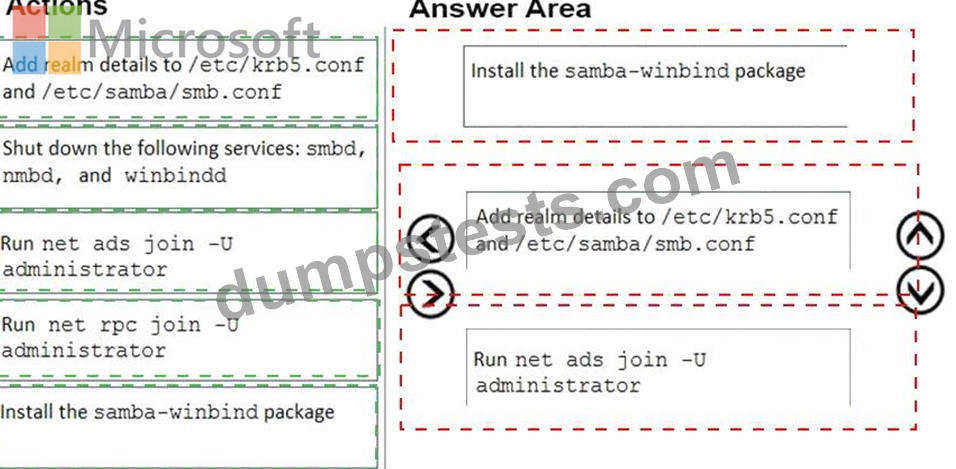
Explanation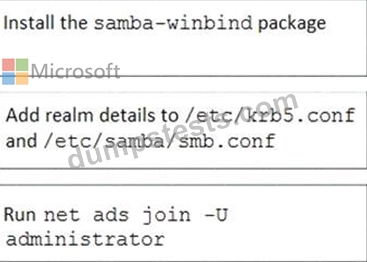
Step 1: Install the samba-winbind package
Install samba-winbind
Step 2: Add realm details to /etc/krb5.conf and /etc/samba/smb.conf
Edit files - best way to do this is to use yast on test machine and copy files from it In following examples you need to replace EXAMPLE/EXAMPLE.COM/.example.com with your values/settings
/etc/samba/smb.conf
[global]
workgroup = EXAMPLE
usershare allow guests = NO #disallow guests from sharing
idmap gid = 10000-20000
idmap uid = 10000-20000
kerberos method = secrets and keytab
realm = EXAMPLE.COM
security = ADS
template homedir = /home/%D/%U
template shell = /bin/bash
winbind offline logon = yes
winbind refresh tickets = yes
/etc/krb5.conf
[libdefaults]
default_realm = EXAMPLE.COM
clockskew = 300
[realms]
EXAMPLE.COM = {
kdc = PDC.EXAMPLE.COM
default_domain = EXAMPLE.COM
admin_server = PDC.EXAMPLE.COM
}
Step 3: Run net ads join -U administrator
Join the SLES 12 Server to the AD domain
References:
https://www.suse.com/support/kb/doc/?id=7018461
NEW QUESTION 63
Note: This question is part of a series of questions that present the same scenario. Each question in the series contains a unique solution that might meet the stated goals. Some question sets might have more than one correct solution, while others might not have a correct solution.
After you answer a question in this section, you will NOT be able to return to it. As a result, these questions will not appear in the review screen.
You have a complex SAP environment that has both ABAP- and Java-based systems. The current on-premises landscapes are based on SAP NetWeaver 7.0 (Unicode and Non-Unicode) running on Windows Server and Microsoft SQL Server.
You need to migrate the SAP environment to a HANA-certified Azure environment.
Solution: You migrate SAP to Azure by using Azure Site Recovery, and then you upgrade to SAP NetWeaver
7.4.
Does this meet the goal?
- A. Yes
- B. No
Answer: B
Explanation:
Explanation
We need upgrade to SAP NetWeaver 7.4 before the migration.
Reference:
https://docs.microsoft.com/en-us/azure/site-recovery/vmware-azure-architecture
NEW QUESTION 64
You are validating an SAP HANA on Azure (Large Instances) deployment.
You need to ensure that sapconf is installed and the kernel parameters are set appropriately for the active profile.
How should you complete the commands? To answer, drag the appropriate values to the correct targets. Each value may be used once, more than once, or not at all. You may need to drag the split bar between panes or scroll to view content.
NOTE: Each correct selection is worth one point.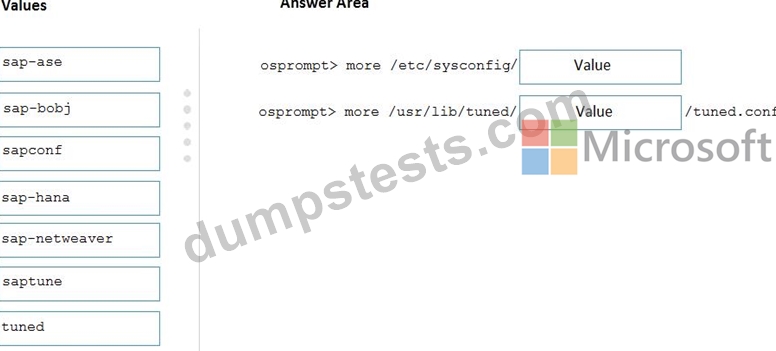
Answer:
Explanation: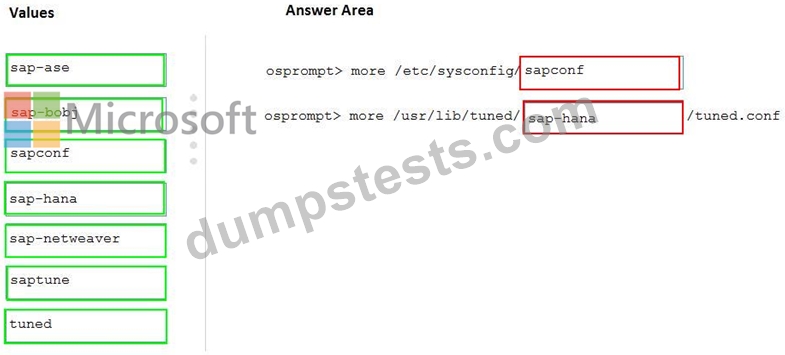
Reference:
https://blogs.sap.com/2017/12/22/prepare-your-linux-for-your-sap-solution-with-saptune/
NEW QUESTION 65
You have an on-premises SAP environment.
Backups are performed by using tape backups. There are 50 TB of backups.
A Windows file server has BMP images of checks used by SAP Finance. There are 9 TB of images.
You need to recommend a method to migrate the images and the tape backups to Azure. The solution must maintain continuous replication of the images.
What should you include in the recommendation? To answer, select the appropriate options in the answer area.
NOTE: Each correct selection is worth one point.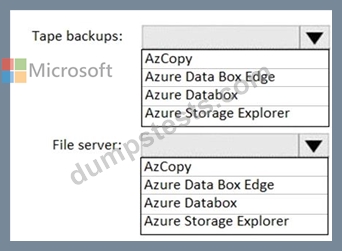
Answer:
Explanation: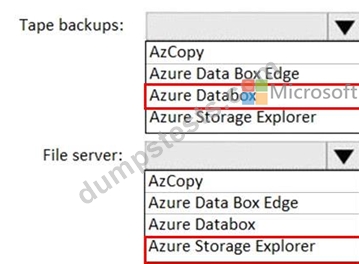
Explanation:
Tape backups: Azure DataBox
The Microsoft Azure Data Box cloud solution lets you send terabytes of data into Azure in a quick, inexpensive, and reliable way. The secure data transfer is accelerated by shipping you a proprietary Data Box storage device. Each storage device has a maximum usable storage capacity of 80 TB and is transported to your datacenter through a regional carrier. The device has a rugged casing to protect and secure data during the transit.
File server: Azure Storage Explorer
Azure Storage Explorer is an application which helps you to easily access the Azure storage account through any device on any platform, be it Windows, MacOS, or Linux. You can easily connect to your subscription and manipulate your tables, blobs, queues, and files.
Incorrect Answers:
Not Azure Data Box Edge: Azure Data Box Edge is rebranded as Azure Stack Edge. Azure Stack Edge is a Hardware-as-a-service solution. Microsoft ships you a cloud-managed device with a built-in Field Programmable Gate Array (FPGA) that enables accelerated AI-inferencing and has all the capabilities of a network storage gateway.
References:
https://docs.microsoft.com/en-us/azure/databox/data-box-overview
https://github.com/MicrosoftDocs/azure-docs/blob/master/articles/vs-azure-tools-storage-manage-with-storage-explorer.md
NEW QUESTION 66
For each of the following statements, select yes if the statement is true. Otherwise, select No.
NOTE: Each correct selection is worth one point.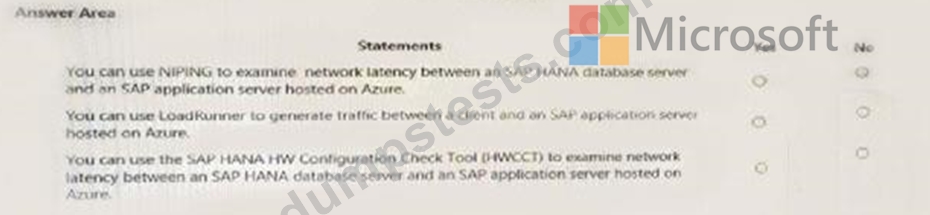
Answer:
Explanation:
Explanation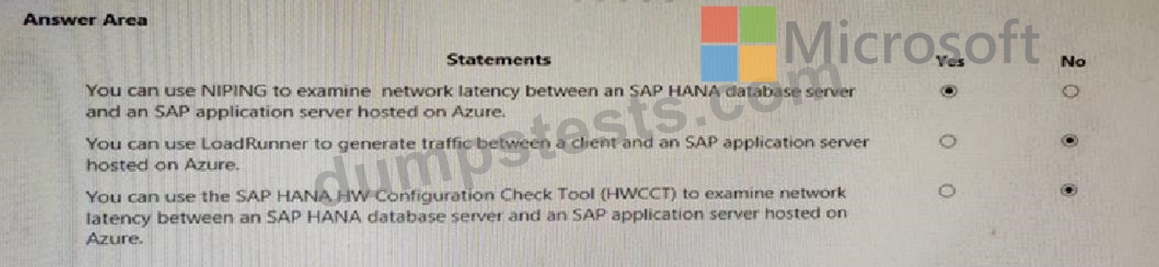
NEW QUESTION 67
You have an SAP environment on Azure.
You use Azure Recovery Services to back up an SAP application server.
You need to test the restoration process of a file on the server.
Which three actions should you perform in sequence? To answer, move the appropriate actions from the list of actions to the answer area and arrange them in the correct order.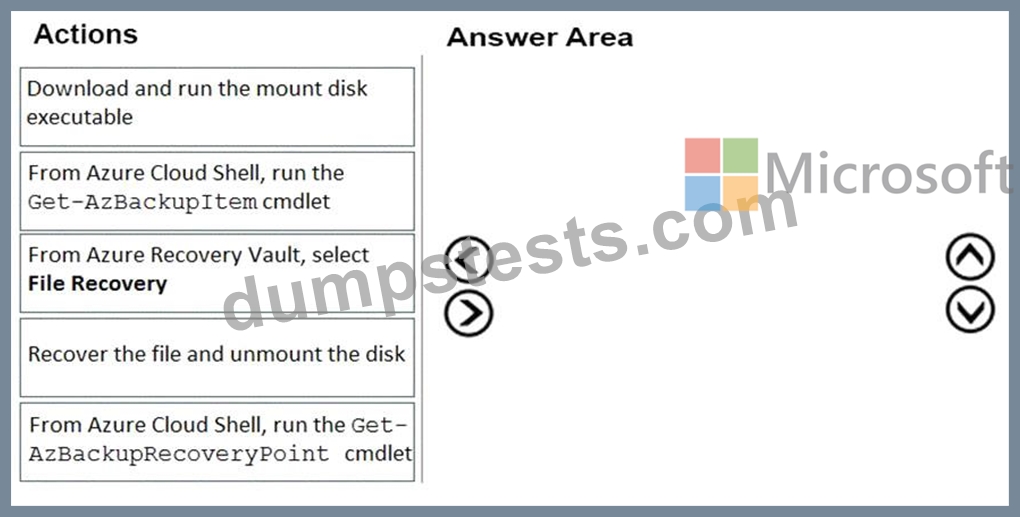
Answer:
Explanation: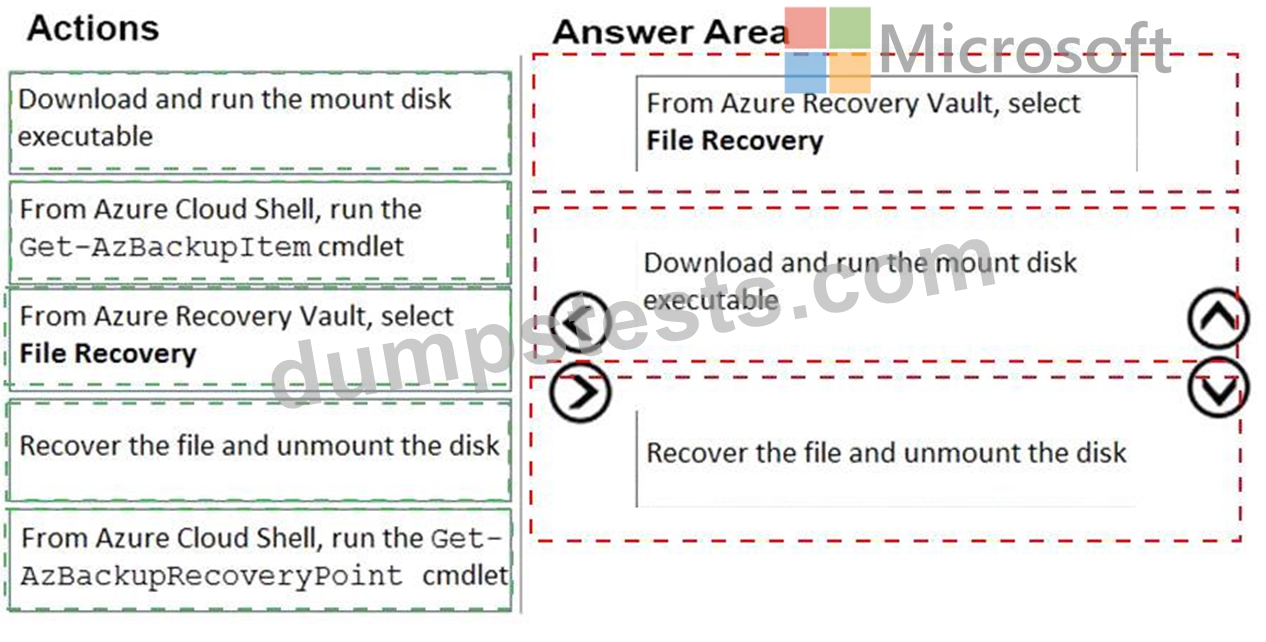
Explanation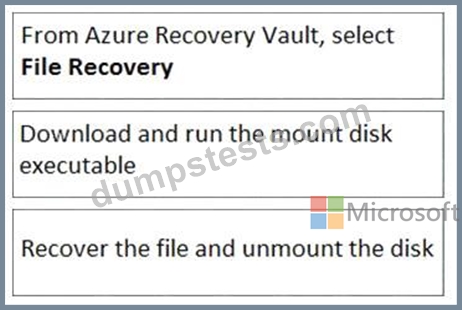
Step 1: From Azure Recover Vault, select File Recovery
To restore files or folders from the recovery point, go to the virtual machine and choose the desired recovery point.
Step 2: Download and run the mount disk executable
Step 3: recover the file and unmount the disk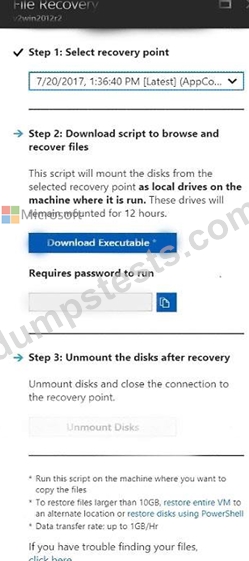
NEW QUESTION 68
You plan to deploy a highly available ASCS instance to SUSE Linux Enterprise Server (SLES) virtual machines in Azure.
You are configuring an internal Azure Standard Load Balancer for the ASCS instance.
How should you configure the internal Standard Load Balancer? To answer, select the appropriate options in the answer area.
NOTE: Each correct selection is worth one point.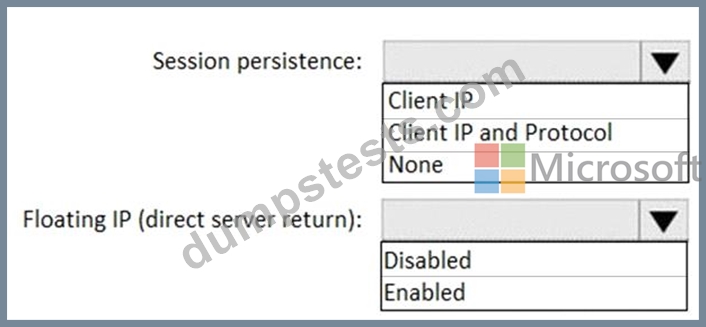
Answer:
Explanation: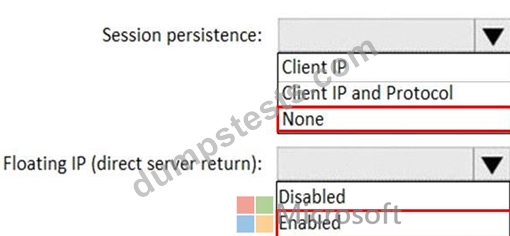
Reference:
https://docs.microsoft.com/en-us/azure/virtual-machines/workloads/sap/high-availability-guide-suse
NEW QUESTION 69
You migrate SAP ERP Central Component (SAP ECC) production and non-production landscapes to Azure.
You are licensed for SAP Landscape Management (LaMa).
You need to refresh from the production landscape to the non-production landscape.
Which four actions should you perform in sequence? To answer, move the appropriate actions from the list of actions to the answer area and arrange them in the correct order.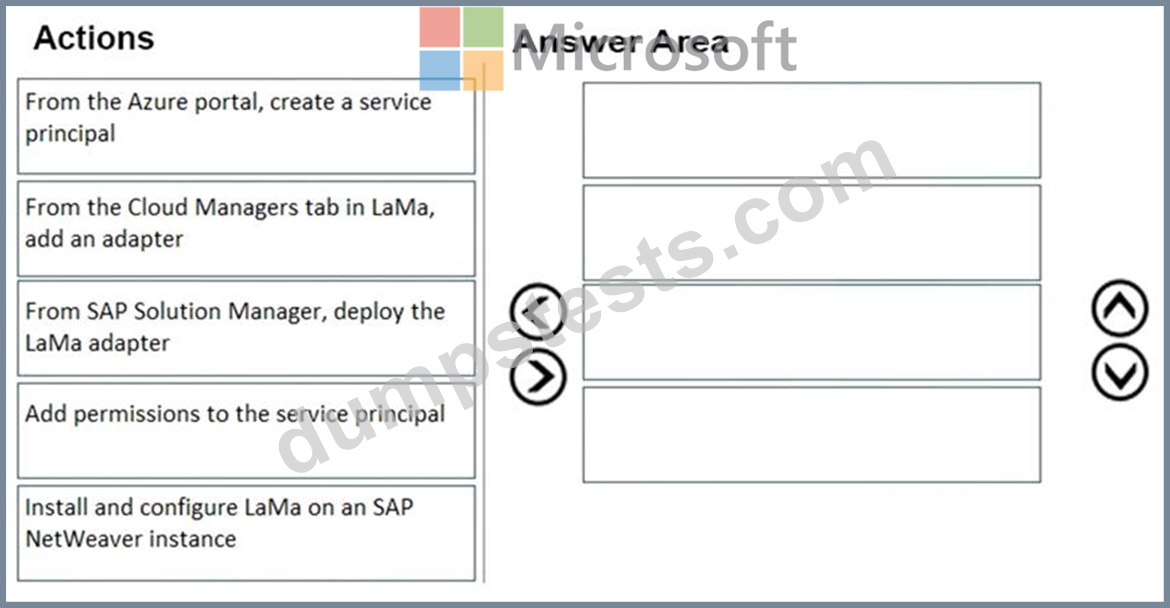
Answer:
Explanation: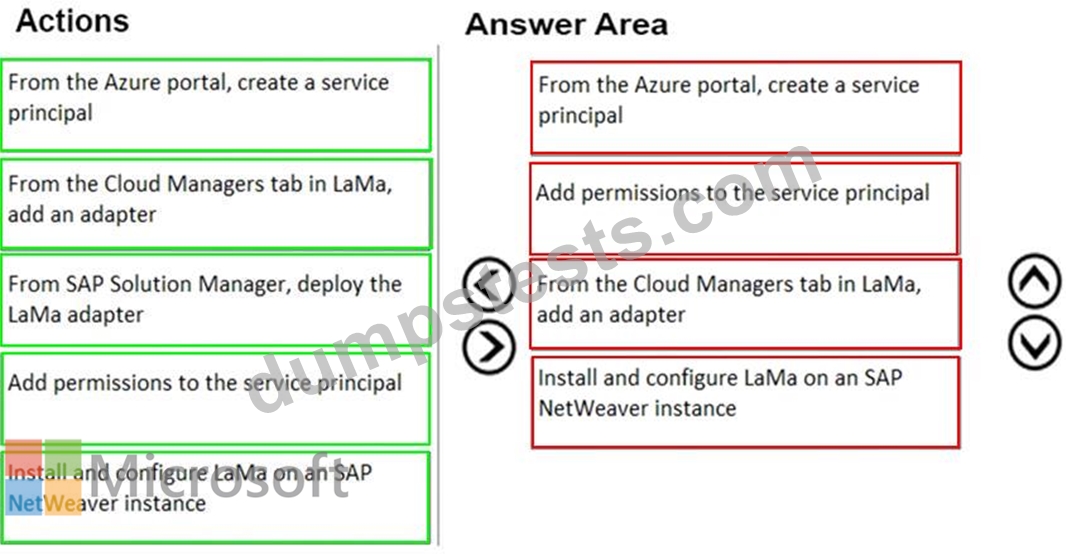
Explanation:
Step 1: From the Azure portal, create a service principal
The Azure connector can use a Service Principal to authorize against Microsoft Azure. Follow these steps to create a Service Principal for SAP Landscape Management (LaMa).
Step 2: Add permissions to the service principal
The Service Principal does not have permissions to access your Azure resources by default. You need to give the Service Principal permissions to access them.
Step 3: From the Cloud Managers tab in LaMa, add an adapter
Create a new connector in SAP LaMa
Open the SAP LaMa website and navigate to Infrastructure. Go to tab Cloud Managers and click on Add. Select the Microsoft Azure Cloud Adapter Step 4: Install and configure LaMA on an SAP NetWeater instance Provision a new adaptive SAP system You can manually deploy a new virtual machine or use one of the Azure templates in the quickstart repository. It contains templates for SAP NetWeaver ASCS, SAP NetWeaver application servers, and the database. You can also use these templates to provision new hosts as part of a system copy/clone etc.
Note: To support customers on their journey into a cloud model (hybrid or entirely public cloud), SAP and Microsoft partnered to create an adapter that integrates the SAP management capabilities of LaMa with the IaaS advantages of Microsoft Azure.
References:
https://docs.microsoft.com/en-us/azure/virtual-machines/workloads/sap/lama-installation
NEW QUESTION 70
Note: This question is part of a series of questions that present the same scenario. Each question in the series contains a unique solution that might meet the stated goals. Some question sets might have more than one correct solution, while others might not have a correct solution.
After you answer a question in this section, you will NOT be able to return to it. As a result, these questions will not appear in the review screen.
You deploy SAP HANA on Azure (Large Instances).
You need to back up the SAP HANA database to Azure.
Solution: Back up directly to disk, copy the backups to an Azure virtual machine, and then copy the backup to an Azure Storage account Does this meet the goal?
- A. Yes
- B. No
Answer: B
Explanation:
Instead you should create a Recovery Services vault and a backup policy.
Reference:
https://docs.microsoft.com/en-us/azure/backup/sap-hana-db-about
https://docs.microsoft.com/en-us/azure/backup/backup-azure-sap-hana-database#configure-backup
NEW QUESTION 71
You have an on-premises SAP environment. Application servers run on SUSE Linux Enterprise Server (SLES) servers. Databases run on SLES servers that have Oracle installed.
You need to recommend a solution to migrate the environment to Azure. The solution must use currently deployed technologies whenever possible and support high availability.
What should you include in the recommendation? To answer, select the appropriate options in the answer area.
NOTE: Each correct selection is worth one point.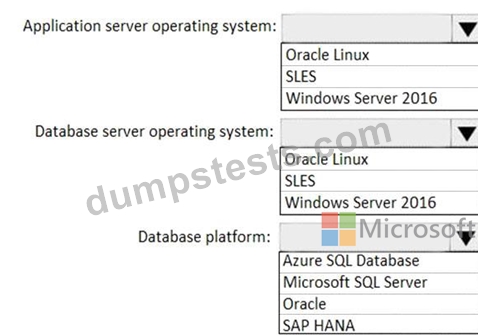
Answer:
Explanation: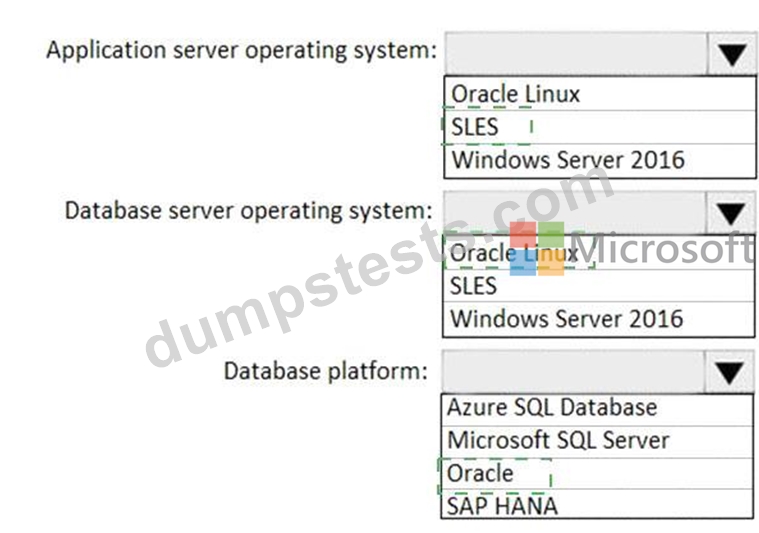
Explanation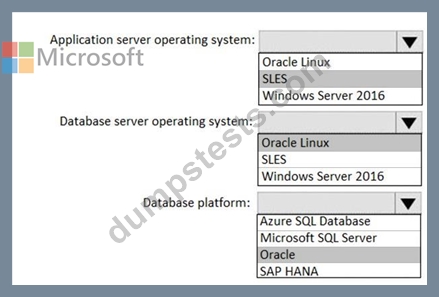
NEW QUESTION 72
For each of the following statements, select Yes if the statement is true. Otherwise, select No.
NOTE: Each correct selection is worth one point.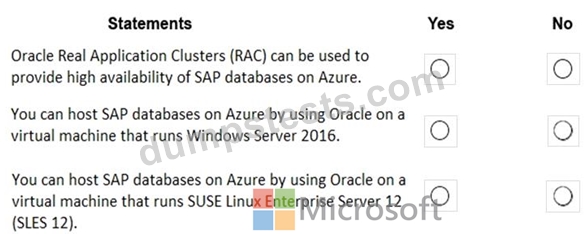
Answer:
Explanation: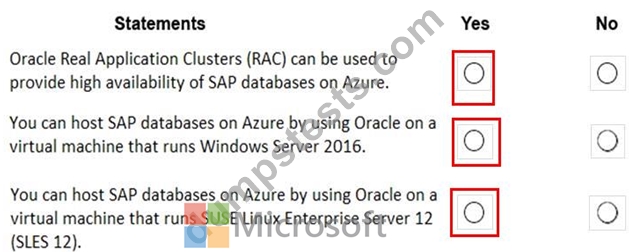
Explanation:
Box 1: Yes
Box 2: Yes
Oracle Database 12c Release 2 (12.2) is certified on Microsoft Windows Server 2016 (Standard, Datacenter, and Essentials Editions), which includes support for the database client, server, and Oracle Real Application Clusters.
Organizations can run SAP applications with Oracle databases on the same code base on Unix, Linux, and Windows operating systems.
Box 3: Yes
References:
https://docs.microsoft.com/en-us/azure/virtual-machines/workloads/oracle/oracle-overview
https://docs.oracle.com/en/database/oracle/oracle-database/12.2/ntdbn/index.html#
NEW QUESTION 73
You have an on-premises SAP environment hosted on VMware VSphere that uses Microsoft SQL Server as the database platform.
You plan to migrate the environment to Azure. The database platform will remain the same.
You need gather information to size the target Azure environment for the migration.
What should you use?
- A. Azure Advisor
- B. Azure Monitor
- C. the SAP HANA sizing report
- D. the SAP EarlyWatch report
Answer: D
Explanation:
Explanation
https://azure.microsoft.com/nl-nl/blog/sap-on-azure-architecture-designing-for-performance-and-scalability/
"For existing on-premises systems, you should reference system configuration and resource utilization data.
The system utilization information is collected by the SAP OS Collecto
NEW QUESTION 74
Note: This question is part of a series of questions that present the same scenario. Each question in the series contains a unique solution that might meet the stated goals. Some question sets might have more than one correct solution, while others might not have a correct solution.
After you answer a question in this section, you will NOT be able to return to it. As a result, these questions will not appear in the review screen.
You have a complex SAP environment that has both ABAP- and Java-based systems. The current on-premises landscapes are based on SAP NetWeaver 7.0 (Unicode and Non-Unicode) running on Windows Server and Microsoft SQL Server.
You need to migrate the SAP environment to a HANA-certified Azure environment.
Solution: You upgrade to SAP NetWeaver 7.4, and then you migrate SAP to Azure by using Azure Site Recovery.
Does this meet the goal?
- A. Yes
- B. No
Answer: A
Explanation:
Explanation
We need upgrade to SAP NetWeaver 7.4 before the migration. Then Azure Site Recovery is used for the migration to Azure.
Reference:
https://docs.microsoft.com/en-us/azure/site-recovery/vmware-azure-architecture
NEW QUESTION 75
A customer has an on-premises SAP environment.
The customer plans to migrate SAP to Azure.
You need to prepare the environment for the planned migration.
Which three actions should you perform in sequence before the migration? To answer, move the appropriate actions from the list of actions to the answer area and arrange them in the correct order.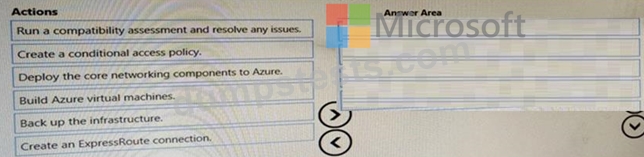
Answer:
Explanation: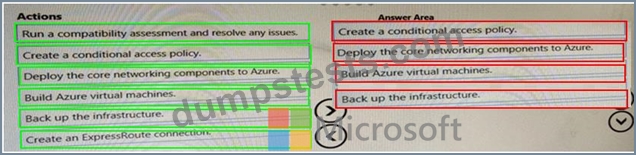
NEW QUESTION 76
For each of the following statements, select Yes if the statement is true. Otherwise, select No.
NOTE: Each correct selection is worth one point.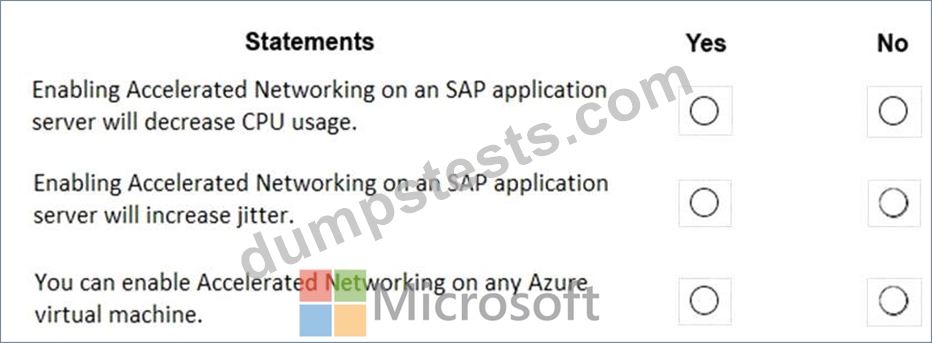
Answer:
Explanation: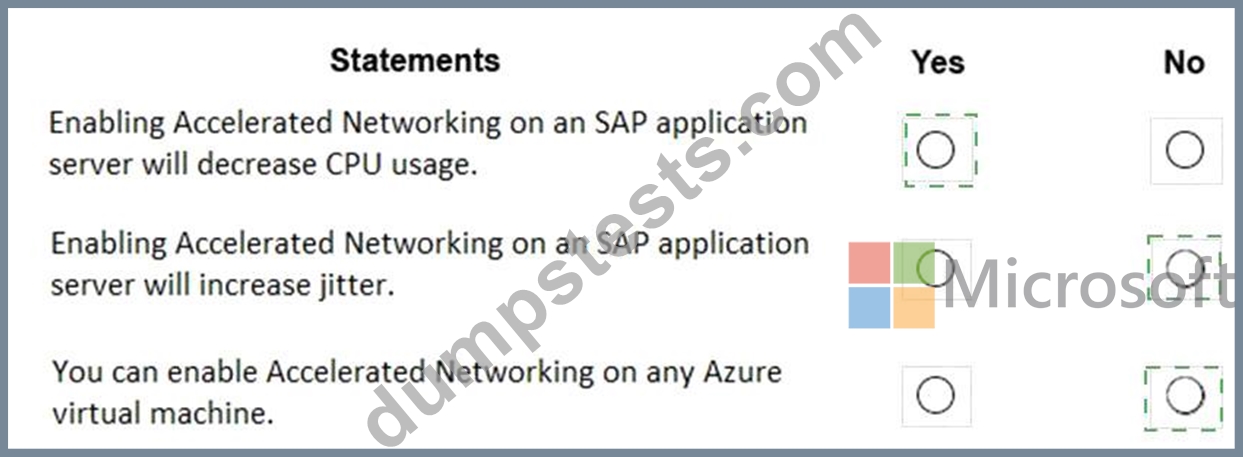
Explanation
Box 1: Yes
By moving much of Azure's software-defined networking stack off the CPUs and into FPGA-based SmartNICs, compute cycles are reclaimed by end user applications, putting less load on the VM, decreasing jitter and inconsistency in latency.
Box 2: NO
Box 3: No
Accelerated Networking (AN) is generally available (GA) and widely available for Windows and the latest distributions of Linux References:
https://azure.microsoft.com/en-us/blog/maximize-your-vm-s-performance-with-accelerated-networking-now-gen
https://azure.microsoft.com/en-gb/blog/maximize-your-vm-s-performance-with-accelerated-networking-now-gen
NEW QUESTION 77
A company named Contoso, Ltd. has users across the globe. Contoso is evaluating whether to migrate SAP to Azure.
The SAP environment runs on SUSE Linux Enterprise Server (SLES) servers and SAP HANA databases. The Suite on HANA database is 4 TB.
You need to recommend a migration solution to migrate SAP application servers and the SAP HANA databases. The solution must minimize downtime.
Which migration solutions should you recommend? To answer, select the appropriate options in the answer area.
NOTE: Each correct selection is worth one point.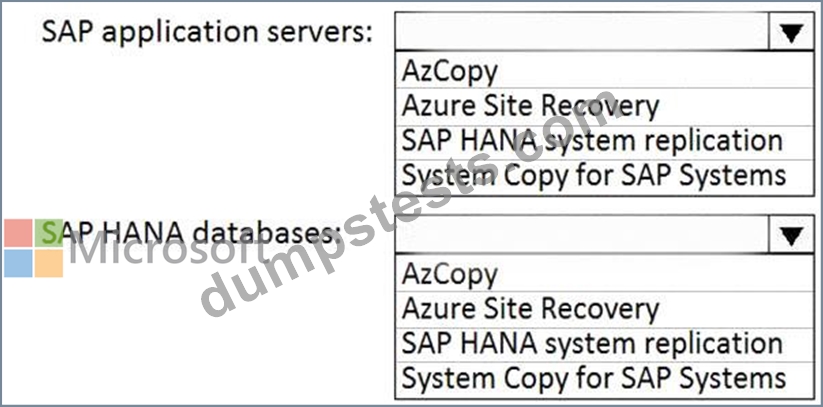
Answer:
Explanation: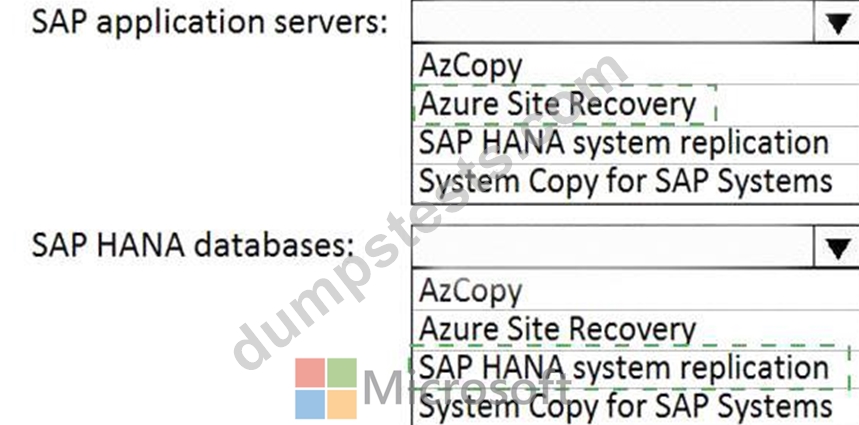
Explanation
Box 1: Azure Site Recovery
Microsoft Azure Site Recovery (ASR) now supports SUSE Linux Enterprise Server 11 SP3/SP4 and SUSE Linux Enterprise Server 12 SP1/SP2/SP3. This is great for customers that are planning to migrate systems to Microsoft Azure or customers who need to have a business continuity strategy for their Azure deployments.
Azure Site Recovery enables SUSE customers to migrate their non-Azure virtual machines or physical servers to Microsoft Azure virtual machines.
Box 2: SAP Hana System replication
Reference:
https://www.suse.com/c/asr_supports_suse/
https://www.netapp.com/us/media/tr-4746.pdf
Topic 2, Contoso Ltd Case Study
Case Study
This is a case study. Case studies are not timed separately. You can use as much exam time as you would like to complete each case. However, there may be additional case studies and sections on this exam. You must manage your time to ensure that you are able to complete all questions included on this exam in the time provided.
To answer the questions included in a case study, you will need to reference information that is provided in the case study. Case studies might contain exhibits and other resources that provide more information about the scenario that is described in the case study. Each question is independent of the other questions in this case study.
At the end of this case study, a review screen will appear. This screen allows you to review your answers and to make changes before you move to the next section of the exam. After you begin a new section, you cannot return to this section.
To start the case study
To display the first question in this case study, click the button. Use the buttons in the left pane to explore the content of the case study before you answer the questions. Clicking these buttons displays information such as business requirements, existing environment, and problem statements. If the case study has an All Information tab, note that the information displayed is identical to the information displayed on the subsequent tabs. When you are ready to answer a question, click the button to return to the question.
Overview
Contoso, Ltd. is a manufacturing company that has 15,000 employees.
The company uses SAP for sales and manufacturing.
Contoso has sales offices in New York and London and manufacturing facilities in Boston and Seattle.
Existing Environment
Active Directory
The network contains an on-premises Active Directory domain named ad.contoso.com. User email addresses use a domain name of contoso.com.
SAP Environment
The current SAP environment contains the following components:
* SAP Solution Manager
* SAP ERP Central Component (SAP ECC)
* SAP Supply Chain Management (SAP SCM)
* SAP application servers that run Windows Server 2008 R2
* SAP HANA database servers that run SUSE Linux Enterprise Server 12 (SLES 12) Problem Statements Contoso identifies the following issues in its current environment:
* The SAP HANA environment lacks adequate resources.
* The Windows servers are nearing the end of support.
* The datacenters are at maximum capacity.
Requirements
Planned Changes
Contoso identifies the following planned changes:
* Deploy Azure Virtual WAN.
* Migrate the application servers to Windows Server 2016.
* Deploy ExpressRoute connections to all of the offices and manufacturing facilities.
* Deploy SAP landscapes to Azure for development, quality assurance, and production.
All resources for the production landscape will be in a resource group named SAPProduction.
Business goals
Contoso identifies the following business goals:
* Minimize costs whenever possible.
* Migrate SAP to Azure without causing downtime.
* Ensure that all SAP deployments to Azure are supported by SAP.
* Ensure that all the production databases can withstand the failure of an Azure region.
* Ensure that all the production application servers can restore daily backups from the last 21 days.
Technical Requirements
Contoso identifies the following technical requirements:
* Inspect all web queries.
* Deploy an SAP HANA cluster to two datacenters.
* Minimize the bandwidth used for database synchronization.
* Use Active Directory accounts to administer Azure resources.
* Ensure that each production application server has four 1-TB data disks.
* Ensure that an application server can be restored from a backup created during the last five days within
15 minutes.
* Implement an approval process to ensure that an SAP administrator is notified before another administrator attempts to make changes to the Azure virtual machines that host SAP.
It is estimated that during the migration, the bandwidth required between Azure and the New York office will be 1 Gbps. After the migration, a traffic burst of up to 3 Gbps will occur.
Proposed Backup Policy
An Azure administrator proposes the backup policy shown in the following exhibit.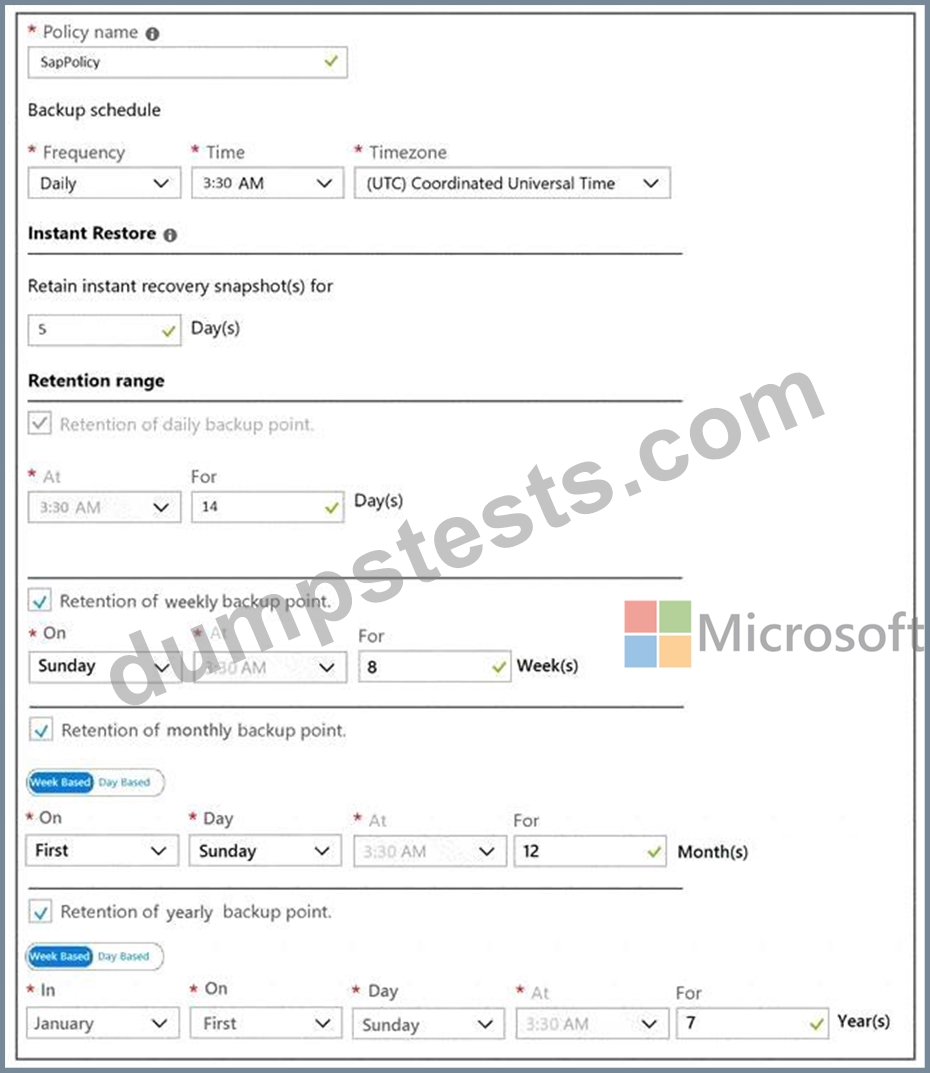
Azure Resource Manager Template
An Azure administrator provides you with the Azure Resource Manager template that will be used to provision the production application servers.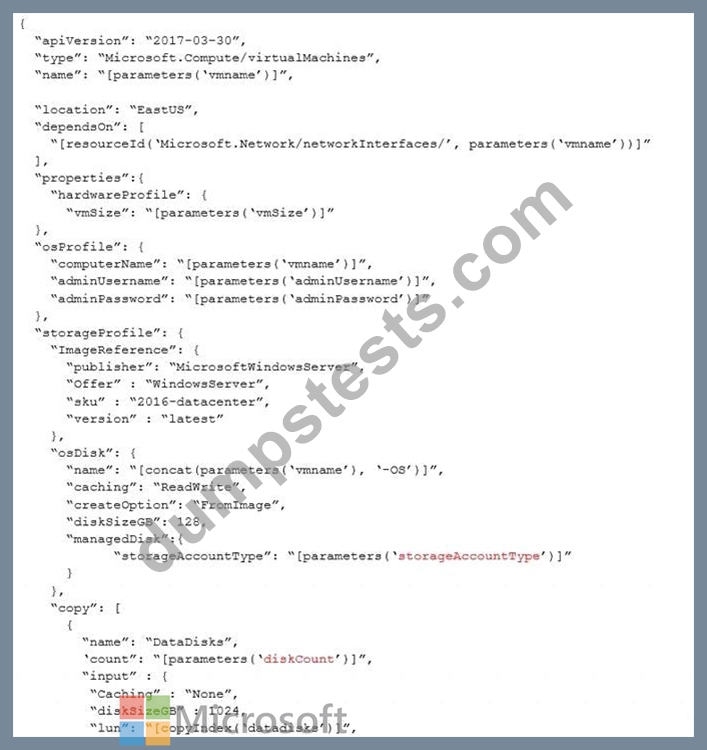

NEW QUESTION 78
You are validating an SAP HANA on Azure (Large Instances) deployment.
You need to ensure that sapconf is installed and the kernel parameters are set appropriately for the active profile.
How should you complete the commands? To answer, drag the appropriate values to the correct targets. Each value may be used once, more than once, or not at all. You may need to drag the split bar between panes or scroll to view content.
NOTE: Each correct selection is worth one point.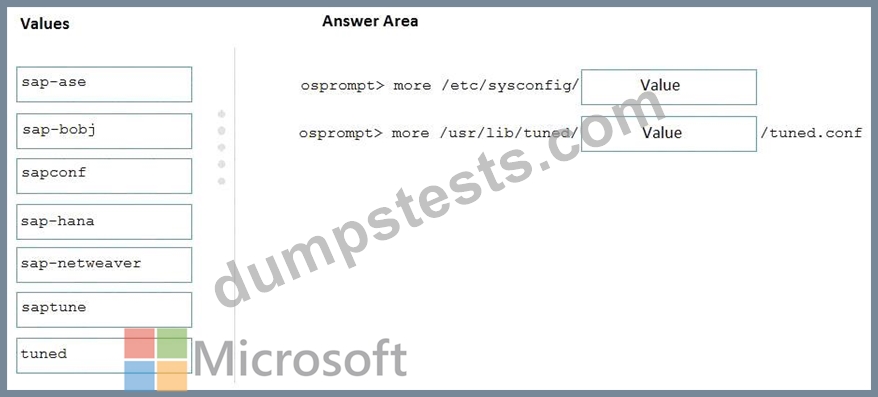
Answer:
Explanation: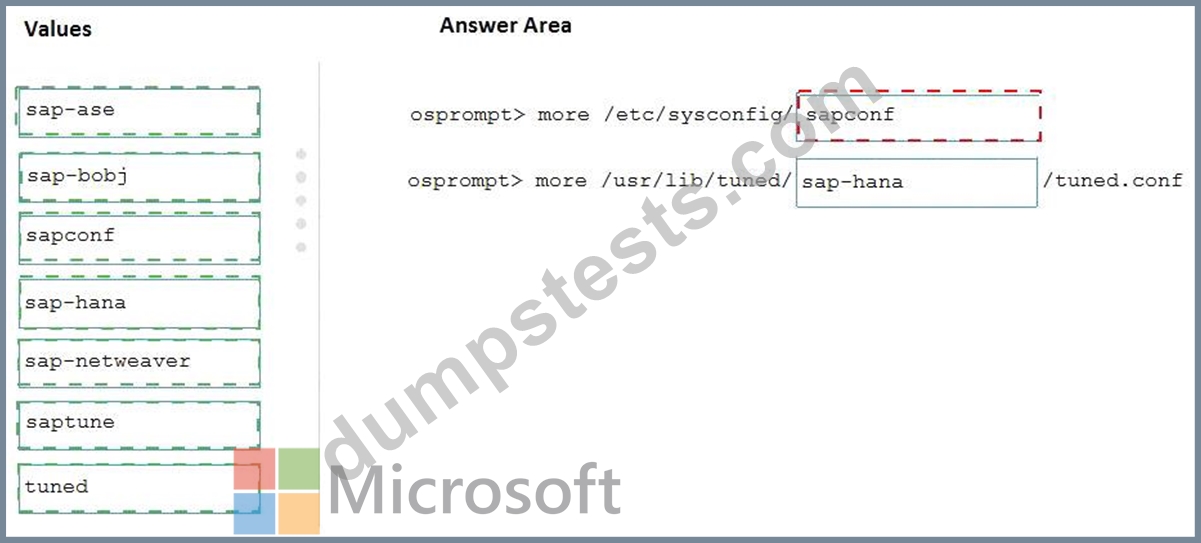
Explanation
Box 1: sapconf
The configuration is split into two parts:
/etc/sysconfig/sapconf
/usr/lib/tuned//tuned.conf
Box 2: sap-hana
References:
https://blogs.sap.com/2017/12/22/prepare-your-linux-for-your-sap-solution-with-saptune/
NEW QUESTION 79
You deploy an SAP environment on Azure by following the SAP workload on Azure planning and deployment checklist.
You need to verify whether Azure Diagnostics is enabled.
Which cmdlet should you run?
- A. Test-VMConfigForSAP
- B. Get-AzureVMAvailableExtension
- C. Test-AzDeployment
- D. Get-AzVmDiagnosticsExtension
Answer: D
Explanation:
Explanation
The Get-AzVMDiagnosticsExtension cmdlet gets the settings of the Azure Diagnostics extension on a virtual machine.
NEW QUESTION 80
Before putting the SAP environment on Azure into production, which command should you run to ensure that the virtual machine disks meet the business requirements? To answer, select the appropriate options in the answer area.
NOTE: Each correct selection is worth one point.
Answer:
Explanation:
Explanation:
Scenario: Ensure that all the production databases can withstand the failure of an Azure region.
References:
https://docs.microsoft.com/en-us/powershell/module/az.compute/get-azvmimage
NEW QUESTION 81
You have a Recovery Services vault backup policy for SAP HANA on an Azure virtual machine as shown in the following exhibit.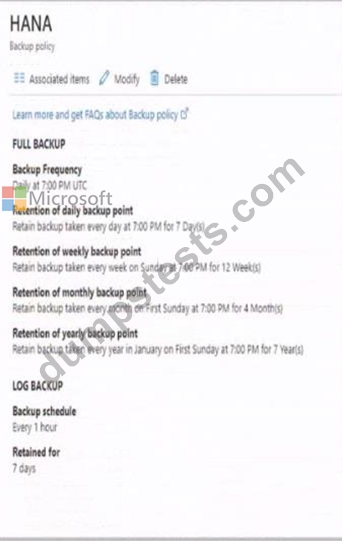
Use the drop-down menus to select the answer choice that completes each statement based on the information presented in the graphic.
NOTE: Each correct selection is worth one point.
Answer:
Explanation:
Answer selected as in image below.
Graphical user interface, text, application, email Description automatically generated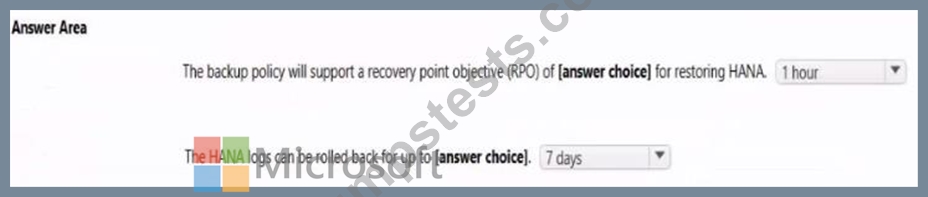
NEW QUESTION 82
You migrate SAP ERP Central Component (SAP ECC) production and non-production landscapes to Azure.
You are licensed for SAP Landscape Management (LaMa).
You need to refresh from the production landscape to the non-production landscape.
Which four actions should you perform in sequence? To answer, move the appropriate actions from the list of actions to the answer area and arrange them in the correct order.
Answer:
Explanation: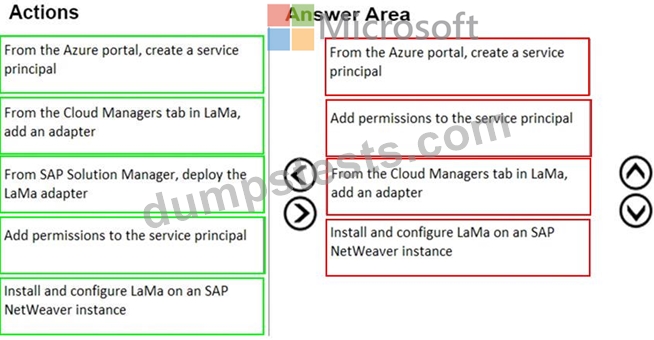
Explanation:
Step 1: From the Azure portal, create a service principal
The Azure connector can use a Service Principal to authorize against Microsoft Azure. Follow these steps to create a Service Principal for SAP Landscape Management (LaMa).
Step 2: Add permissions to the service principal
The Service Principal does not have permissions to access your Azure resources by default. You need to give the Service Principal permissions to access them.
Step 3: From the Cloud Managers tab in LaMa, add an adapter
Create a new connector in SAP LaMa
Open the SAP LaMa website and navigate to Infrastructure. Go to tab Cloud Managers and click on Add. Select the Microsoft Azure Cloud Adapter Step 4: Install and configure LaMA on an SAP NetWeater instance Provision a new adaptive SAP system You can manually deploy a new virtual machine or use one of the Azure templates in the quickstart repository. It contains templates for SAP NetWeaver ASCS, SAP NetWeaver application servers, and the database. You can also use these templates to provision new hosts as part of a system copy/clone etc.
Note: To support customers on their journey into a cloud model (hybrid or entirely public cloud), SAP and Microsoft partnered to create an adapter that integrates the SAP management capabilities of LaMa with the IaaS advantages of Microsoft Azure.
References:
https://docs.microsoft.com/en-us/azure/virtual-machines/workloads/sap/lama-installation
NEW QUESTION 83
You are deploying an SAP environment on Azure that will use an SAP HANA database server.
You provision an Azure virtual machine for SAP HANA by using the M64s virtual machine SKU.
You need to set the swap space by using the Microsoft Azure Linux Agent (waagent) configuration file.
Which two settings should you configure? Each correct answer presents part of the solution.
NOTE: Each correct selection is worth one point.
- A. ResourceDisk.EnableSwapEncryption=n
- B. ResourceDisk.EnableSwap=y
- C. AutoUpdate.Enabled=n
- D. ResourceDisk.SwapSizeMB=229376
Answer: B,D
Explanation:
Explanation
To create a swap file in the directory that's defined by the ResourceDisk.MountPoint parameter, you can update the /etc/waagent.conf file by setting the following three parameters:
ResourceDisk.Format=y
ResourceDisk.EnableSwap=y
ResourceDisk.SwapSizeMB=xx
References:
https://support.microsoft.com/en-us/help/4010058/how-to-add-a-swap-file-in-linux-azure-virtual-machines
NEW QUESTION 84
......
How to Prepare For AZ-120:Planning and Administering Microsoft Azure for SAP Workloads Exam
Preparation Guide for AZ-120:Planning and Administering Microsoft Azure for SAP Workloads Exam
Introduction
Microsoft has created a track for Azure professionals who are knowledgeable in SAP landscape to get certified this platform. This certification program provides Microsoft Azure for SAP Workloads professionals a way to demonstrate their skills. The assessment is based on a rigorous exam using industry standard methodology to determine whether a candidate meets Microsoft's proficiency standards.
According to Microsoft, a Microsoft Certified Professional enables organizations to leverage Microsoft Azure for SAP Workloads technologies with a thorough understanding of generating existing SAP inventories, designing migration strategies, designing Azure infrastructure services, HA models supported in HANA .
Certification is evidence of your skills, expertise in those areas in which you like to work. If candidate wants to work on Microsoft Azure for SAP Workloads and prove his knowledge, certification offered by Microsoft. This AZ-120 Exam Certification helps a candidate to validates his skills in Microsoft Azure for SAP Workloads Technology.
In this guide, we will cover the AZ-120:Planning and Administering Microsoft Azure for SAP Workloads Certification exam, AZ-120:Planning and Administering Microsoft Azure for SAP Workloads Certified professional salary and all aspects of the AZ-120:Planning and Administering Microsoft Azure for SAP Workloads Certification.
Microsoft AZ-120 Official Cert Guide PDF: https://www.dumpstests.com/AZ-120-latest-test-dumps.html
Free Microsoft Azure AZ-120 Official Cert Guide PDF Download: https://drive.google.com/open?id=1FRDSY_0QS18s62QOswORdCNuO9_EYTqp